111 Years: How the World Remembers the Armenian genocide
Twelve countries recognized the Armenian Genocide in 2015. It was the 100th anniversary, and the diplomatic momentum looked like it might be permanent. In 2025, the 110th anniversary, one country recognized it. The data since has kept declining: fewer state visits to the Yerevan memorial, flatter recognition politics, a shrinking window each April when the world briefly pays attention. This piece is not about whether the genocide happened. It is about what the numbers tell us about how long collective memory holds.
The recognition map
Formal recognition of the Armenian Genocide began with Uruguay in 1965, fifty years after the events. For the next three decades, the list grew slowly: Cyprus, Russia, Greece, France. Recognition was almost always a parliamentary act taken over executive objection, because the executive branch had strategic reasons to keep Ankara content. The United States is the clearest example: all 50 state legislatures had recognized the genocide before the federal government did, and Congress passed resolutions in both chambers in 2019 before President Biden finally issued a formal presidential statement in 2021.[1]
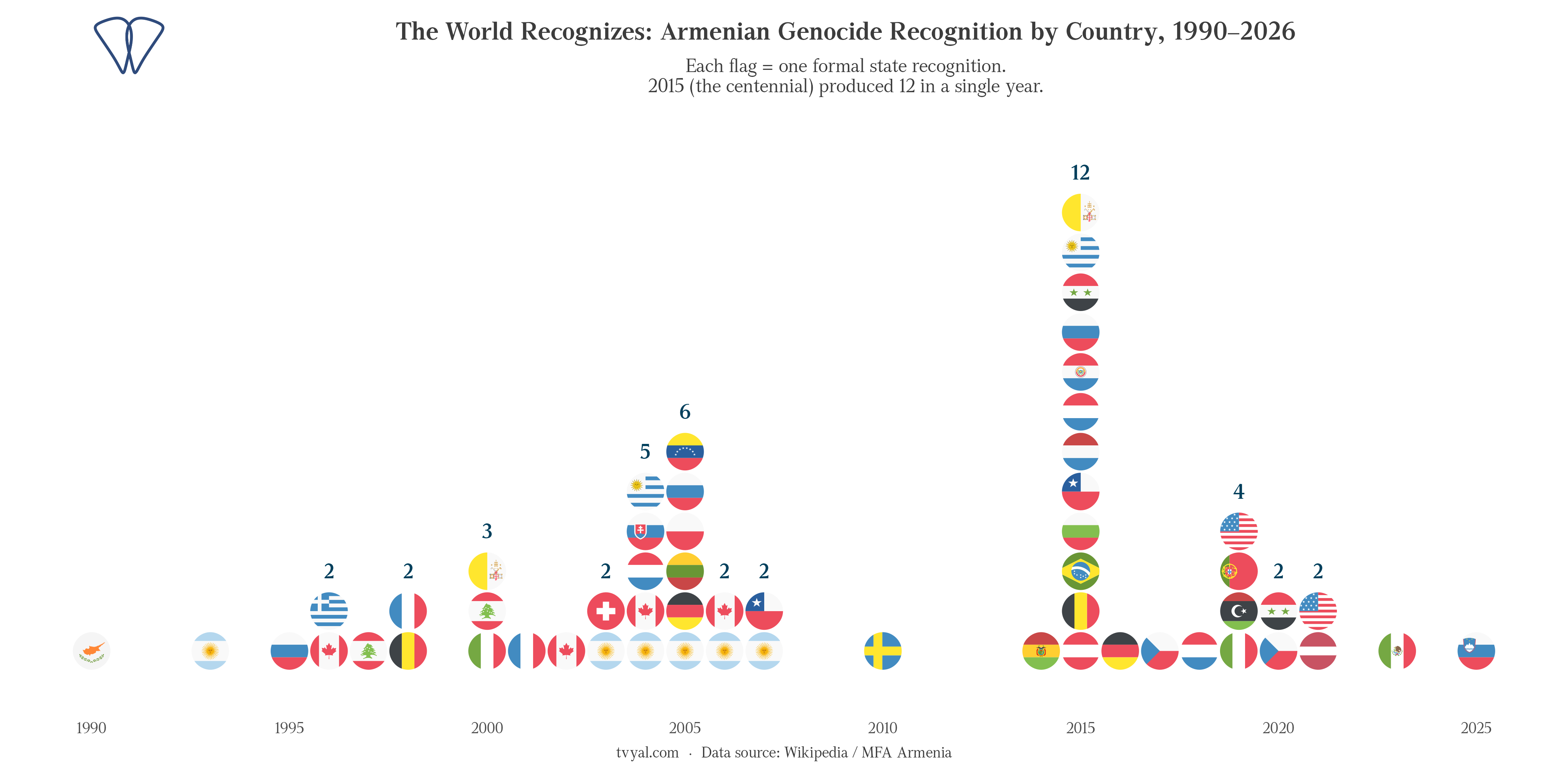
As of April 2026, 35 sovereign states have recognized the genocide. The chart above plots every recognition since 1990, stacked by year. Three things are visible. The 1990s flags are sparse. The 2015 column is dense: Austria, Belgium, Brazil, Bulgaria, Chile, Luxembourg, and six others all moved within a single calendar year, pulled by the weight of the centennial. After 2021, the chart empties.
The states still outside the list are not random omissions. The UK has strong economic and security ties with Turkey. Israel has a strategic partnership with both Turkey and Azerbaijan. Most of the Muslim world has not moved. These are political positions, not historical ones, and they are not changing quickly.
The annual search spike
Every April, global search interest in the Armenian Genocide spikes, holds for a few weeks, and returns to baseline. This has happened every year since Google Trends data begins in 2004, and the chart below shows the pattern clearly.
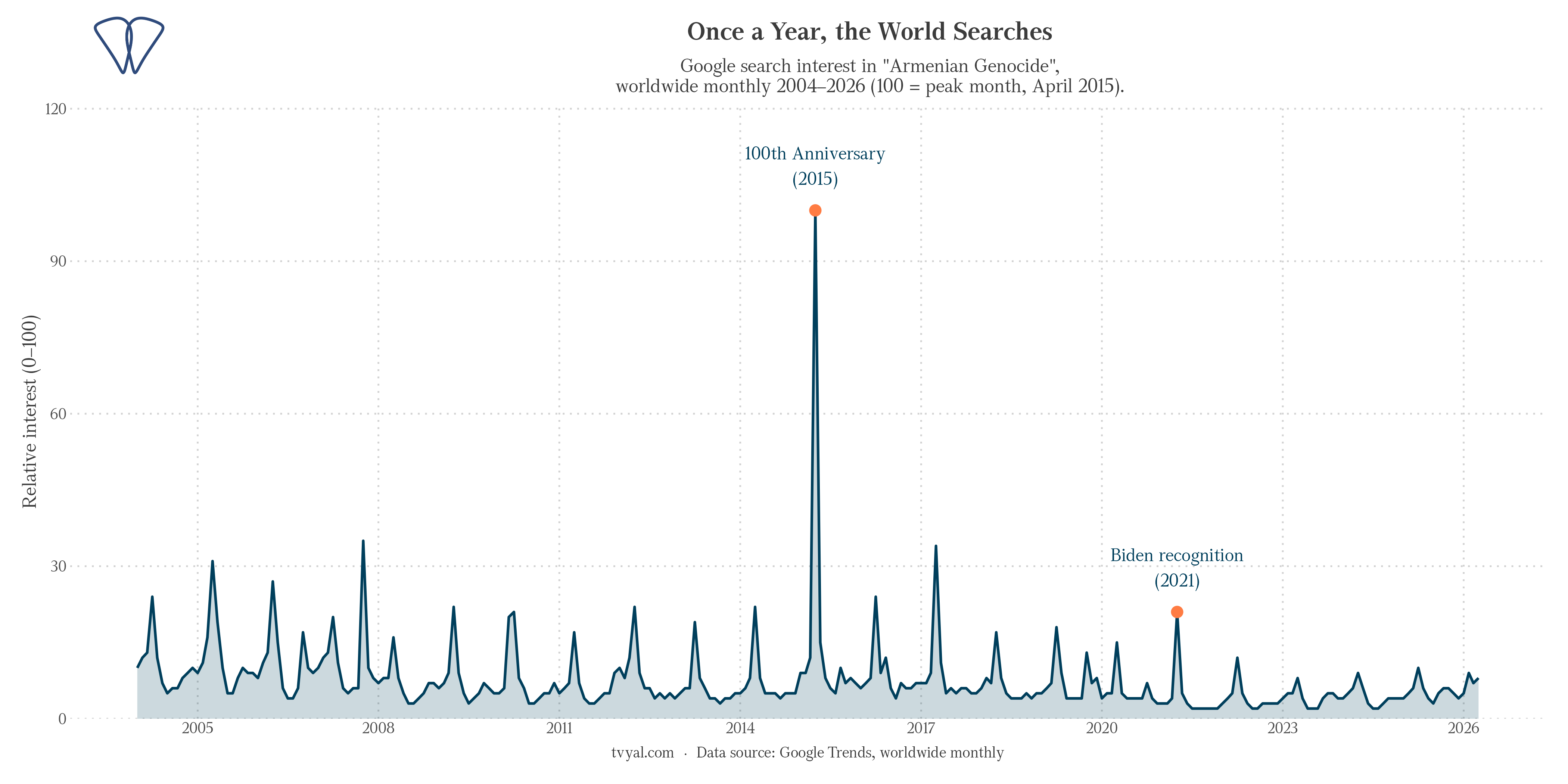
The 2015 centennial spike is roughly five times larger than a typical April. The 2021 Biden statement produced a smaller but visible bump. The smaller peaks in 2019 correspond to the Congressional resolutions.
The baseline after 2015 is higher than before it. Something from the centennial stuck. Whether that level holds or slowly erodes is the open question.
The pilgrimage to Tsitsernakaberd
Visiting Tsitsernakaberd, the Armenian Genocide Memorial in Yerevan, has long been part of state protocol for foreign delegations to Armenia. The count of official visits by year follows the same bell-shaped arc as the recognition chart.[2]
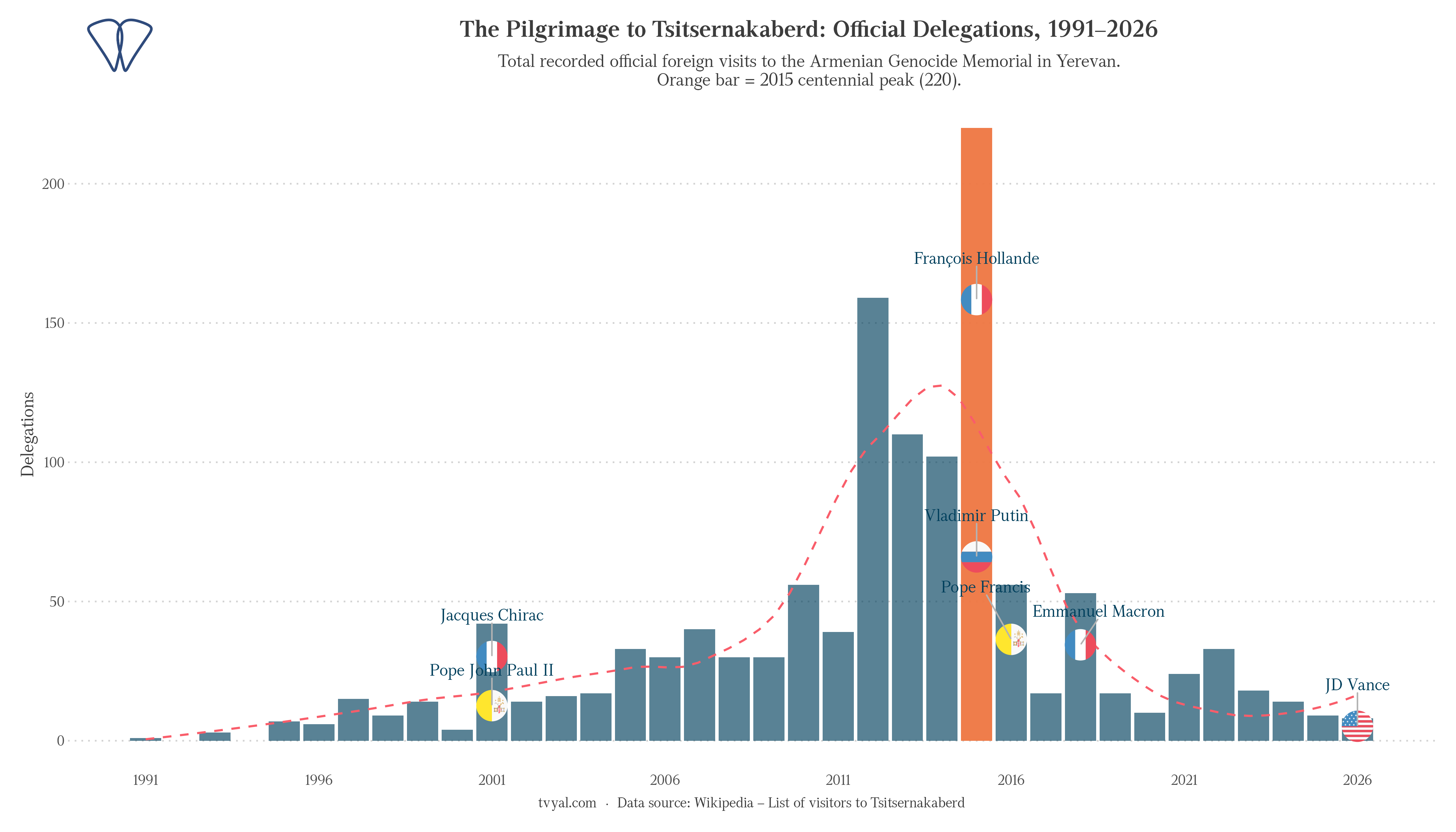
The memorial received 102 official delegations in 2014, 220 in 2015, 56 in 2016. By 2023 the count had fallen to 18, by 2025 to 9. In 2026, eight delegations have been recorded through April, including US Vice President JD Vance. A memorial visit is not the same as formal recognition, but in diplomatic signaling it carries weight: it is a physical act that a government has to choose to make.
The 2015 peak was not just more delegations visiting Armenia. It was the moment when visiting Tsitsernakaberd became politically expected for governments that had previously avoided it. The decline since then suggests the reverse: the memorial has reverted from required to optional. A delegation can visit Yerevan, hold bilateral meetings, and leave without walking through Tsitsernakaberd, and few will notice.
The academic record
Formal recognition and diplomatic protocol measure institutional memory. Search trends measure popular attention. Scholarly output measures something different: whether the genocide remains a live research subject, not just a historical reference point.
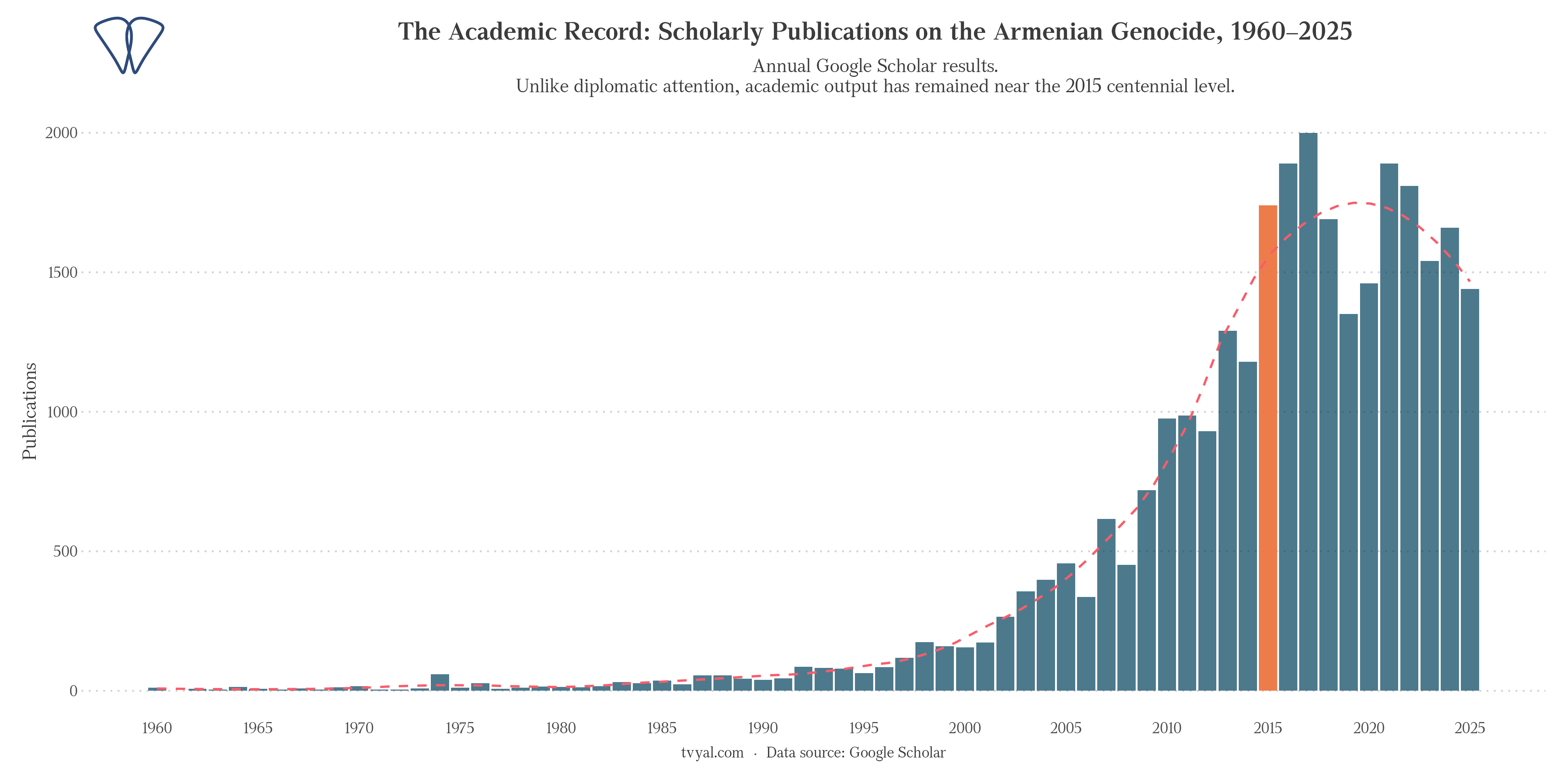
The chart above plots annual Google Scholar results for “Armenian Genocide” from 1960 to 2025. Before 1990 the numbers were small: dozens in the 1970s, under a hundred through the 1980s. Growth accelerated sharply after 2000, reaching 976 publications annually by 2010. The centennial year pushed that to 1,740; the peak came in 2017 at 2,000.
The academic curve does not collapse after 2015. Memorial visits fell from 220 in 2015 to 9 a decade later. Scholarly output in 2025 stands at 1,440, close to the centennial level and not a return to the pre-2010 baseline. The centennial appears to have brought a cohort of researchers into the field rather than generating a single publication surge that then reversed.
What the pattern shows
The four datasets measure the same underlying dynamic from different angles, with one exception. Recognition, search interest, and memorial visits all peaked around 2015 and have been declining since, at different rates. Scholarly output has not: it remains close to the centennial level a decade later.
Recognition is the most durable: 35 countries that have recognized will not un-recognize. But the frontier of new recognitions has effectively frozen. Search interest is volatile but tracks April reliably; the elevated baseline may hold for years. Memorial visits are the most sensitive measure and the most striking: down from 220 to 9 in a decade. Academic publications are the quiet exception, suggesting that whatever diplomatic attention faded, the research infrastructure built around 2015 has proved stickier.
The straightforward reading: the centennial created a surge in global attention that has since reverted toward a lower equilibrium in most channels. The genocide remains recognized and commemorated. It is not forgotten. But outside the academy, it is no longer commanding the weight it did in 2015.
The single indicator to watch: the recognition count in 2030, the 115th anniversary. Anniversary years are when recognition politics move. The question is whether 2025’s one-country result was a floor or a new normal.
* Recognition data scraped from Wikipedia “Armenian genocide recognition” (rvest), cross-referenced with mfa.am. Google Trends data exported manually from trends.google.com, worldwide monthly, 2004–2026. Tsitsernakaberd visit counts parsed from Wikipedia “List of visitors to Tsitsernakaberd.” Google Scholar publication counts for “Armenian Genocide” queried annually, 1950–2025. Calculations and chart code available on GitHub.
References
[1] Armenian genocide recognition // Wikipedia — https://en.wikipedia.org/wiki/Armenian_genocide_recognition
[2] List of visitors to Tsitsernakaberd // Wikipedia — https://en.wikipedia.org/wiki/List_of_visitors_to_Tsitsernakaberd
[3] Recognition // Ministry of Foreign Affairs of Armenia — https://www.mfa.am/en/recognition/