Armenia’s Exports Quadrupled—Until Russia Closed a Sanctions Loophole
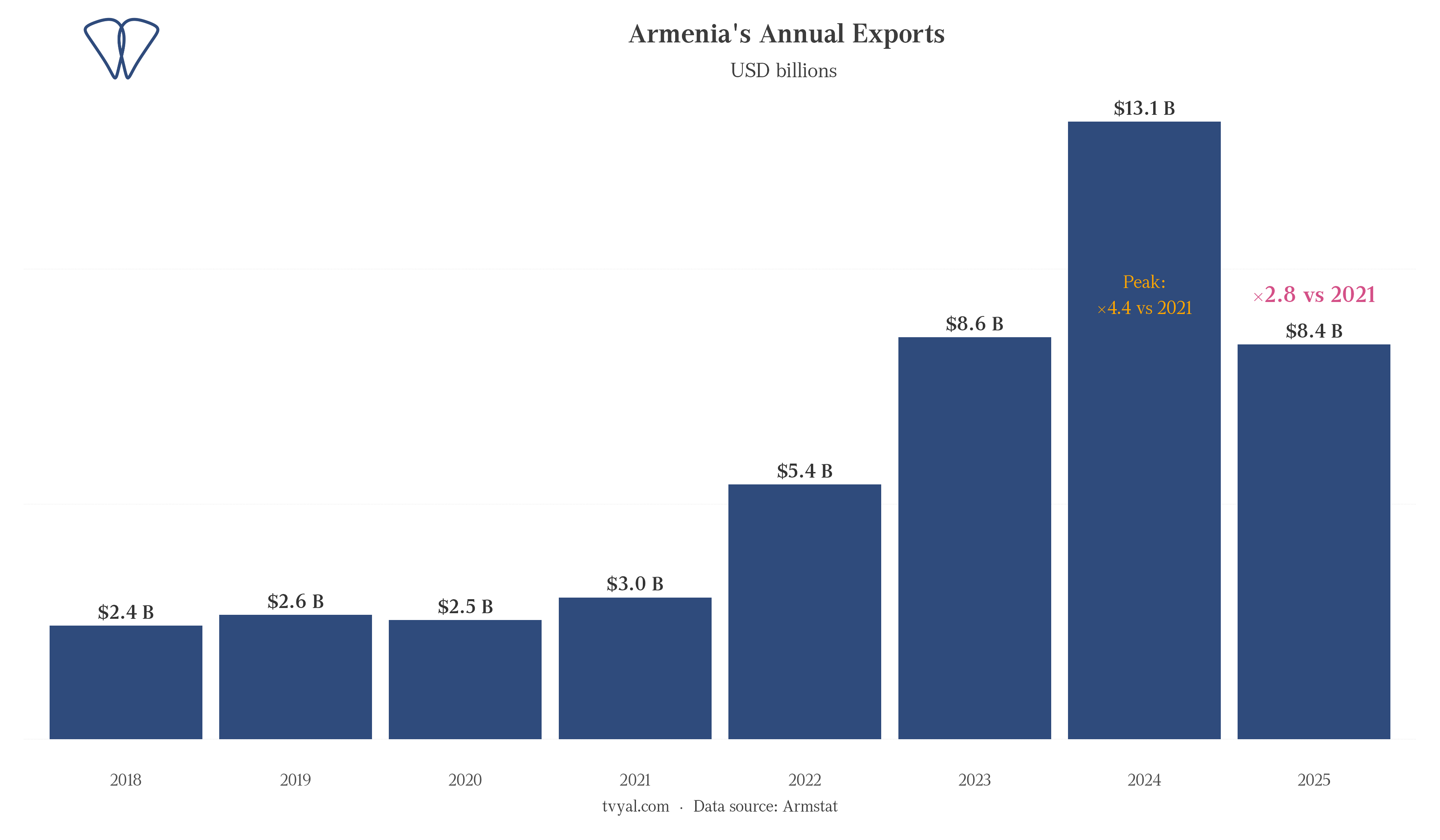
Armenia’s official exports hit $13.1 billion in 2024, up from $3.0 billion in 2021. A 4.4× increase in three years. By 2025, the number had fallen to $8.4 billion. The spike was almost entirely Russian gold re-export flowing through Armenian banks and refiners to the UAE and Hong Kong. When Russia changed its domestic rules in April 2024, the corridor closed.
How the gold and auto corridor worked
The 2022 sanctions created a price gap. With London and Swiss refining markets cut off, Russian gold traded at a significant discount to world spot prices. Armenian intermediaries bought it, processed it locally, and sold it to UAE and Hong Kong buyers at market rates. A second channel ran alongside: Western cars and electronics moved through Armenia into Russia under EAEU free trade rules, bypassing Russia’s external tariff.
Gold dominated. At the peak in early 2024, Armenia was importing over $1.3 billion and exporting $1.5 billion in precious metals (HS 71) every month. Roughly 10–15% of that value stayed in Armenia as intermediary fees covering storage, refining, financial services, and logistics.
What real exports look like
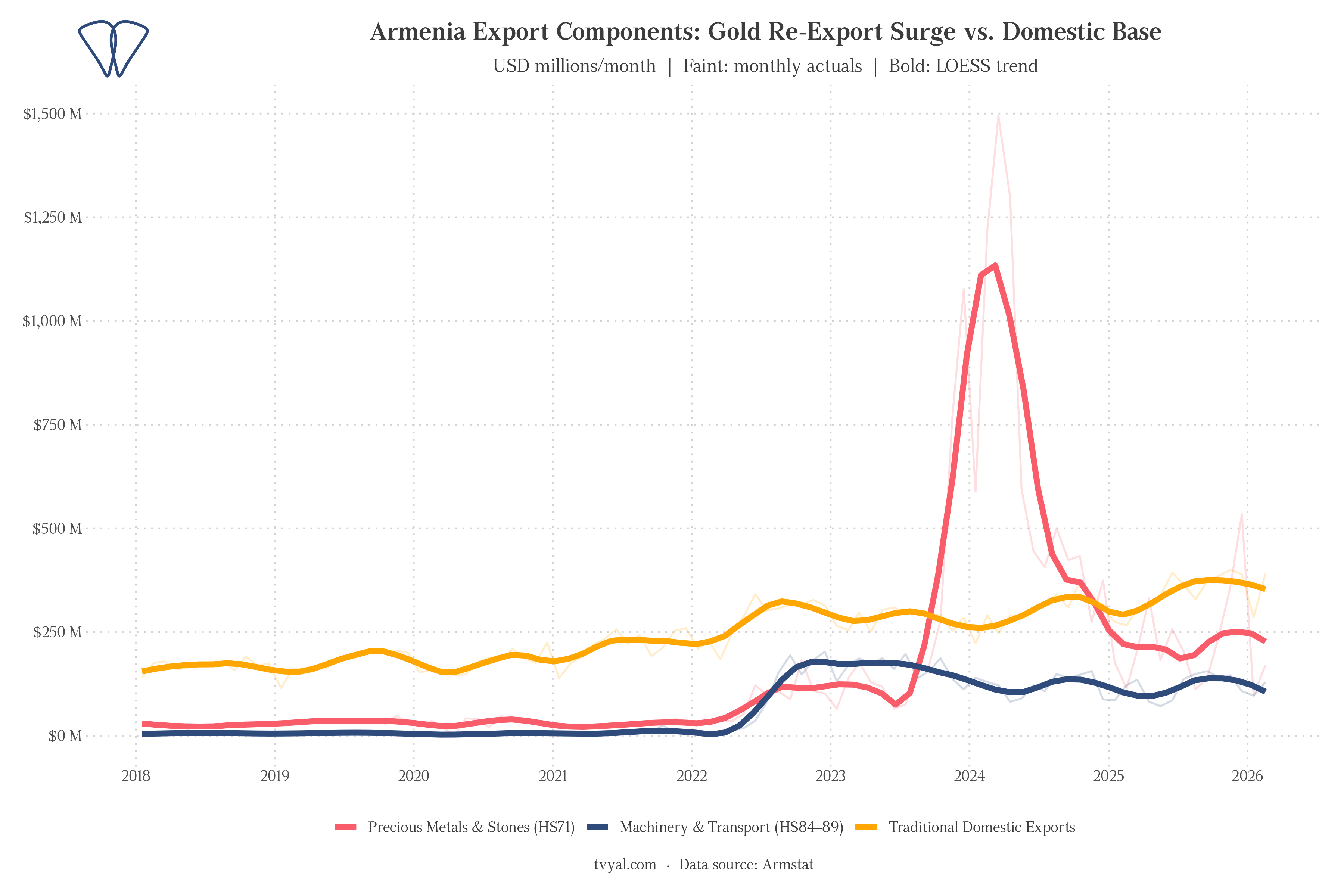
The chart makes the structure plain. Precious metals exports were near zero before 2022, then shot up from mid-2022, peaked above $1.1 billion per month in early 2024, and have been contracting since. Vehicles showed the same artificial cycle.
Traditional domestic exports, by contrast, kept a slow steady climb throughout. No break in 2022, no collapse in 2025. The re-export income sat on top of the existing economy without feeding back into it.
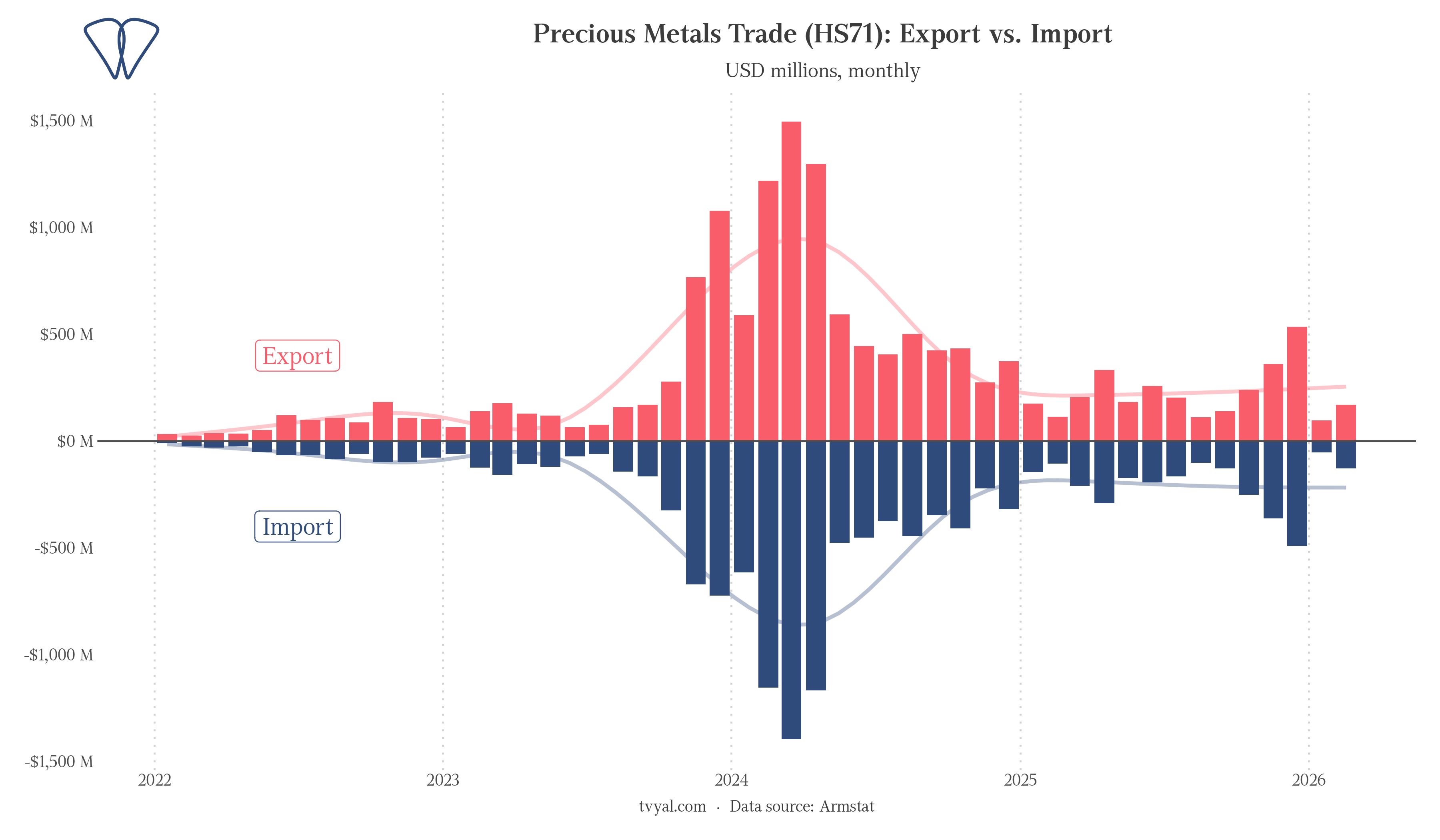
The gold chart shows why it ended. Import and export volumes tracked closely, the gap representing the captured margin. In April 2024, Russia abolished its gold export duty, which erased the commercial logic of the Armenian route. Volumes fell within months.
The logistics: two corridors, two closed borders
All of this moved through just two land crossings. Armenia borders Georgia to the north and Iran to the south. The western and eastern borders (Turkey, Azerbaijan) have been closed since the early 1990s. Every truck going between Armenia and Russia or European markets passes through Georgia.
When Georgia restricted transit of sanctioned vehicles in August 2023, Armenian vehicle exports (HS 84–89) dropped immediately. No rerouting was possible. The policy change appeared in Armenia’s trade statistics within two months.
The Iranian corridor does different work. It moves energy from south to north. In 2025, Armenia imported roughly $680 million in Iranian natural gas, 55% above the 2021 figure. The two routes are not substitutes: Georgia handles manufactured goods heading north; Iran supplies energy coming in from the south.
Real sector and what to watch
At $8.4 billion, 2025 exports are 36% below the 2024 peak but still 2.8 times the 2021 baseline. The underlying domestic export base held its pre-2022 trajectory through both the boom and the correction. That stability is what actually matters.
Armenia’s post-2022 GDP growth rate exceeded its pre-2022 average by 4.3 percentage points. Only Kyrgyzstan posted a larger differential among EAEU members. But that premium was built substantially on the re-export boom. With Russia’s export duty gone and the arbitrage margin zeroed out, the channel is closed.
The indicator to watch: monthly HS 71 (precious metals) data from Armstat. If it stabilizes above pre-2022 levels, some of the processing and financial infrastructure built during the shock has found permanent use. If it continues toward zero, the $13 billion peak was simply transit income, now gone.
Details of the 2022 appreciation process are in “Dollar Near a 22-Year Low: Armenia’s Hidden Currency Risk”. GDP growth context is in “The Iranian Wave: The Hidden Capital Behind Armenia’s 7.2% GDP”.
* Statistics are from Armstat monthly trade data (two-digit HS classification, by partner country) through February 2026, cross-verified against UN Comtrade through November 2025. Calculations and chart code available on GitHub.
References
[1] Gold Trade and Finance: Global Gold Trade Report 2024 // World Gold Council, 2024 — https://www.gold.org/goldhub/research/gold-trade-and-finance
[2] Partsvaniya, L. et al. Western Goods via Eastern Routes: Sanctions Circumvention Through Post-Soviet States // PONARS Eurasia, 2024 — https://www.ponarseurasia.org