The European Vector and the EAEU Reality: Armenia's Exports Under the Current Government
On May 4th and 5th, Yerevan hosted the eighth summit of the European Political Community. Forty-eight heads of state flew in. France’s President Macron came. So did the NATO secretary-general, the European Council president, and Ukraine’s Zelensky, who quipped that Ukrainian drones could “fly in this parade” (a nod to Russia’s Victory Day on May 9th). It was June 7th parliamentary elections minus one month, and Prime Minister Nikol Pashinyan was at the center of the most visible pro-European spectacle Armenia had ever staged.
Then look at the trade data.
The picture
Since Mr Pashinyan took office after the 2018 Velvet Revolution, Armenia’s exports to EAEU countries (the Russian-led customs union Armenia belongs to) have grown 4.7 times. Exports to the EU have gone nowhere.
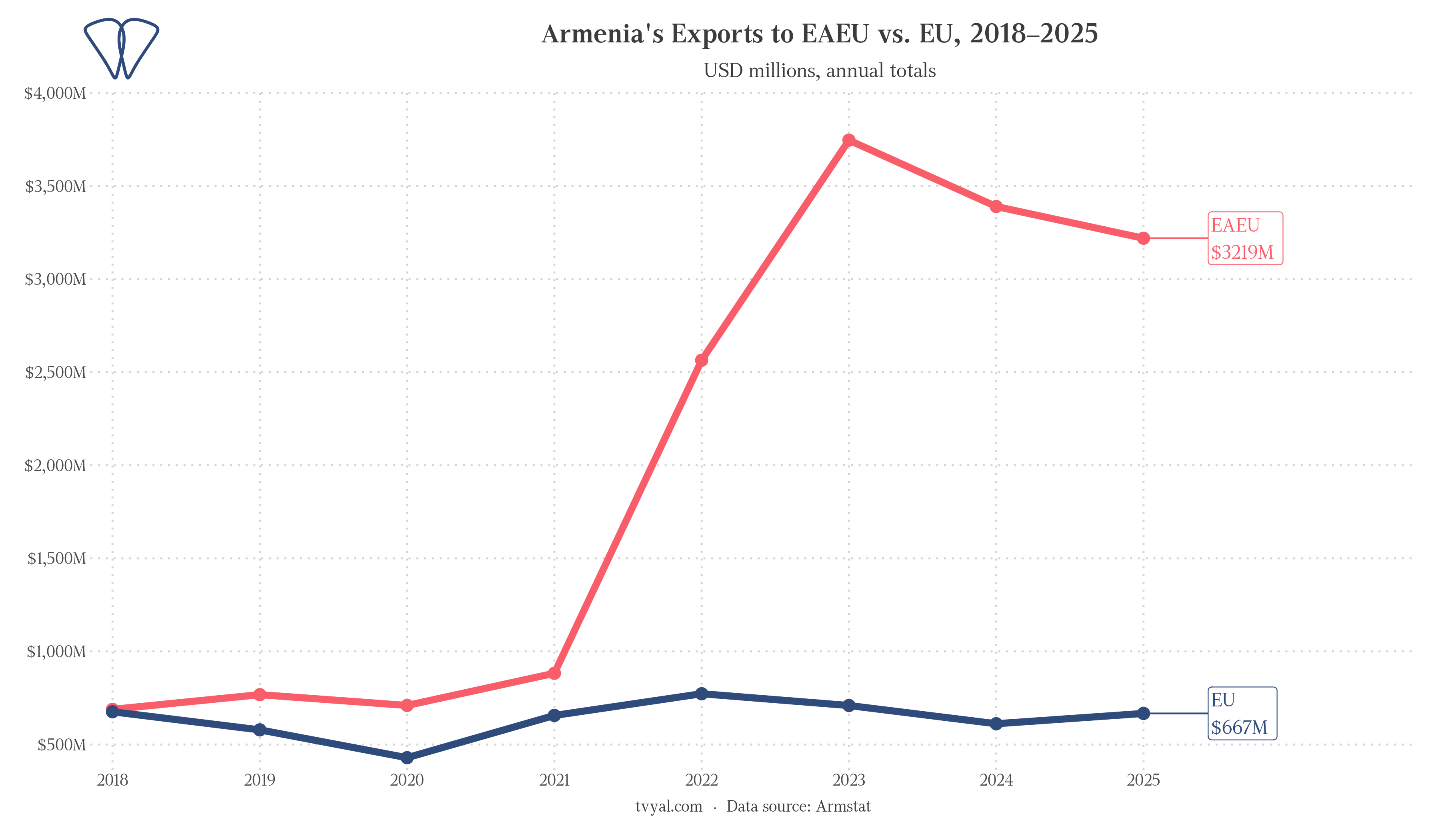
In 2018, the two blocs were neck and neck: around $680 million each. By 2025, EAEU exports stood at $3.2 billion. EU exports: $667 million, barely changed. Russia alone accounts for 92% of Armenia’s EAEU trade. When officials speak of Eurasian integration, they are describing one relationship.
The longer story
This is not a trend the current government inherited and reversed. Go back to 2012 and the picture was the opposite: the EU took 37% of Armenia’s exports, the EAEU took 21%. By 2018, when Mr Pashinyan came to power, the two had converged to near parity. Since then, one has surged and one has flatlined.
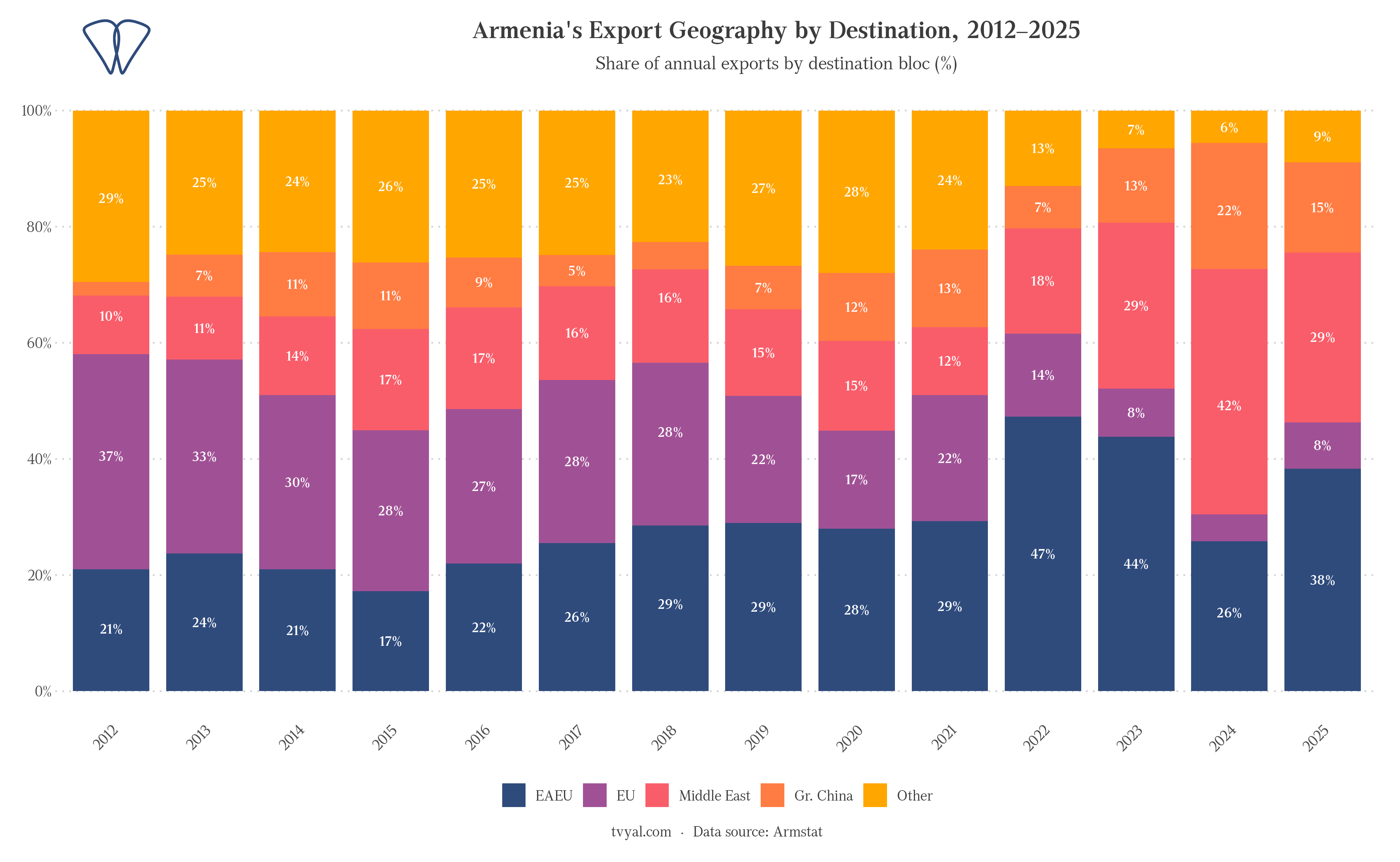
Between 2022 and 2024, the chart briefly looked more complicated. A gold re-export boom inflated the Middle East and Greater China columns. But this was not diversification. Russia, cut off from Western financial markets by sanctions, was moving its gold through Armenian banks and refiners to buyers in Dubai and Hong Kong. Western cars and electronics went the other way, into Russia, under EAEU free-movement rules. Armenia was being paid to run both channels of Russia’s sanctions workaround.
When Russia changed its gold export rules in April 2024, the corridor collapsed. Middle East exports fell by half. Greater China fell by half. Once the windfall cleared, the underlying picture reappeared: EAEU at 38%, EU at 8%.
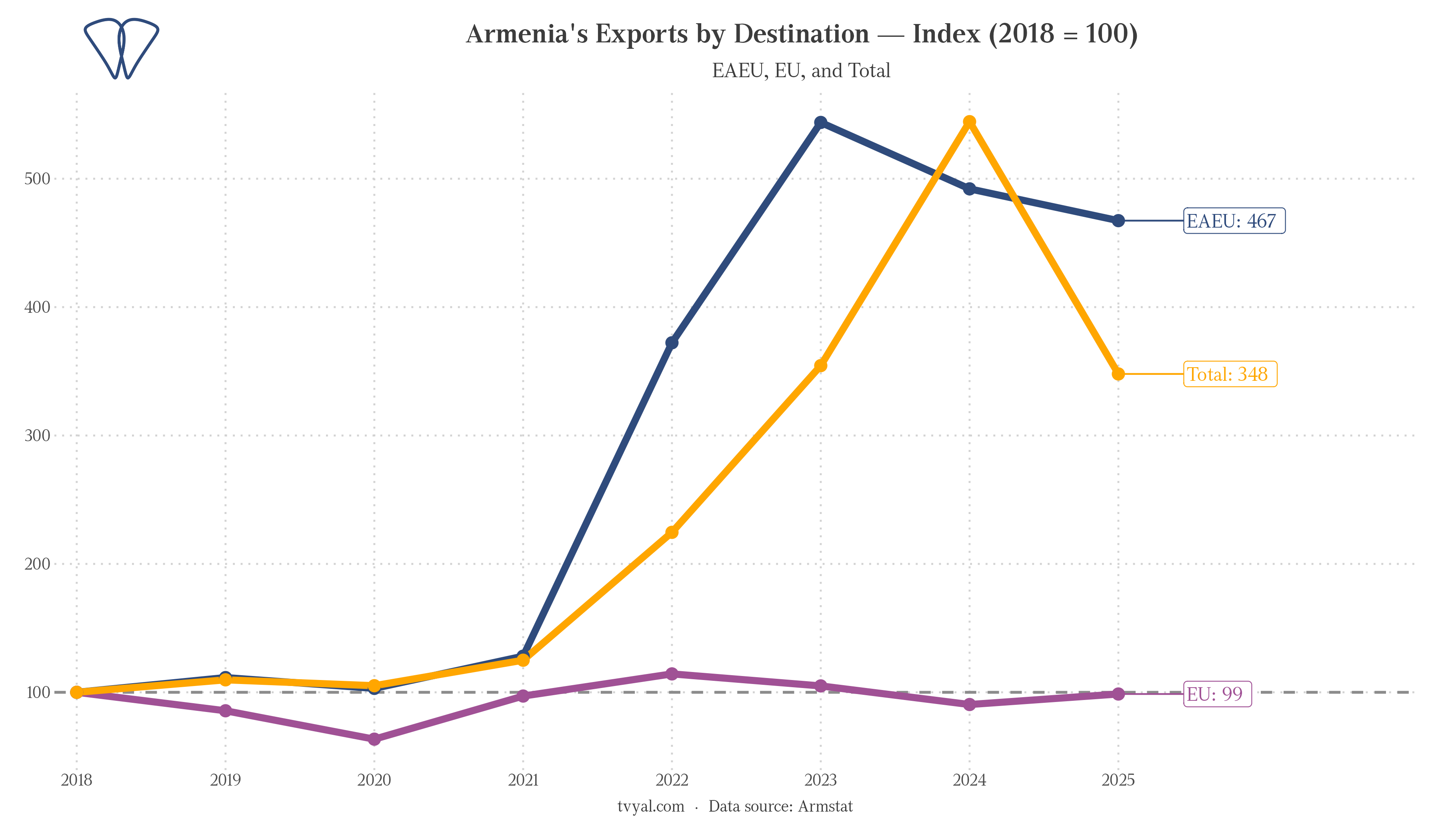
Seven years, one column
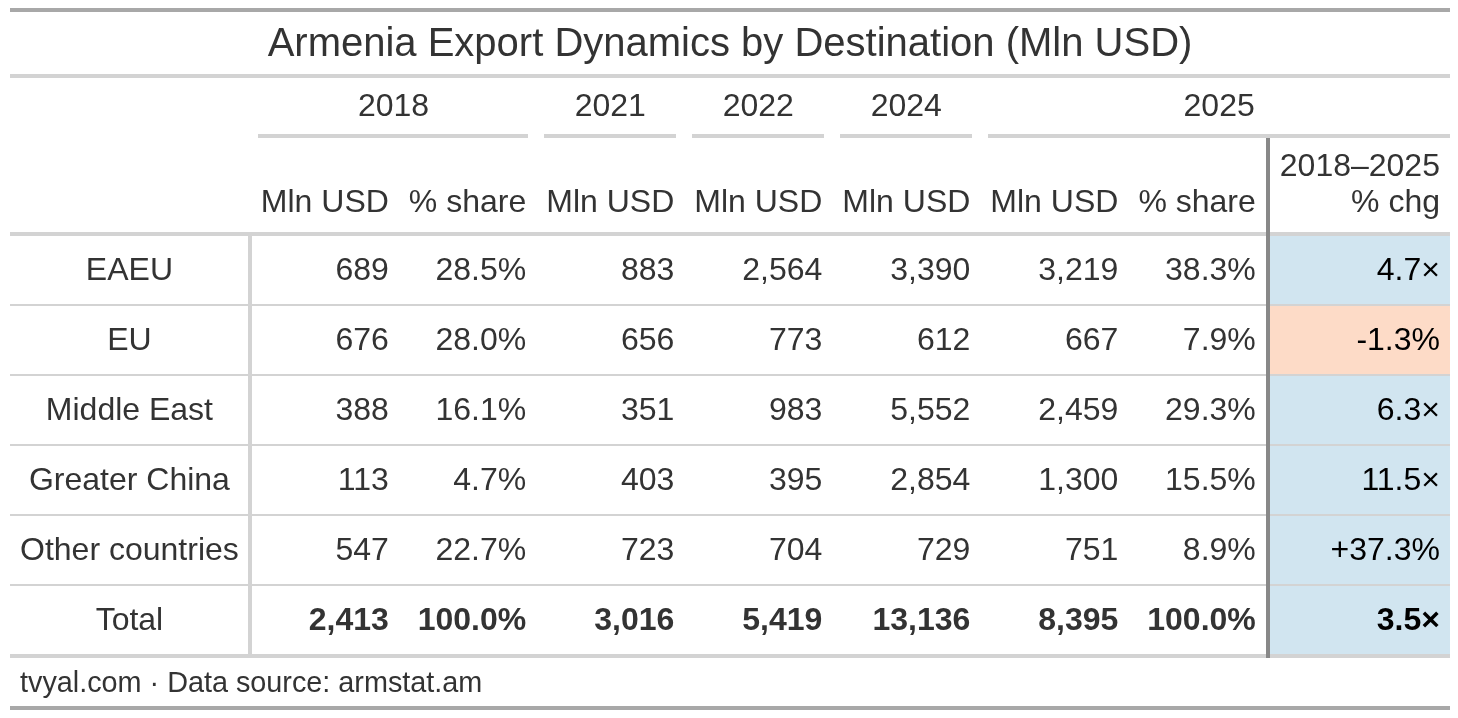
The 2018 column is the pre-sanctions baseline. The final column is seven years of a stated European vector, measured in actual trade flows.
The inconvenient arithmetic
In 2018, reorienting Armenia’s exports away from Russia would have meant rerouting about $689 million a year. Real money, but manageable. In 2025, the same exercise involves $3.2 billion, nearly 40% of a normalized export base, built on years of contracts, freight routes, and banking relationships that run in one direction.
Whatever the political rhetoric, walking away from the EAEU market today would exact a far heavier economic toll on Armenia than it would have in 2018.
The summit was a very good day for the cameras. The trade data covers the rest of the seven years.
Mr Pashinyan’s government did not create Armenia’s economic dependence on Russia. But under its watch that dependence got heavier, while the government’s own language about where Armenia was headed moved the other way.
EU exports with gold (HS71) stripped out, compared 2025 to 2018: that is the number that would settle the question. If the European vector is real and not just diplomatic theater, it should be rising. The Armstat data say otherwise.
The gold re-export story in full: “Armenia: A Haven for Russian Gold”. The export boom and its collapse: “Armenia’s Exports Quadrupled — Until Russia Closed a Sanctions Loophole”.
* All data from Armstat monthly trade statistics by partner country, 2007–2025, full calendar years. Calculations and chart code available on GitHub.
References
[1] Foreign Trade Statistics // Armstat — https://www.armstat.am