Same Source, Different Price: How Armenia's Medicine Market Adds a 58% Premium
In 2024, Armenia paid $61 per kilogram of imported pharmaceuticals. Georgia paid $39. The two countries share a border and buy from most of the same source countries. In 2023, those prices were nearly identical: $41.22 versus $40.83. One year later, the gap was back at 58%. [4]
The price gap
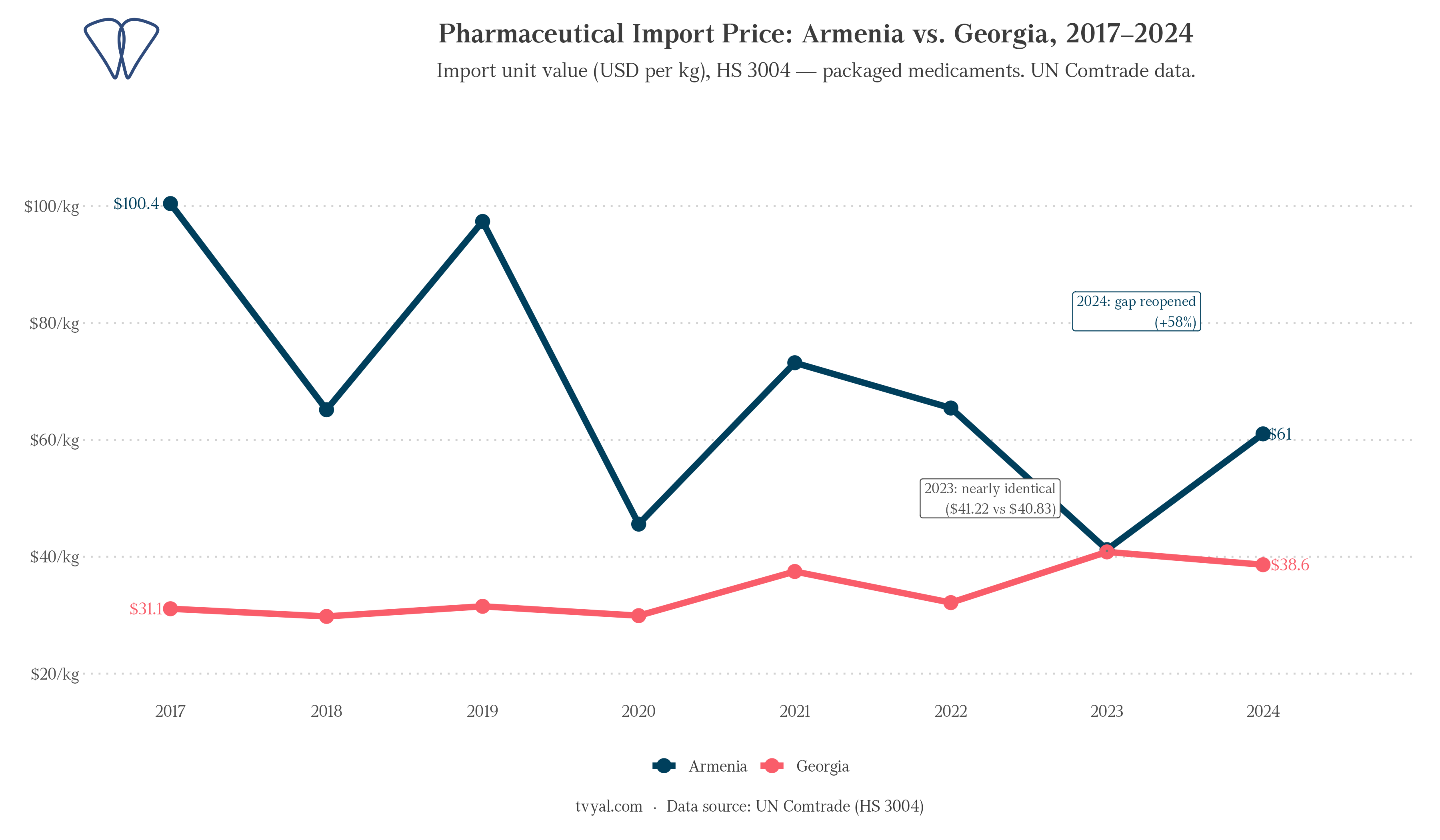
Georgia’s price barely moves. Over eight years it has stayed in a narrow band, tracking global markets without lurching. Armenia’s is a different story: high at the start of the period, a sharp drop during COVID, recovery, then a sudden collapse in 2023 that nearly matched Georgia’s level.
That 2023 convergence came from both directions. Georgia’s price crept up slightly as it bought more expensive medicines. Armenia’s fell sharply. The volumes tell you why: Armenia imported nearly twice as much medicine by weight that year for roughly the same total spend. When you pay the same money for twice the weight, you’re buying cheaper medicines: generics, bulk orders, lower-cost products.
In 2024, it reversed. Volumes fell, the price climbed back to $61, and the gap reopened.
The 2023 data proves the gap is not a permanent feature of geography. It closed once, in a single year, without any structural change to the tax code or market. That means it can close again.
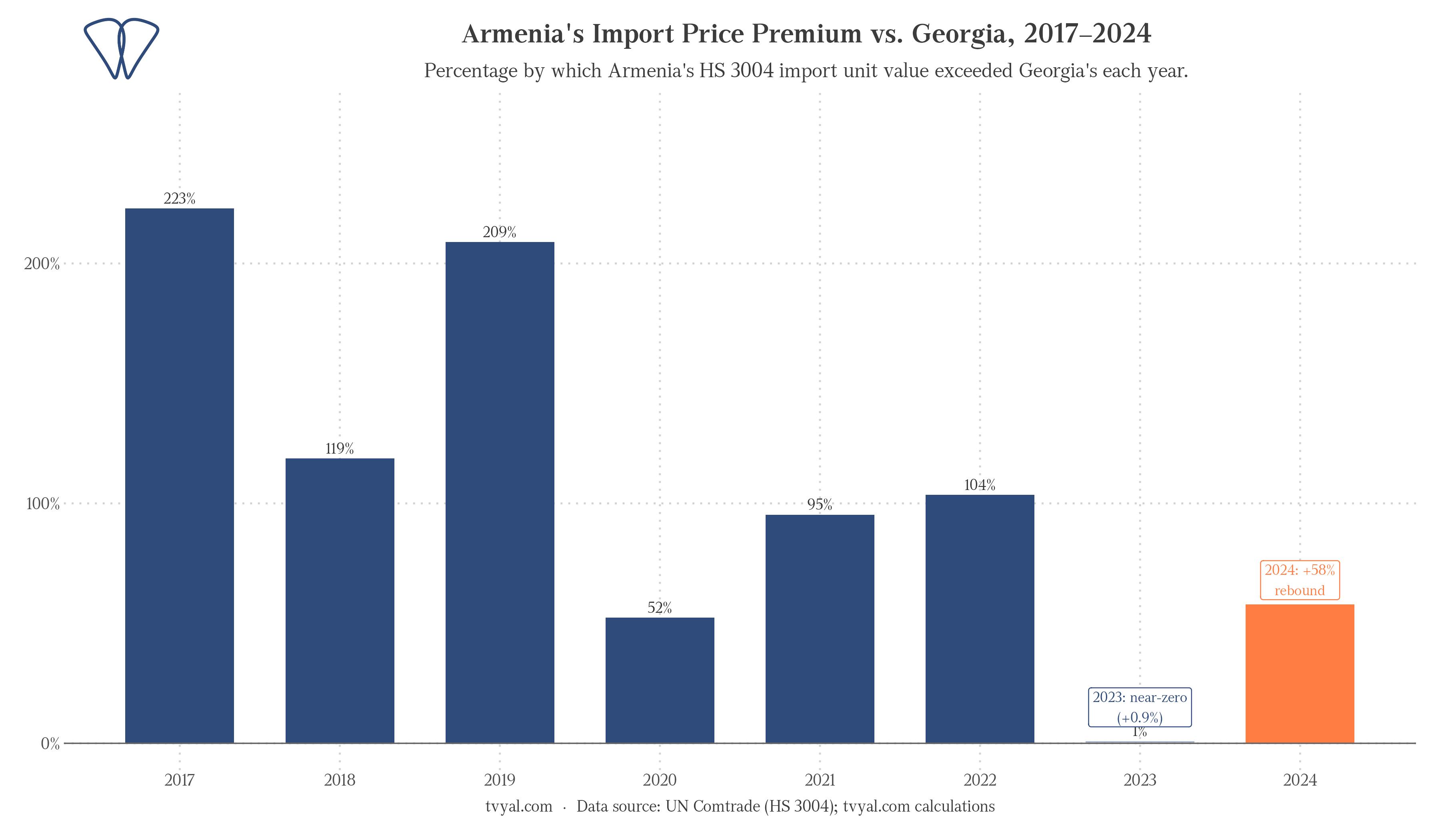
The trade data doesn’t settle what drove Armenia’s product-mix swing in 2023 or why it reversed. The structural conditions that produced the premium were unchanged in both years. When something briefly offset them, prices converged.
Part of Georgia’s lower average comes from where it buys. Georgia sources about a fifth of its pharmaceuticals from Turkey ($699 million across the period, at $54 per kilogram average), a major generic producer, plus significant volumes from India and Ukraine at similarly cheap unit values. Armenia buys almost nothing from any of those three.
The source mix doesn’t fully explain the gap though.
From Germany, Armenia paid $99 per kilogram on average while Georgia paid $64. A 55% premium from the same exporting country.
The gap exists before Turkey and India pull Georgia’s average down.
Who pays
Armenia’s out-of-pocket share of health spending is the highest in the region. The import price gap does not stop at customs.
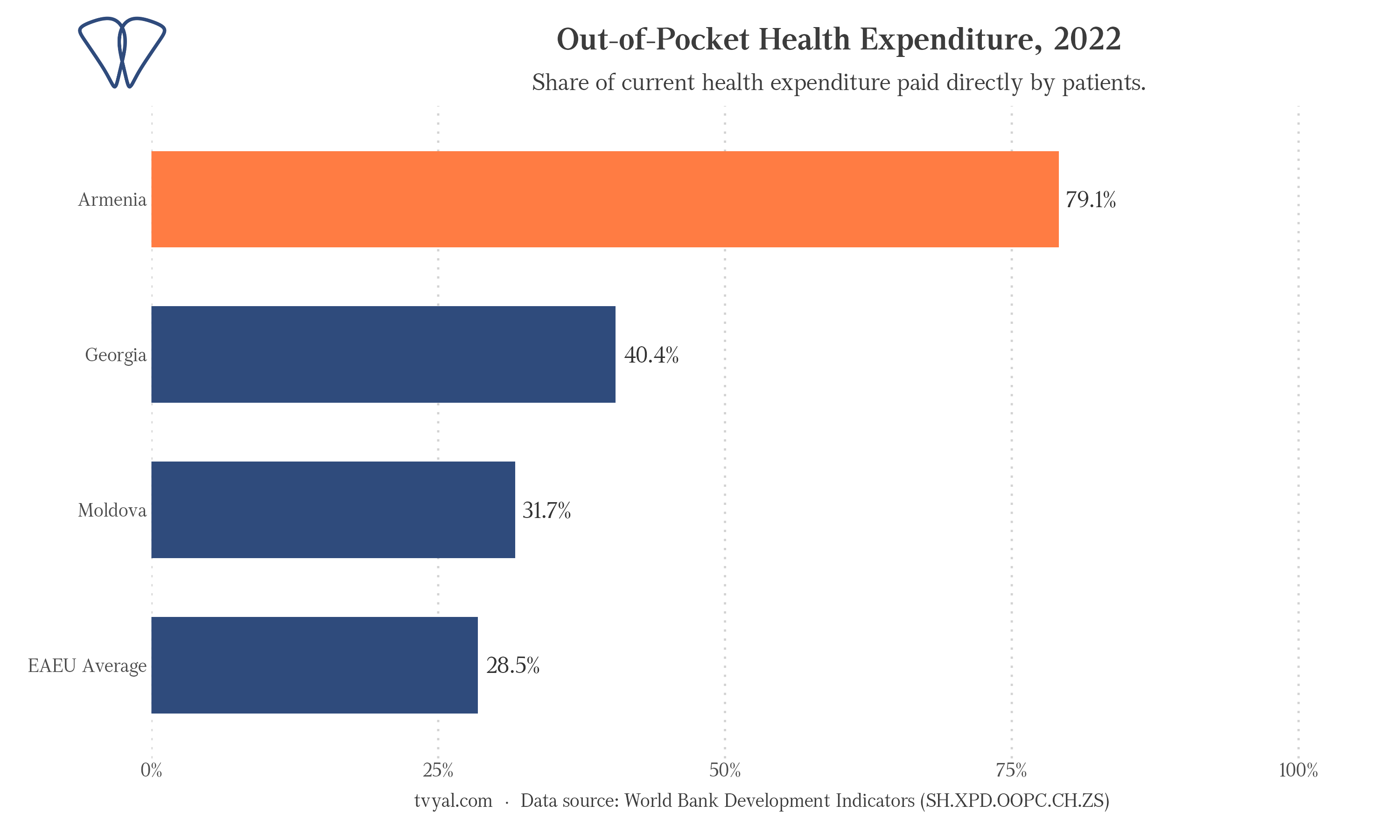
In 2022, the latest year with complete data, 79.1% of Armenia’s health spending came directly from patients. Georgia: 40.4%. Moldova: 31.7%. The EAEU average across Russia, Belarus, Kazakhstan, and Kyrgyzstan: 28.5%. [2]
The gap with Georgia is 38.7 percentage points and it shows up in real lives. A pensioner on 46,000 AMD a month who gets sick will spend roughly half that income on medicines and consultations, and get very little back from the state. [5] Georgia asks a lot from patients too. About half as much.
The VAT floor
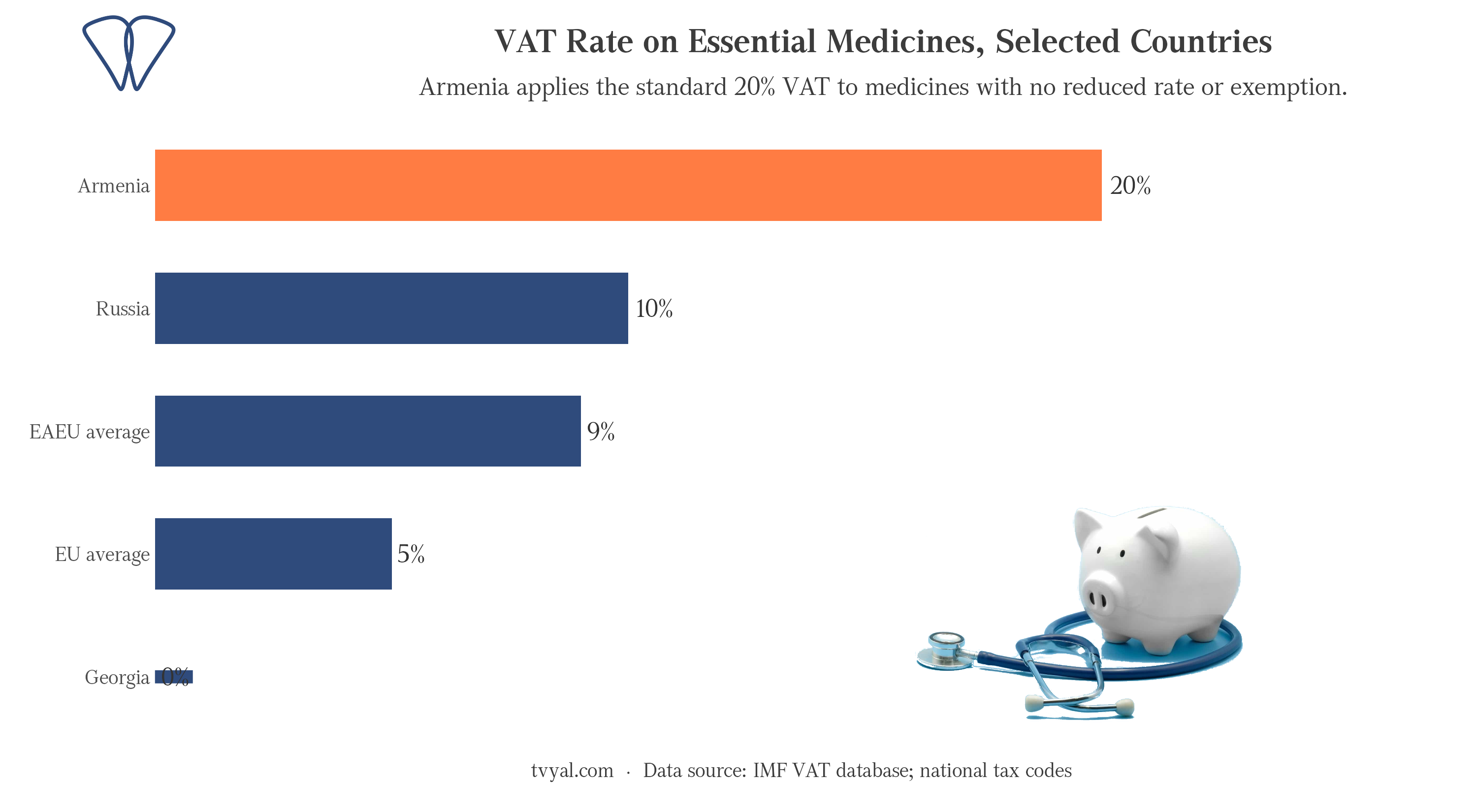
Armenia charges 20% VAT on all medicines. No reduced rate, no exemption. Georgia: 0%. Russia applies 10% to an approved essential medicines list. Belarus: 10%. Kazakhstan and Kyrgyzstan exempt medicines entirely, pulling the EAEU population-weighted average to around 9%. Most EU members apply 0 to 5% on prescription medicines. [3]
The 20% rate is present at every transaction. The importer pays it on the declared value. The distributor adds it to the markup. The pharmacy passes it to the customer.
The consumer pays it directly. Businesses at each stage recover the VAT they paid in, so it doesn’t compound. But the patient has no input VAT to recover. In Georgia the retail price carries zero VAT. In Armenia it carries 20%. If wholesale and retail margins were identical in both countries, Armenian patients would still pay roughly 20% more at the till.
Cutting the rate wouldn’t close the full gap. The import unit value premium is real on its own. But the VAT is the one piece that domestic policy can remove today, without restructuring anything else.
Market structure
Three companies hold over 60% of Armenia’s pharmaceutical wholesale market and run integrated chains from import license to pharmacy shelf [1]. They capture margin at wholesale and at retail. The mechanisms that push prices down in a more open market (competition between importers, parallel imports, generic substitution at the counter) are limited by that structure.
| Armenia | Georgia | |
|---|---|---|
| VAT on essential medicines | 20% | 0% |
| OOP share of health spending | 79% | 40% |
| Import unit value, 2024 | $61/kg | $39/kg |
The 2023 dip fits here too. Unit values fell when Armenia bought more bulk and generic products, which compressed distributor margin as a share of import cost. When the purchasing mix shifted back in 2024, the price followed. A concentrated, vertically integrated market doesn’t hold that state for long.
What the data shows
79% out-of-pocket. 20% VAT. Three importers with over 60% of wholesale supply. None of these changed in 2023. Prices converged anyway.
2023 proved the gap can close. 2024 showed it comes back when nothing underneath has moved. The question the data leaves open is what drove Armenia’s one-year product-mix shift and what reversed it.
What the data does settle: the gap has three structural causes. A 20% VAT, three companies with over 60% of wholesale supply, and a sourcing mix that skips the cheap generic markets. 2023 showed all three can be overridden without any of them changing. 2024 showed they snap back when nothing holds them off. That is not pessimism. It tells you where the levers are.
* Import price data from UN Comtrade (HS 3004, pharmaceutical imports, reporter-side). Out-of-pocket health expenditure from World Bank Development Indicators (SH.XPD.OOPC.CH.ZS), latest available year 2022. VAT rates from PPRI and national tax codes. Calculations and chart code available on GitHub.
References
[1] Hetq Investigative Journalists. "Armenian Drug Imports: Three Companies Capture 60.3% of Market." 2019. hetq.am[2] World Bank. “Out-of-Pocket Health Expenditure (% of Current Health Expenditure).” World Development Indicators, indicator SH.XPD.OOPC.CH.ZS. data.worldbank.org
[3] Pharmaceutical Pricing and Reimbursement Information (PPRI). “Armenia country profile.” PPRI Network, Austrian Public Health Institute. ppri.goeg.at
[4] United Nations. “UN Comtrade Database: HS 3004, pharmaceutical imports, 2015–2024.” comtrade.un.org
[5] Karapetyan, Narek. “Armenia to make medicines 20% cheaper by following Georgia’s model.” Aysor.am, January 2026. aysor.am