Turkey Opens Railway Connection for Armenia
Originally published by JAMnews.
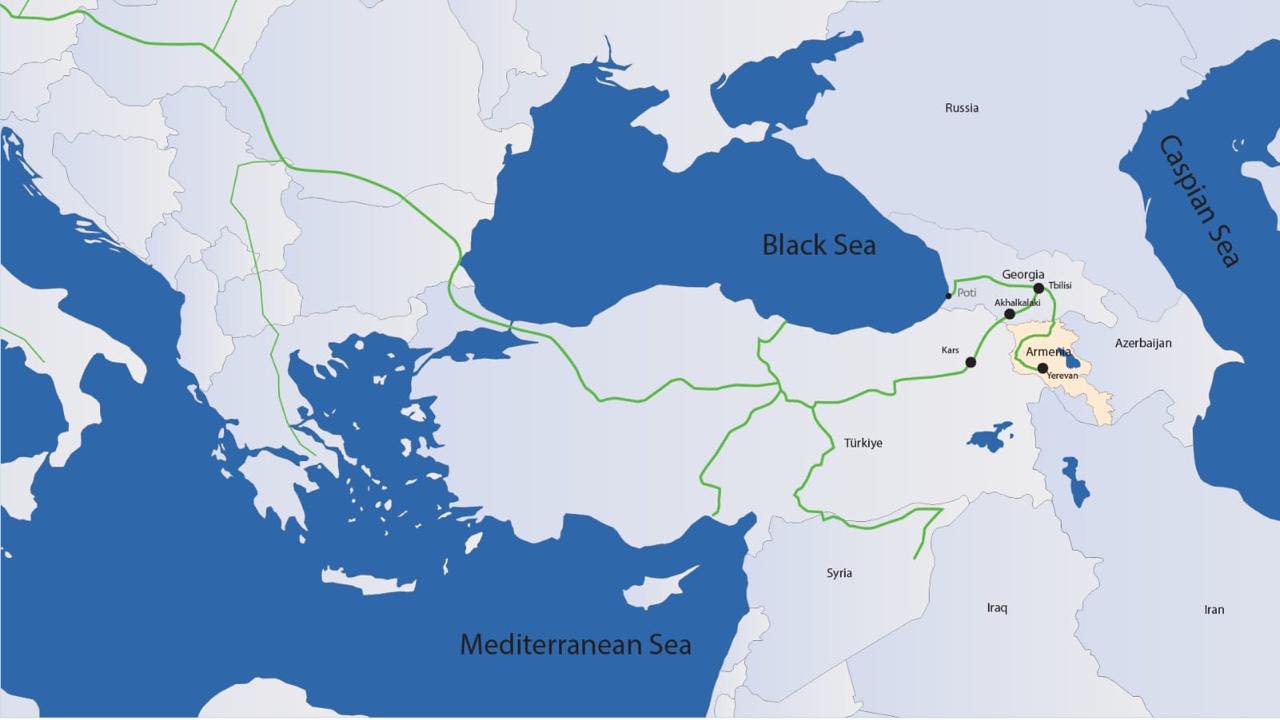
“The Akhalkalaki-Kars railway is now open for exports from Armenia and imports into Armenia,” Prime Minister Nikol Pashinyan announced yesterday on social media.
He described this as a very significant development for the country’s economy, and thanked his Turkish and Georgian partners. Turkey’s special envoy for the Armenian-Turkish normalization process, Serdar Kılıç, shared the Prime Minister’s post on X.
“I hope this new step, which will also promote Turkey-Armenia-Azerbaijan-Georgia four-party cooperation and make a significant contribution to strengthening regional peace and stability, will be beneficial to all these countries,” the diplomat wrote.
Armenian experts are not rushing to make assessments. Economist Aghasi Tavadyan, head of Tvyal.com, told JAMnews that at the moment the decision carries more political significance. The economic impact of opening the railway connection, he said, can only be properly assessed after serious analysis.
In Tavadyan’s view, opening the border with Turkey would “to some extent resolve” the logistics problems tied to exporting to EU markets. But the question of Armenian products meeting EU standards remains open.
Details: what the Prime Minister said
Prime Minister Pashinyan emphasized that Armenia has gained railway connectivity with the European Union via Georgian and Turkish territory. He recalled that Armenia had previously established railway links with Russia via Georgia and Azerbaijan, and then with China via Russia and Kazakhstan.
“In the future, the Armenia-Turkey, Armenia-Azerbaijan, and then Armenia-Iran via Nakhchivan railways will open. We will witness these events in the near future as a result of implementing the TRIPP project,” Pashinyan said.
TRIPP (Trump Route for International Peace and Prosperity) is a road that would connect mainland Azerbaijan with its exclave of Nakhchivan through Armenian territory.
Commentary
Economist Aghasi Tavadyan says he has not yet analyzed the economic aspects of railway connectivity via Georgia and Turkey for Armenia. However, he has already examined what economic effects and risks a full opening of the Armenia-Turkey border could bring, in terms of both imports and exports.
Tavadyan noted that Armenia already imports Turkish goods via Georgia today. These include textiles, agricultural products, and construction materials. Despite the transaction costs, these goods are “highly competitive” on the Armenian market because they are cheap.
“If the Armenia-Turkey border opens, those transaction costs will disappear. Turkish goods will become even cheaper in Armenia and the range of products will expand. First of all, we will definitely see economic growth,” Tavadyan said.
At the same time, he notes that economic growth is expected mainly in Yerevan.
In his view, border opening will benefit the capital’s residents and the restaurant business, which will be able to buy goods more cheaply. But it will negatively affect agriculture. He uses Armenian tomatoes as an example, noting they have been displaced by Turkish varieties in recent years. Ukraine, he adds, refused to import certain agricultural products from Turkey, treating it as a “risk” to its own economy.
The economist also presented statistical data. In particular, he noted that since 2018, economic growth in Armenia has been concentrated mainly in IT and banking, sectors that grew three times or more:
“Agriculture, meanwhile, contracted by about 15 percent. If Turkey decides to import cheap tomatoes, apricots, or other products into Armenia, it will of course increase economic growth, but it will hurt agriculture.”
Tavadyan argues that economic development matters not only for Yerevan but also for rural communities, calling it a factor of “economic security.”
Speaking about exporting Armenian goods to the EU via Turkey, he emphasized that under the Pashinyan government, exports to EAEU countries — led by Russia — grew almost five times:
“Growth toward the European Union, however, was not recorded.”
Tavadyan believes that opening the Armenian-Turkish border would in part solve the logistics problems tied to EU markets.
At the same time, he reminds that steps must be taken to bring Armenian products into compliance with European standards:
“We need to think about high-value, low-weight, non-perishable goods. Traditional agricultural products like tomatoes and apricots will cost significantly more by the time they reach the EU, will spoil, and other problems will arise.”
Asked which goods he considers most viable for early EU export, the economist listed:
- nuts, in attractive packaging with Armenian branding,
- chocolate candies with dried fruits,
- asparagus,
- honey.
Tavadyan also considers it important to build Armenian brands and participate in trade shows across EU countries — to understand demand and establish new connections.