The Parade Glee and the Stark Reality of the Budget
On May 28, Armenia held its first military parade in a decade. Over two hours, the government displayed weapons acquired from seven countries since 2022: French armored vehicles, Indian surface-to-air missiles, Chinese combat drones, Iranian air defense systems, domestic strike UAVs, and four-legged robotic reconnaissance platforms. Prime Minister Pashinyan called the event a government accountability report to citizens. The budget data is a different kind of accountability report.
* The numbers in this article come from armenian-budget-tools, an open-source pipeline by The Gituzh Initiative that parses the Ministry of Finance’s annual budget law and quarterly spending XLSX files (2019–2026) into validated CSVs.
What the defence budget shows
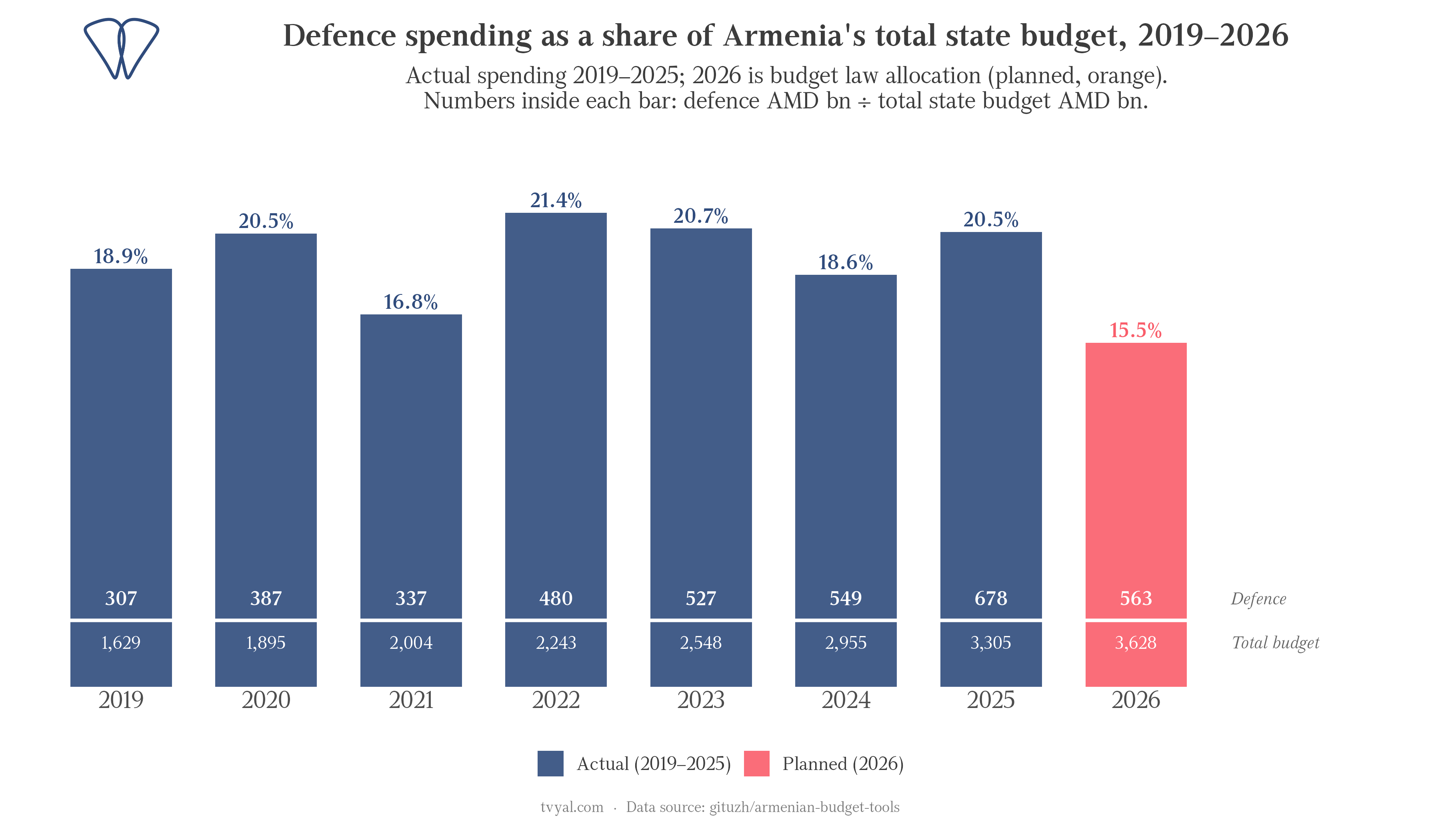
Armenia’s state defence spending grew from 307 billion AMD in 2019 to 678 billion AMD in 2025, a 2.2-fold increase. [1] Defence has run at roughly 19–21% of total state expenditure for most of those years. It is the largest single block in the budget.
The 2026 budget cuts defence by about 17%, to 563 billion AMD, or 15.5% of planned total spending. That is the first reduction since the 2020 war. As a share of GDP, the 2026 planned figure would be the lowest since 2018, below even the 2021 allocation written just after the 44-day war. The cut follows the Washington Declaration of August 2025, when Armenia, Azerbaijan, and the United States initialled a peace framework. The parade showed what the build-up bought. The budget shows what comes after.
By comparison, Azerbaijan’s 2026 defence budget is about 21% of its total state spending, and roughly 3.5 times Armenia’s defence in absolute terms (about 8.7 billion manat). [3] Azerbaijan has been raising that share year on year. Armenia, for the first time since 2018, is heading the other way — down to 15.4%.
What the R&D budget shows
Armenia’s state budget also funds scientific research through Programme 1162 (Scientific and Scientific-Technical Research) under the Ministry of Education, Science, Culture and Sports. Allocations under this programme rose from 14.4 billion AMD in 2019 to a peak of 35.8 billion AMD in 2024, slipped to 33.9 billion in 2025, and fall to 29.2 billion in the 2026 budget law. That is a 14% year-over-year cut, in the same direction as defence. Programme 1162 is not the only science line being cut. The Ministry of High-Tech Industry, which funds R&D, the startup ecosystem, and defence-industrial innovation, has its budget cut by about 21% in 2026. The precise figure is 21.4%, landing on R&D, the startup programme, and defence-industrial innovation under the same roof.
The parallel ends there.
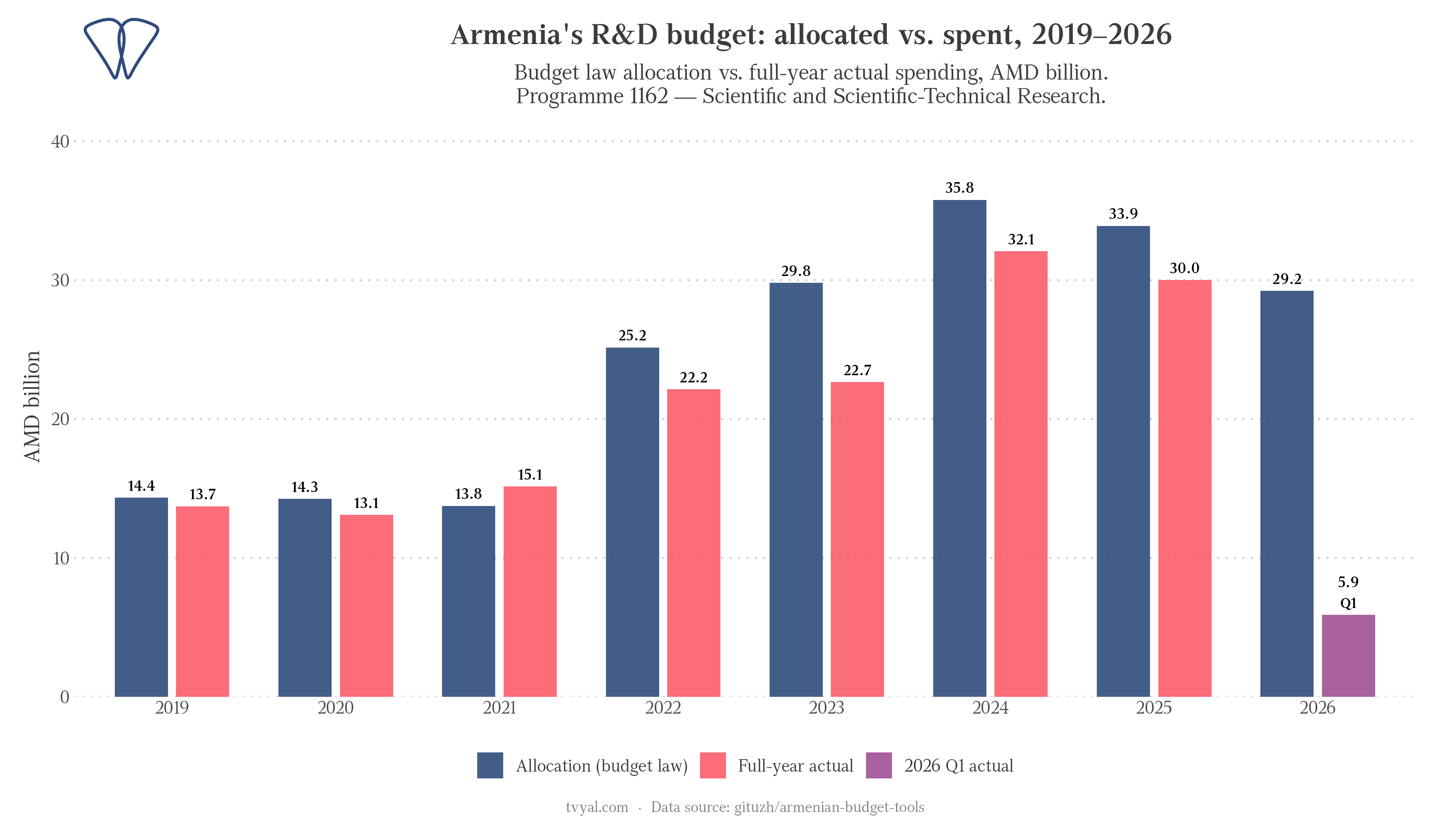
In six of seven years, R&D allocations exceeded what was actually spent. In 2023 the gap was widest: 29.8 billion AMD allocated, 22.7 billion spent. That works out to 76 drams disbursed for every 100 allocated. In 2024 it narrowed to about 90%: 35.8 billion allocated, 32.1 billion spent. 2021 was the one exception in seven years; actual spending ran above the allocation, 15.1 billion against 13.8 billion planned. [1]
Where Armenia sits
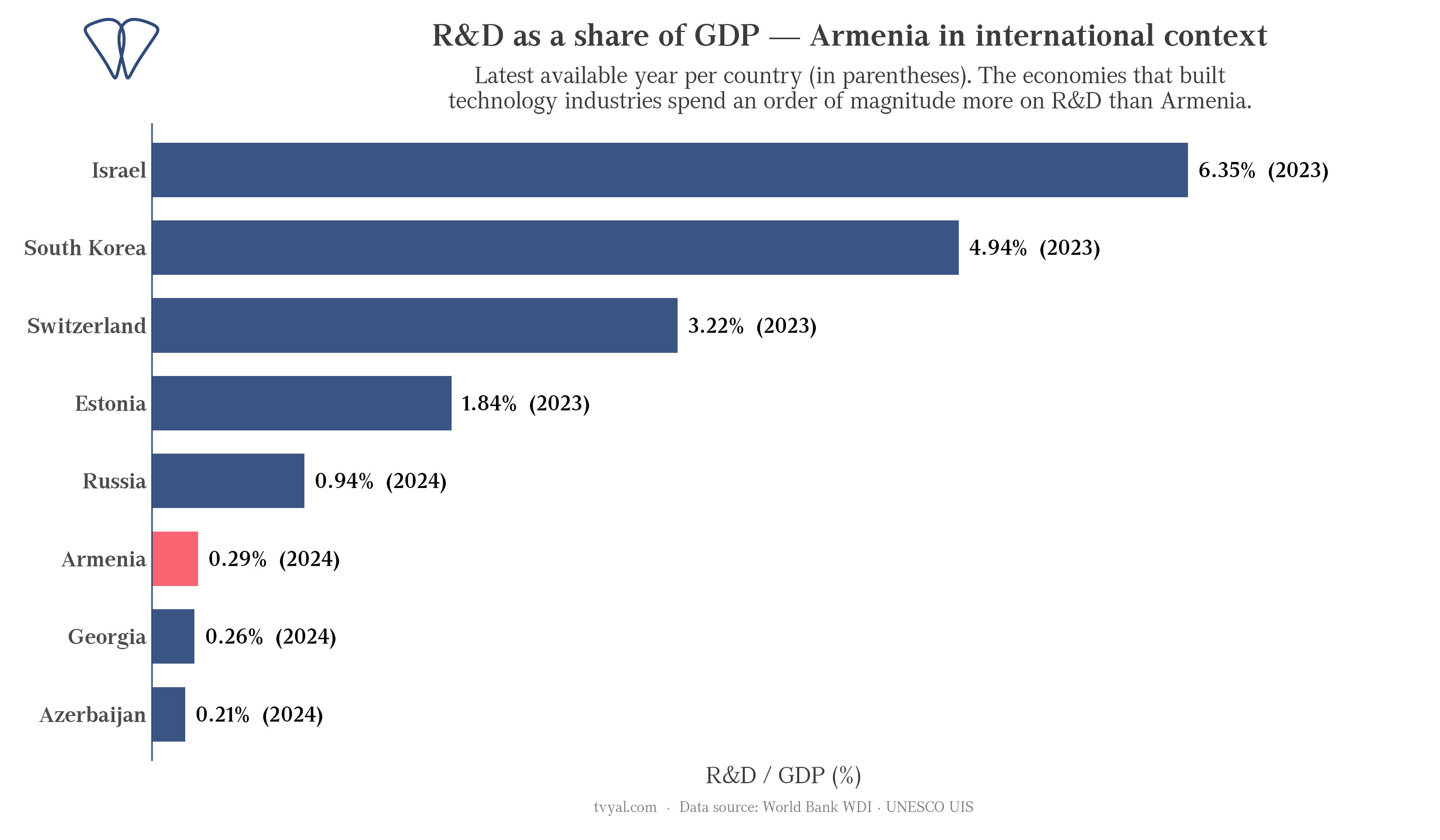
The World Bank’s R&D-to-GDP series includes everything: state programmes, business enterprises, universities, foundations. In Armenia’s case the state programme is essentially the total. There is no significant private R&D sector to absorb a state pullback.
The latest reading for Armenia is 0.29% of GDP. Georgia is at 0.26, Azerbaijan at 0.21; the South Caucasus runs as a low cluster, around a quarter of one percent. Russia sits at 0.94. Estonia, a post-Soviet country of comparable population and starting line, is at 1.84. The economies whose science-and-technology models Armenian policy explicitly invokes (Switzerland 3.22, South Korea 4.94, Israel 6.35) run at ten to twenty times Armenia’s level. [2]
These ratios are not targets imposed by anyone. They describe where each country chose to put its resources over thirty years.
The execution gap
The state has shown it can move budget funds when it decides to. Defence executed 99% or more of plan every year since 2019. In 2020 and 2022, supplemental appropriations pushed execution to 126% and 139% as the war years drew on wartime reserves. R&D averaged 91% across the same seven years and bottomed at 76% in 2023. The shortfall is not a capacity problem.
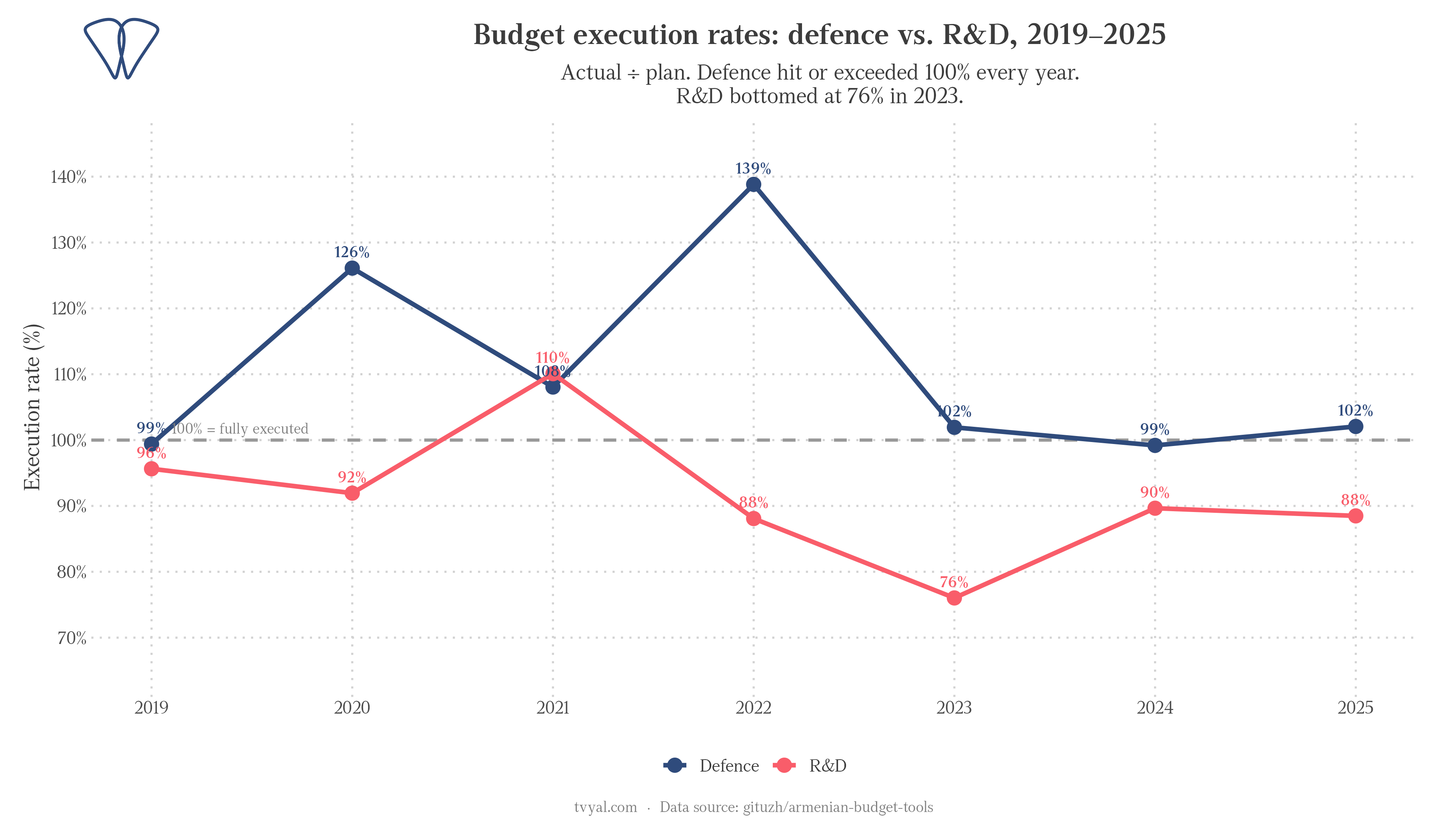
Cumulatively from 2019 to 2025, the budget laws allocated 167 billion AMD to scientific research. The treasury disbursed 149. The 18 billion AMD difference was returned to the budget: capacity the legislature had named, but the executive did not deploy. That is roughly two-thirds of one full year of Programme 1162.
What the numbers don’t settle
Execution rate is not effectiveness. Defence ran at 99–139% of plan, but that measures disbursement, not readiness. R&D underspending does not mean the money was wasted. Unspent allocations return to the treasury. It means the money did not reach science institutions at the rate the legislature approved.
The parade did real work. After a lost war, the public display itself was the state saying it had rebuilt something. Mind that the parade was held one week before the major election. For the army standing in formation, for the citizens watching, for the neighbors reading the columns, that signal carries its own weight. Symbolic capital is not a cheap currency; in Armenia’s strategic position deterrence runs partly on signals.
The budget is the next signal. It says where the country places its bets for what comes after the rebuilt army. Defence falls 17%. R&D falls 14%. The High-Tech Ministry falls 21%.
The parade is one side of the state’s accounting. Programme 1162 is the other.
* Budget data sourced from gituzh/armenian-budget-tools, a pipeline drawing from the Armenian Ministry of Finance (minfin.am). Programme 1162 covers state-funded scientific and scientific-technical research under the Ministry of Education, Science, Culture and Sports.
References
[1] Armenian state budget execution data, 2019–2025 // Armenian Ministry of Finance — minfin.am, processed by gituzh/armenian-budget-tools
[2] Research and development expenditure (% of GDP) // World Bank Open Data — data.worldbank.org
[3] Azerbaijan 2026 state budget law (Ministry of Finance of the Republic of Azerbaijan) and SIPRI Military Expenditure Database — sipri.org/databases/milex