One Ruble, Three Prices: Why Armenian Banks Don't Want Your Cash Rubles
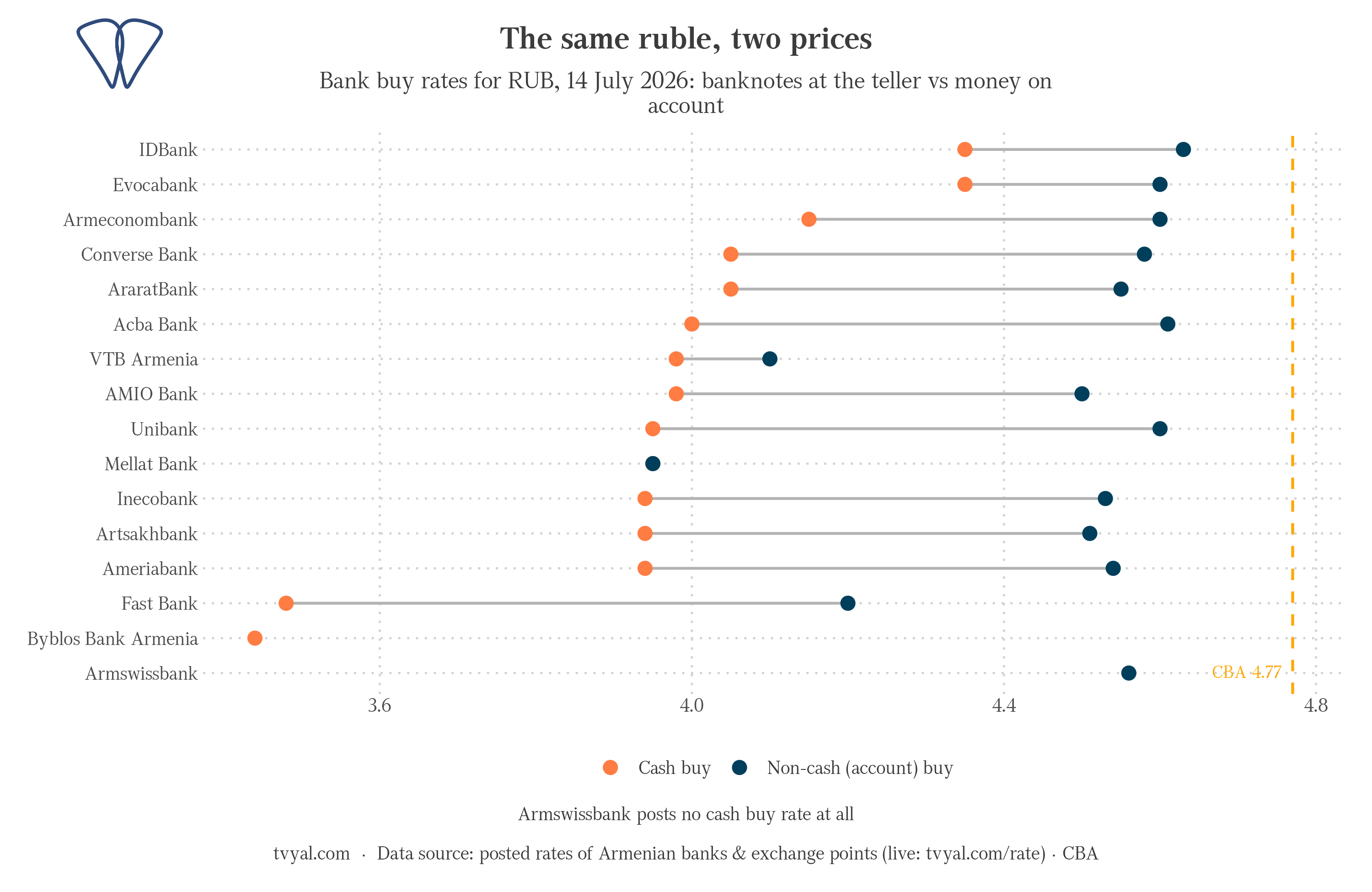
As of this week, the average exchange rate for buying Russian rubles in cash in commercial banks of Armenia is 3.98 drams. The official exchange rate of the Central Bank of Armenia is set at 4.77 drams. At the same time, in the case of non-cash conversions (rubles held on an account), banks offer an exchange rate of up to 4.55 drams. In fact, the same currency has three different values during the same day and in the same financial institution. The gap between the official exchange rate and the market exchange rate for buying cash has reached about 17 percent. The extremely low exchange rate set for buying cash rubles in some banks is, in essence, a way to refuse the transaction: the banks simply do not want to accept ruble banknotes. Armswissbank does not set an exchange rate for buying cash rubles at all.
For more than three years, we have been collecting and analyzing the buying and selling exchange rates set by banks and exchange offices in Armenia with high frequency (real-time data is available on our exchange rate dashboard). This data dashboard allows us to clearly see the day of the break and assess its depth. This is the only tool in Armenia that shows the long-term dynamics of buying and selling exchange rates at exchange offices and banks, as well as the margin, which allows us to assess the real state of the market. Although the situation in the exchange rate market may at first glance be viewed as a coordinated action by the banking system against the ruble, a closer look at the data reveals that other macroeconomic factors underlie the problem.
Two-week stability and a sharp decline
On June 11, the Russian Federation adopted a decision effectively banning the import and transit of Armenian agricultural products. In the two weeks that followed, the ruble exchange rate on the Yerevan foreign exchange market was relatively stable. However, this stability was deceptive.
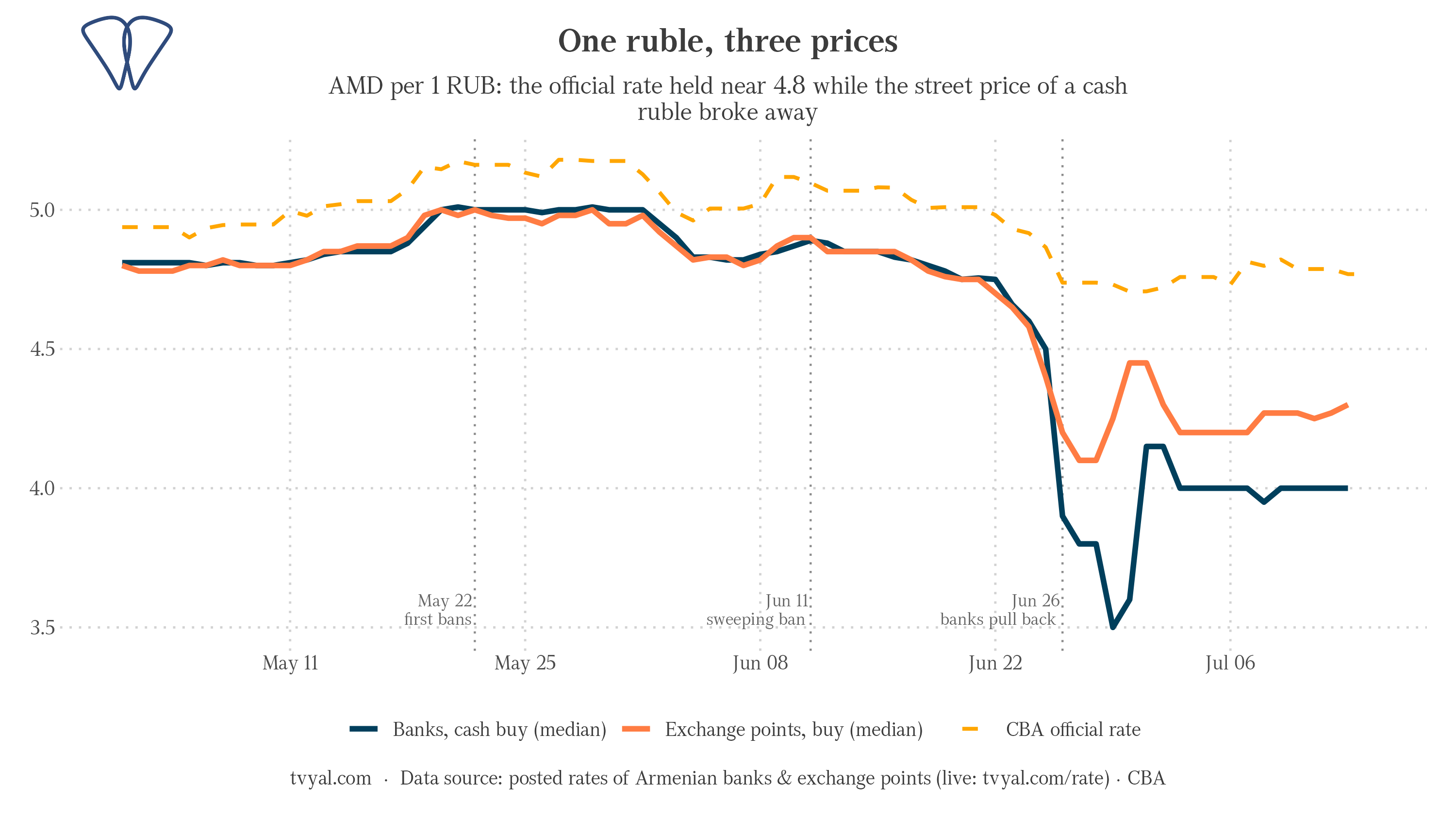
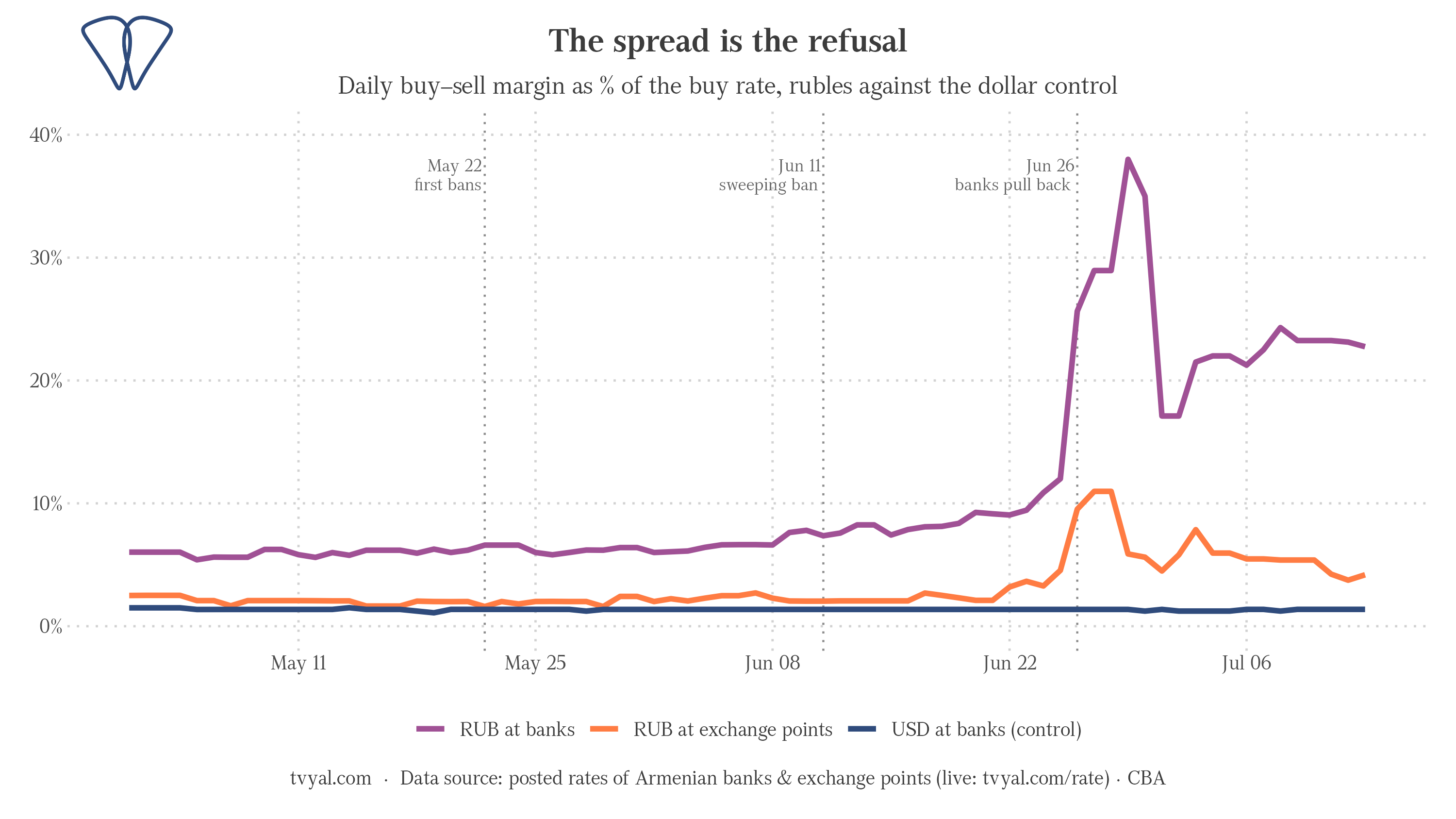
The sharp revision of the exchange rate was recorded on June 26. Over the course of three days, the average bank exchange rate for buying cash rubles decreased from 4.60 drams to 3.50 drams. In parallel, the margin between the buying and selling rates increased from about 10 percent to 38 percent. Currently, it has stabilized at around 23 percent. For comparison, it is worth noting that during the same period, the US dollar margin in the mentioned banks remained within the range of only 1 percent. The margin is the percentage ratio between the buying and selling rates and shows the degree of liquidity and riskiness the market assigns to a given exchange rate. At the moment, the Armenian exchange rate market assesses the ruble as a currency with a high level of uncertainty. In the event of economic shocks, as a rule, all foreign currencies depreciate simultaneously in the market. In this case, only the cash ruble depreciated.
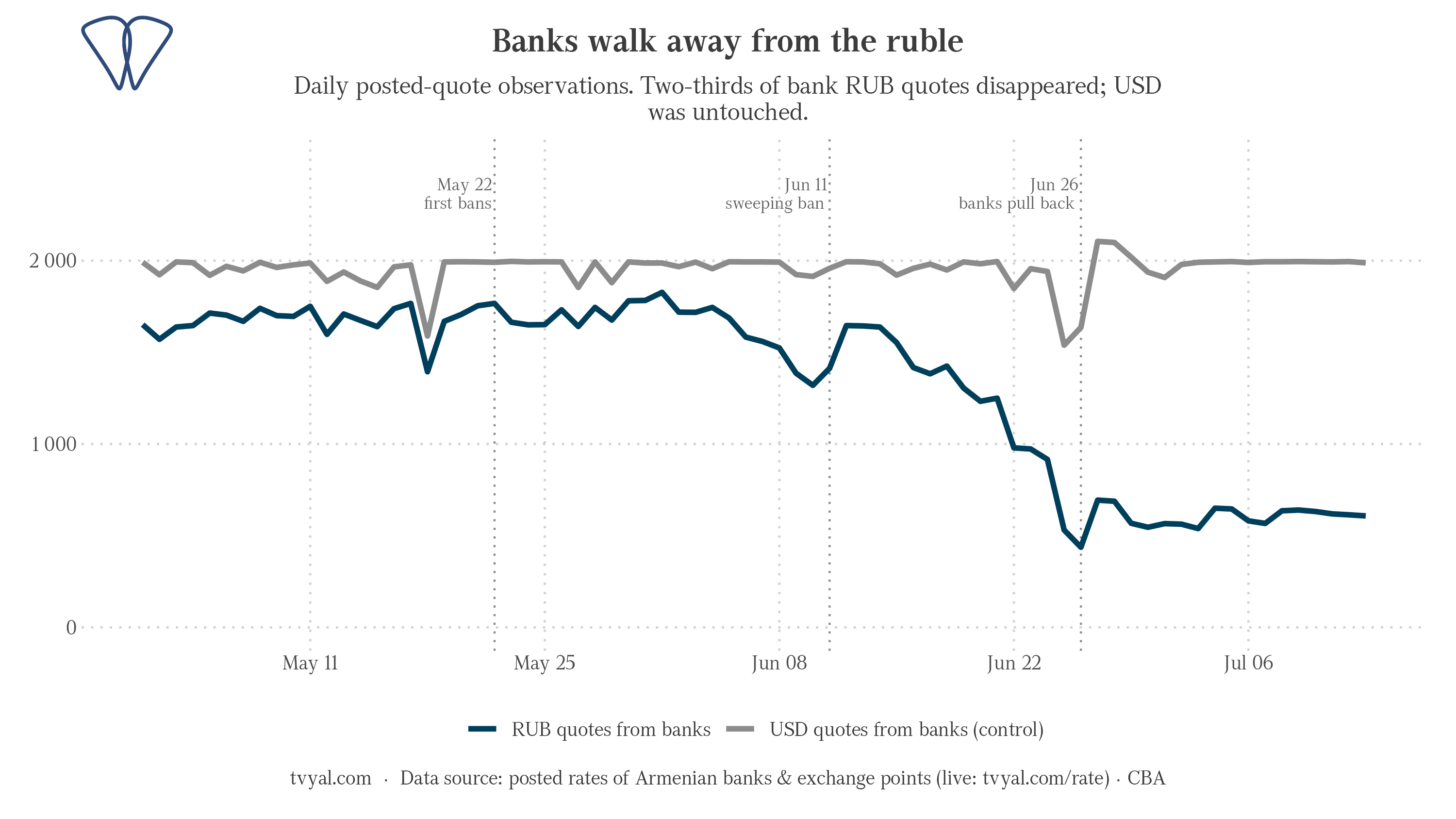
It is noteworthy that the banks’ reaction began before June 26. A study of the data shows that before the sharp decline in exchange rates, banks were gradually limiting transactions. In particular, between June 11 and 24, the number of quotes published by banks on the ruble exchange rate was reduced by almost half, while no changes were recorded in the case of dollar quotes. Although banking services were physically continuing, the demand for the ruble had already effectively dried up.
At the same time, it should be noted that there is no global systemic depreciation of the ruble. During the specified period, the official exchange rate of the Central Bank of Armenia decreased from 5.16 drams to 4.77 drams (about 7 percent decrease), which is consistent with the ruble depreciation trends in international markets. The additional 10 to 17 percent loss suffered by cash ruble holders in Armenia is a purely local Armenian economic phenomenon and manifests itself exclusively in the case of cash foreign currency.
Disruption of trade channels
This phenomenon is not the result of a mutual agreement of the Armenian banking system aimed at the internal depreciation of the ruble, but rather a disruption of trade channels. This is also evidenced by the gap between the exchange rates of cash and non-cash ruble within the same bank. As of July 14, according to the average indicator of banks, the non-cash ruble was purchased for 4.55 drams, which is only 4.6 percent lower than the official CB exchange rate. In fact, this was approximately the margin that was in effect until the current situation. At the same time, banks offered an average exchange rate of 3.98 drams for the cash ruble. The recorded difference of 0.57 drams is not the foreign exchange rate, but a reflection of additional costs associated with the management and physical export of the cash ruble.
The inability of banks to sell cash rubles is due to the closure of trade channels by the Russian Federation, which was implemented in two stages. A presidential decree signed on March 25 banned the export of cash rubles from Russia to the EAEU countries in excess of the equivalent of $100,000 per individual, and banned it entirely for legal entities [1]. In parallel, Russian banks have tightened the conditions for accepting cash banknotes flowing in from foreign financial institutions. The Union of Banks of Armenia officially announced that local restrictions are a consequence of new regulations applied by the Russian Federation and are not a manifestation of a deliberate policy directed against the ruble [2].
The economic logic of the process is clear: when the final recipient in the supply chain refuses to accept an unlimited amount of goods (in this case, cash foreign currency), intermediary links are forced to significantly limit purchases. As a result, the purchase price decreases, and reserves gradually accumulate. In this situation, the mentioned intermediary links are the commercial banks of the Republic of Armenia, in whose vaults an excess accumulation of cash rubles is recorded.
The disruption is systemic and covers the entire EAEU. More than a third of banks in Belarus now charge a 2 to 5 percent commission for depositing cash rubles, and similar fees have appeared in banks in Kazakhstan and Kyrgyzstan [1]. Cash in circulation within Russia increased by 1.4 trillion rubles in the first half of the year, the largest increase in six years, precisely because banknotes have no way out. In fact, the situation is even more acute in Armenia, which is directly due to the June 11 ban. Freight carriers and agricultural exporters were the main buyers of the ruble on the market. The introduction of the ban coincided with the peak of the tourist season, when the volume of cash ruble sales by incoming tourists is at its highest. Supply continues to grow, while the two main channels of sale, trade and banknote repatriation, were disrupted during the same month.
Therefore, the current situation is not the result of an oligopolistic agreement in the Armenian banking system. In the event of an internal agreement, a single exchange rate would be set. Banks’ cash ruble quotations vary from 3.44 to 4.35 drams, which indicates that each financial institution sets the price based on its own liquidity and reserves. Banks with free funds offer an exchange rate close to the market, while those with oversaturated reserves set an artificially low exchange rate with the aim of curbing additional cash inflows.
Cash foreign currency, the repatriation of which becomes impossible, loses its function as a means of payment and turns into a commodity reserve.
How to manage available ruble funds
Given the public resonance of the issue, the available alternatives were analyzed. The chart below reflects the real cost of converting 1,000,000 rubles into Armenian drams through the available channels (as of July 14).
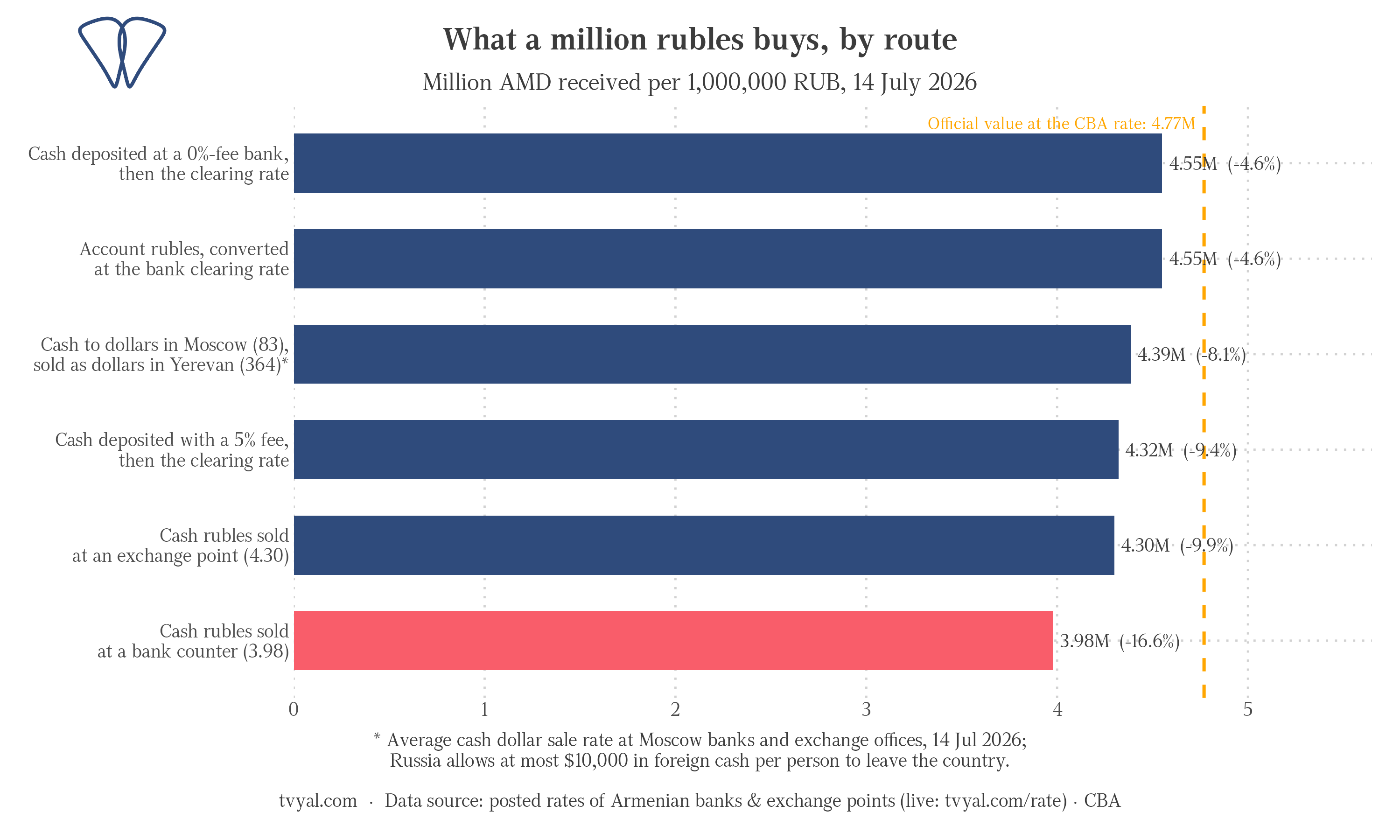
Thus, a number of non-obvious patterns are recorded.
First, the most optimal option for selling cash foreign currency is not exchange offices, but banks. It is advisable to deposit banknotes in banks that still accept them without a commission fee (as of early July, IDBank and VTB Bank-Armenia, while Inecobank had stopped cash deposits, and Ameriabank charged a 5 percent commission fee [3]) with the condition of later converting them at the non-cash exchange rate. The above-mentioned approach makes it possible to receive 4.55 drams for one ruble, instead of 4.30 drams offered at exchange offices. The calculation of Ameriabank’s 5 percent commission fee is noteworthy: 4.55 drams minus 5 percent makes 4.32 drams, which is almost equal to the offer of exchange offices. The use of commission fees is aimed at limiting arbitrage opportunities. The experience of Belarus testifies to the inevitability of this process throughout the system. Opportunities for preferential deals are gradually being exhausted.
Second, the approach of “importing US dollars instead of rubles” is not economically justified. Since 2022, Russia has had a limit on the export of foreign currency in cash of $10,000 per person, and the Central Bank of the Russian Federation has extended the cash withdrawal restrictions until September 2026 [5]. At the same time, in Moscow exchange offices, cash dollars are sold for about 83 rubles, compared to the official 77. The same crisis phenomenon that leads to the depreciation of the ruble in Yerevan stimulates the growth of the dollar price in Moscow: pricing reflects the increase in risks at both ends of the chain. The cash dollar conversion route involves a loss of about 8 percent, which is not significantly different from the loss of selling cash rubles at the market price. In the case of large transactions, the most effective option for moving capital is non-cash transfers.
Third, if there is a real demand for the use of the ruble within Russia (family, real estate, travel), then the ruble retains its nominal value there. Moreover, the transfer of cash to Russia does not have such strict restrictions as in the case of export. This circumstance also explains the maintenance of active buying and selling at exchange offices at an exchange rate of 4.30, even when banks reduce operations. The local retail market is able to recirculate the ruble, while bank reserves are deprived of this opportunity.
What to do: is waiting effective?
Should large capital managers adopt a wait-and-see approach? The EAEU treaty essentially provides for the “free movement” of goods, services, capital, and labor. It can be assumed that the restoration of cargo transportation in the event of the lifting of the trade barrier will lead to the stabilization of the ruble purchase rate in the domestic market. However, this scenario requires two significant adjustments.
First of all, it is necessary to note that the treaty is a document that lacks effective mechanisms. At the moment, the fundamental freedoms of the EAEU, such as the free movement of goods and capital, are effectively restricted. The current restrictions already violate its provisions, and without any legal consequences [4].
Secondly, even in the most optimistic scenario, there are objective limitations. In the event of the lifting of the ban on the export of agricultural products, the demand for the commercial ruble will be restored. However, the regulations on the return of banknotes to Russia are restrictions of a completely different nature, aimed at preventing capital outflow. They were adopted even before the current problems in trade with Armenia arose. The warming of diplomatic relations will not lead to their neutralization. In a realistic scenario, the discount on cash purchases may decrease from 10 percent to 5 percent, but not to the previous level of 3 percent. In this context, the policy of VTB Bank-Armenia is noteworthy. It has already set a non-cash exchange rate of 4.10 drams, while all other banks offer 4.5 to 4.6 drams. Keeping the cash ruble does not provide any interest income, while at the moment the currency continues to depreciate in international markets. Let us also emphasize that, as our previous research showed, the ruble historically has an appreciation trend in the first half of the year (January to June); after June it has a depreciation trend, mainly due to the budget execution needs of the Russian Ministry of Finance.
Which key indicator to follow? It is the gap between the cash and non-cash purchase rates of the ruble in banks, which currently amounts to about 12 percentage points. This indicator reflects exclusively the cost of the disruption of cash circulation. When the gap drops below 5 points, this will indicate the restoration of circulation channels, as a result of which the discount will automatically disappear. The main series of purchase, sale and spread rates for the ruble and eight other currencies are published at tvyal.com/rate, updated every 15 minutes and covering a two-year period. The main exchange rates are available from many sources. Meanwhile, historical data, a table of indicators and spread dynamics are presented exclusively on our platform.
On the trade ban behind all of this: A Harvest With Nowhere to Go. On the economic model that led to such vulnerability of the economy: The Growth Wave Stalled and the closing of the sanctions loophole.
* Exchange rate data: retail exchange rates published by commercial banks and exchange offices of the Republic of Armenia, collected by the tvyal.com FX system every 15 minutes and aggregated daily. Source of official exchange rates: Central Bank of the Republic of Armenia. Data on cash dollar exchange rates in Moscow are presented as of July 14, 2026. The data archive and source codes of the charts are available on the GitHub platform.
References
[1] EAEU banks set fees for cash ruble deposits due to currency surplus and sanctions // Коммерсантъ — kommersant.ru; English version: Banks across the Eurasian Economic Union begin charging fees on cash ruble deposits // Meduza — meduza.io
[2] Why do Armenian banks impose restrictions on cash transactions in Russian rubles? The Union of Banks of Armenia clarifies // NEWS.am — news.am
[3] Armenian banks have the right to determine the terms of cash ruble transactions; the regulator has not imposed any restrictions // ARKA — arka.am
[4] Yerevan questions the effectiveness of the EAEU: the alliance “does not exist” without the free movement of goods and labor // ARMENPRESS — armenpress.am
[5] The Bank of Russia has extended restrictions on cash foreign currency withdrawals for another six months, until September 9, 2026 // Bank of Russia — cbr.ru