Out of the shadows and into Yerevan: what created 300,000 registered jobs
On July 22, perhaps the most beautiful economic number of this year was published: in nine years, the number of registered jobs in Armenia grew by 302,411, from 527,337 to 829,748. The number is real; the official database confirms it. But “registered jobs” and “new jobs” are not the same thing. A worker who has been working on construction sites for ten years but signed an employment contract for the first time last year is a new job for statistics. For the worker himself, no. It is in this difference that the story of the 300,000 lies. We have analyzed who received the increased salaries, where the new jobs were created, and how many of them are truly new.
The job growth picture without tables
The official database shows that in January 2018, there were 509,934 registered workers. In December 2025, the number reached a historic peak of 821,470, an increase of more than 311,000 jobs. The average wage has also increased over the same period, and the two curves in the graph have been growing in parallel for almost a decade.
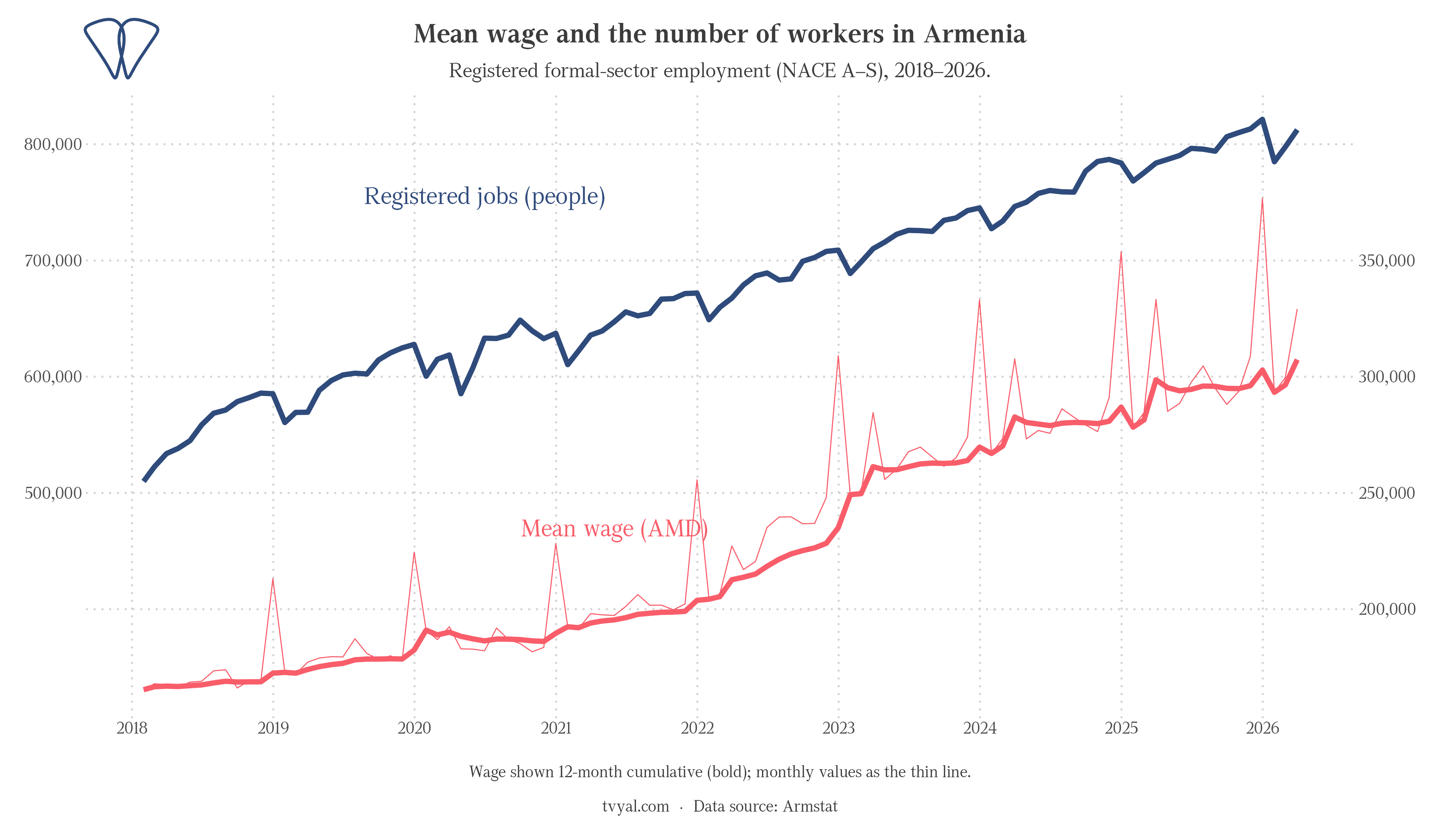
This growth is visible even without statistics, in Yerevan’s new office buildings and crowded cafes. In official reports, the numbers are regularly presented as a record, and that’s true: registered employment has never been this high. It remains to be understood what that record is made of.
💰 tvyal.com/wages — find out your salary’s percentile position in the distribution of over 800,000 registered employees → 📊 tvyal.com/wages/trends — explore the dynamics of wages and employment since 2018 →
Waves of our neighbors’ misfortunes
After February 2022, both capital and people came to Armenia from Russia. It was logical to expect a sharp increase in jobs. Something else happened: in 2022 and 2023, the annual growth of the average salary exceeded 20%, while registered employment increased by only about 5%. The money that flowed in mainly increased the wages of people already working, primarily in the IT and financial sectors, whose salaries more than doubled compared to 2018.
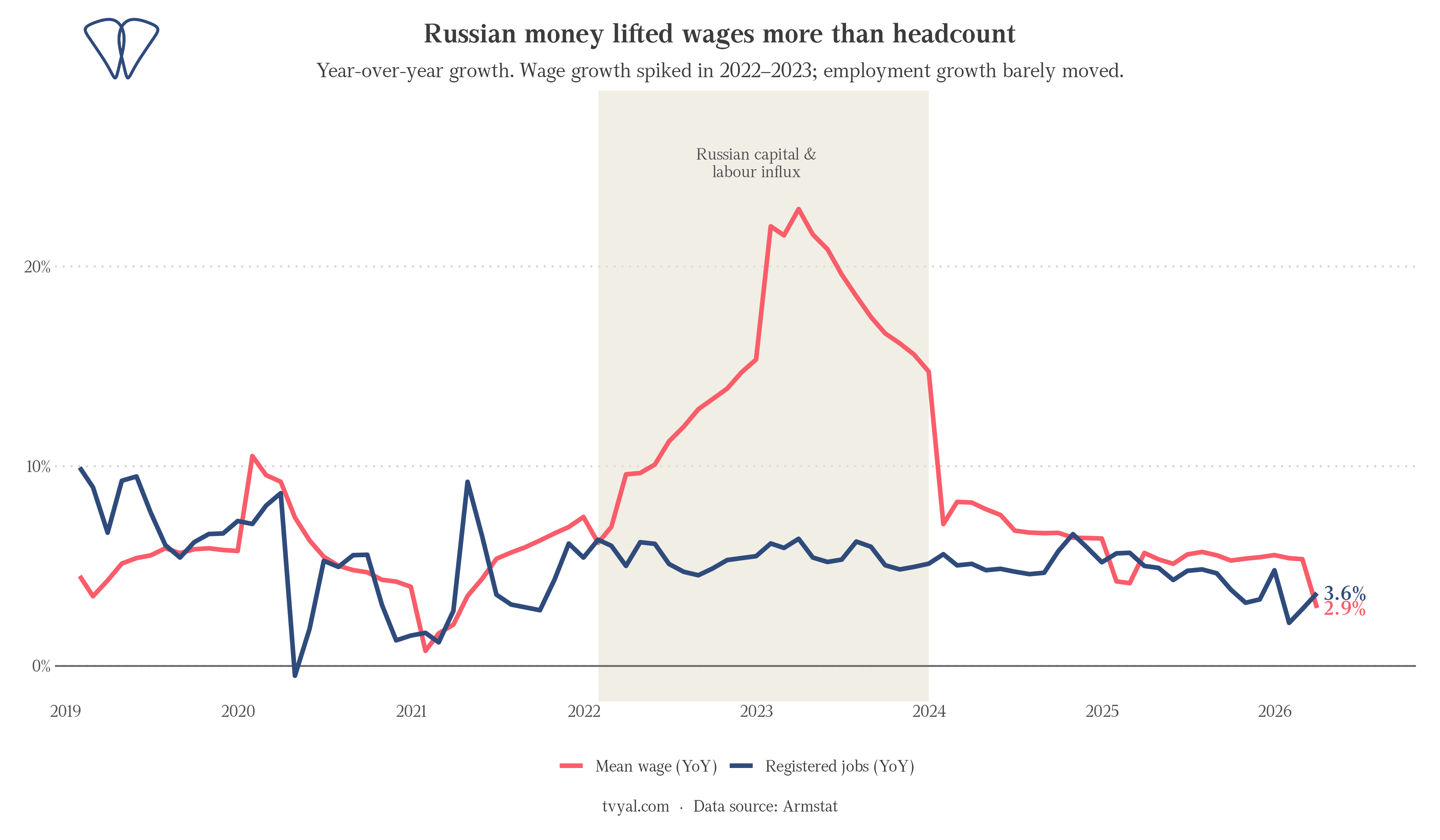
The Russian wave was not the only one. In 2022, there was the Russian-Ukrainian war; from 2023 to mid-2024, there was the re-export of gold from Russia. And the last wave, which was short-lived, was the wave from Iran, which also brought 7.2% economic growth in 2025. What these impulses have in common is that they were all born from the misfortunes of our neighbors and do not depend on us. The waves are receding, which is visible in the numbers: in mid-2026, the annual growth of wages is 3.6%, of employment 2.9%.
Especially in Yerevan, especially in the center
The address of new jobs is almost always the same. 79% of the net employment growth registered since 2018, about 192,000 employees, falls on Yerevan. More than 80% of the payroll fund is currently registered in Yerevan; in 2018 the figure was 72%. The growth has accumulated in IT, services and banking positions, which are concentrated especially in Yerevan and especially in the center.
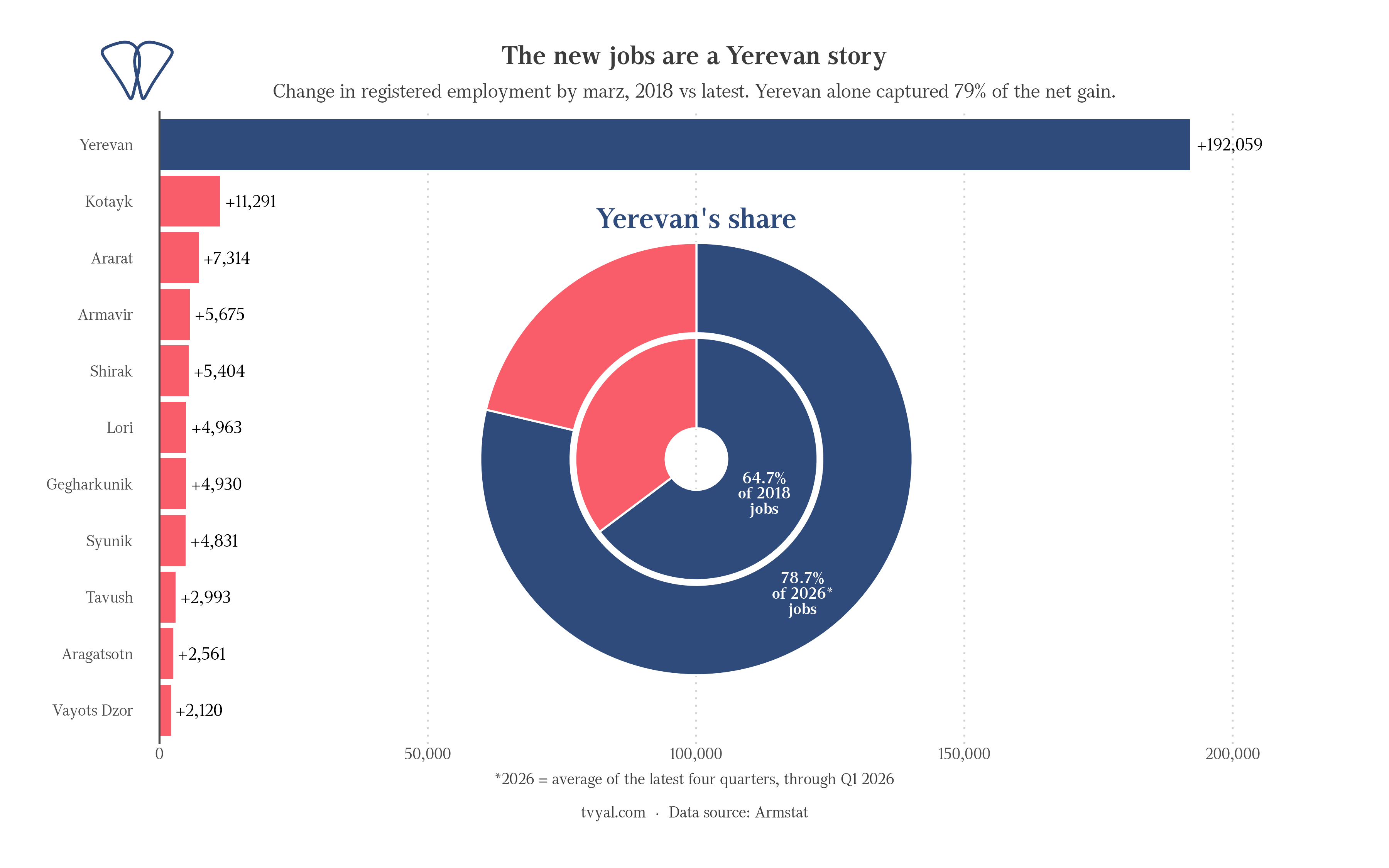
Meanwhile, private employment in Gegharkunik, Aragatsotn, Shirak, and Tavush remains low, and the state continues to be the main employer here. It is for these four regions that we have previously proposed targeted tax incentives to bring local businesses out of the shadows and stimulate private job creation.
Four out of every five new jobs created since 2018 have been in Yerevan.
People are the same, registration is new
Let’s go back to the worker. When he signed a contract, the statistics recorded a new job. But he is doing the same job at the same construction site. The only thing that has changed is that now he is visible to the state.
This reality became widespread after the “velvet revolution”, when businessmen, inspired by the revolution, began to register workers and leave the shadow economy. In fact, most of these people had been working before, they simply began to register. The second incentive was the flattening of the income tax. In 2020 the tax became a flat 23%, then it decreased by one percentage point annually, reaching 20% in 2023. With a simple and predictable rate, registering became cheaper than being in the shadows. Our analysis of 2024 also showed the opposite side: if the tax burden becomes heavier again, the same mechanism will work towards the growth of the shadow economy.
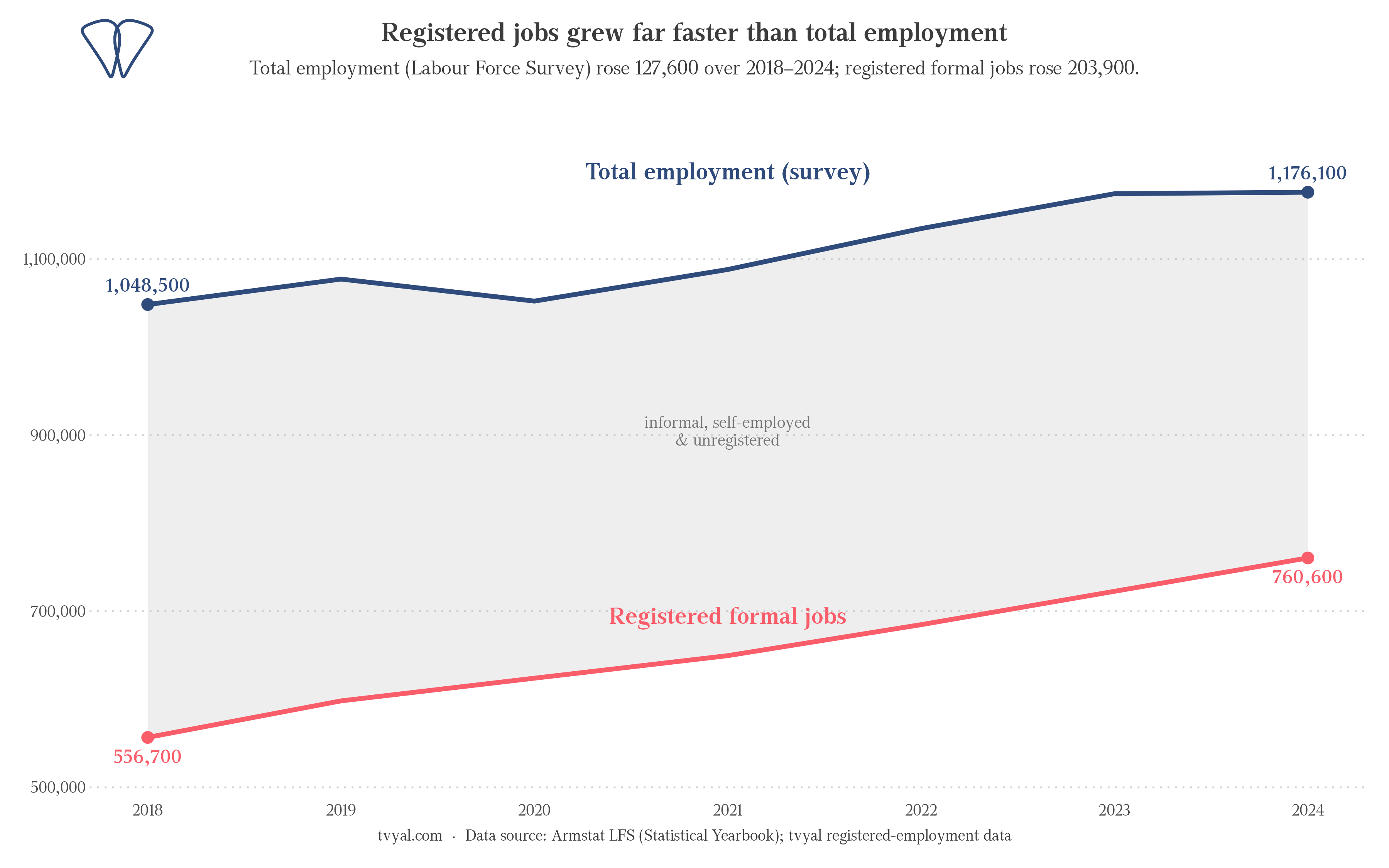
The Labor Force Survey data show the scale of the phenomenon. Between 2018 and 2024, total employment, which also includes unregistered and self-employed workers, increased by about 128,000. Registered jobs increased by more than 200,000 over the same period, and the share of registered employment rose from 53% to 65%. A significant part of the 300,000 is therefore not new jobs created, but the official registration of previously unregistered workers.
There is also a counting subtlety. According to Armstat’s methodology, the primary unit in this database is the employer, not the employee, and the count also includes people holding second jobs [4]. In other words, one person registered with three employers is three workers for the statistics.
We do not exclude that part of the recent growth is provided by workers from India, the Philippines and other countries, whom the statistics do not show as a separate group. The role of the public sector in this growth is modest: about 28% of registered employment is in the public sector, and the additional growth was almost entirely provided by the private sector.
Everyone benefits from registration: the worker receives social protection, the state receives tax revenues, the economy receives transparency. It’s just that no new jobs are created along with all this.
What remains when the waves recede?
All the growth engines were temporary, and their momentum is running out. Current data for 2026 shows annual growth of about 30,000 workers, compared to about 35,000 last year. This is simply inertial growth: the economy is still moving forward, but on its earlier momentum, not on new fuel. The demand for workers is still there, mainly in construction and related sectors, where our worker works.
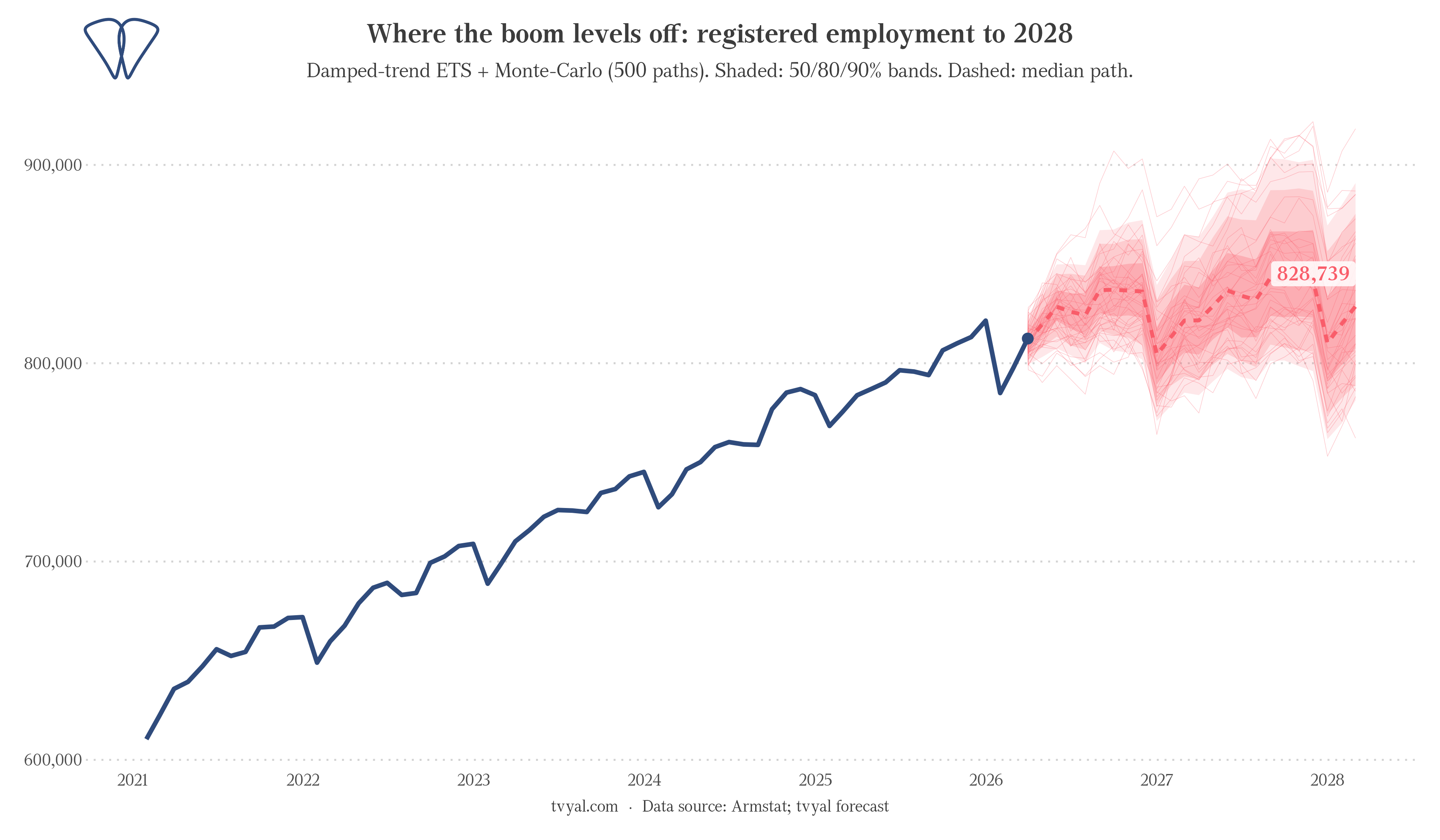
The damped-trend model, which we also use for real estate market forecasts, shows about 2% growth for the next two years, an average of about 8,000 registered jobs per year. For comparison, in the 2026 parliamentary election campaign political forces promised 25,000–60,000 new jobs per year. There is a three to sevenfold difference between promises and inertia, which is also shown by our forecast.
Which indicator to watch: The gap between wage and employment growth rates. As long as wages are growing faster than the number of employees, the impact of the 2022 capital inflows is still at work. When the two curves converge at a low level, the wave is over. The full series of both indicators, overall and by NACE sector, are updated monthly on tvyal.com/wages/trends, and you can check your own salary’s position in the overall distribution with our tvyal.com/wages calculator.
And the worker continues to work. Now he has a contract, social payments and a line in the statistics. Yesterday’s shadow worker appears in the numbers today, and that is real progress. It’s just not a new job.
For more details on the mechanisms for tightening tax administration and reducing the shadow economy, see Armenia Taxes Time. For the high concentration of the capital (80%) and the proposed tax mechanisms for the four underdeveloped regions, see 80% of Armenia’s Wages are in Yerevan.
* The source of data on registered employment is the monthly and quarterly labor statistics of the Statistical Committee of the Republic of Armenia (registered sector, NACE sections A–S). Regional data are quarterly, including the first quarter of 2026. Total employment indicators, which also include unregistered and self-employed workers, are taken from the Labor Force Survey published in the Statistical Yearbooks. A damped-trend exponential-smoothing model was used to forecast employment, using Monte-Carlo simulation for 500 scenarios. The database and the code for the charts are available on the GitHub platform.
References
[1] Labor market: average monthly nominal wage and number of employees // Statistical Committee of the Republic of Armenia — armstat.am
[2] Labor Force Survey, Statistical Yearbook of Armenia // Statistical Committee of the Republic of Armenia — armstat.am
[3] The real and shadow sides of job growth: an economist analyzed the factors // Sputnik Armenia — arm.sputniknews.ru
[4] Remuneration of work and number of employees, methodological clarifications // Statistical Committee of the Republic of Armenia — armstat.am