Crisis before the border closed: what's behind Armenia's 11.9% agricultural decline?
A summary of macroeconomic data for the first half of the year shows that the agricultural sector recorded the lowest performance in the last 10 years. In the first half of 2026, the volume of gross agricultural output decreased by 11.9% compared to the same period last year. All other main sectors of the economy grew: construction by almost 25%, industry and services by more than 10% each, and the trade sector also kept a positive trend. Agriculture is the only sector that recorded a decline, and this is the deepest decline in the first half of the year since 2015.
In public and media coverage, the decline is mainly attributed to one factor: the ban imposed by the Russian Federation on Armenian agricultural products, as a result of which the northern border was closed to the export of Armenian fruit and vegetables in late May and June. The restrictions are real and have a tangible negative impact. However, the analysis of the data makes it clear that the decline cannot be explained by this ban alone. As of the end of March, before the actual application of border restrictions, the volume of agricultural production had already decreased by 16.6%. In essence, the crisis in the agricultural sector had started much earlier than the border closure.
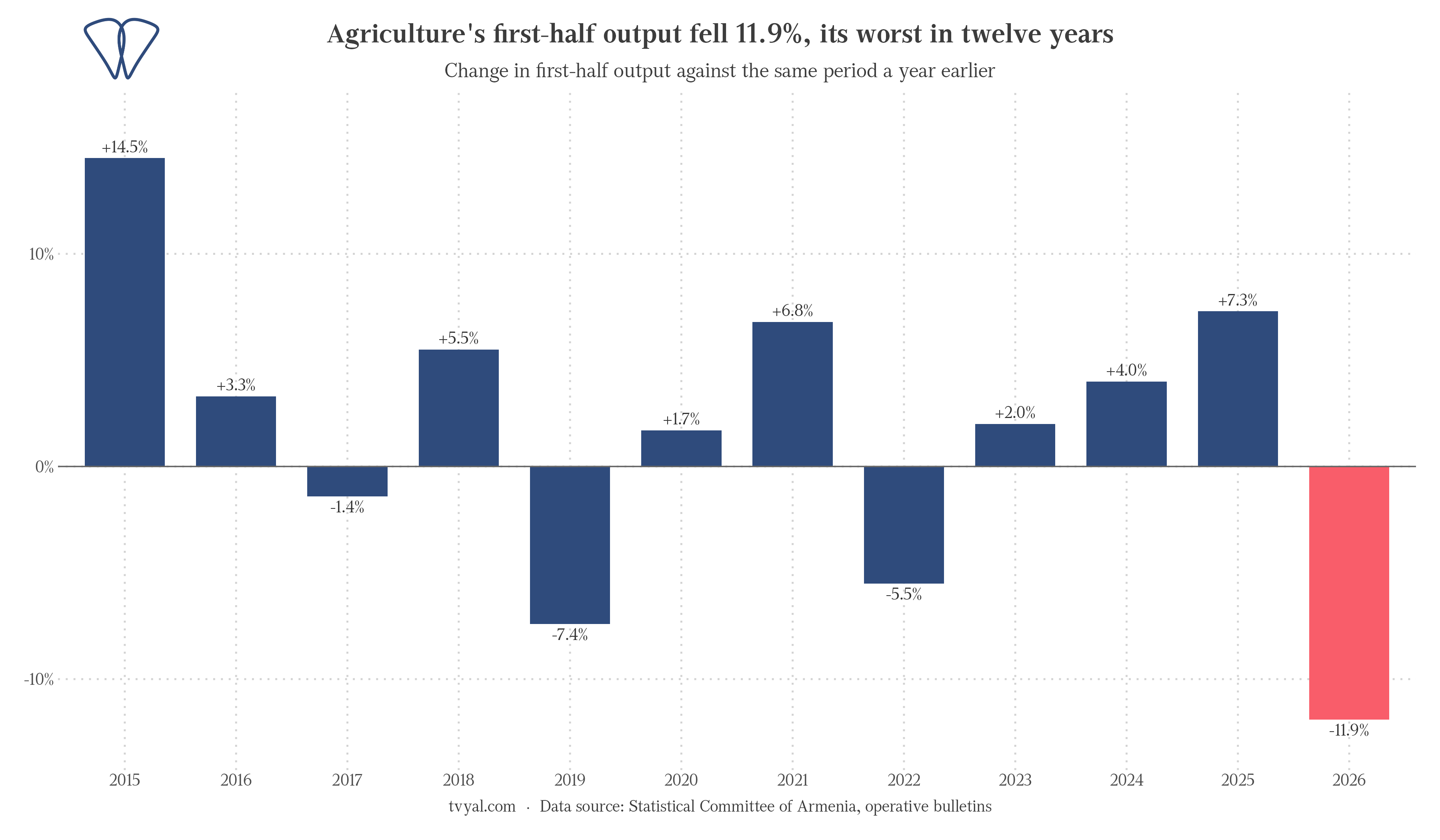
This is not a newly emerging economic problem. It is the logical consequence of the continuous decline of agriculture, which has reached a critical point that can no longer be ignored.
The only sector of the economy that has experienced a decline
A comparative analysis of the main sectors of the economy shows that agricultural indicators stand out sharply from the overall macroeconomic picture.
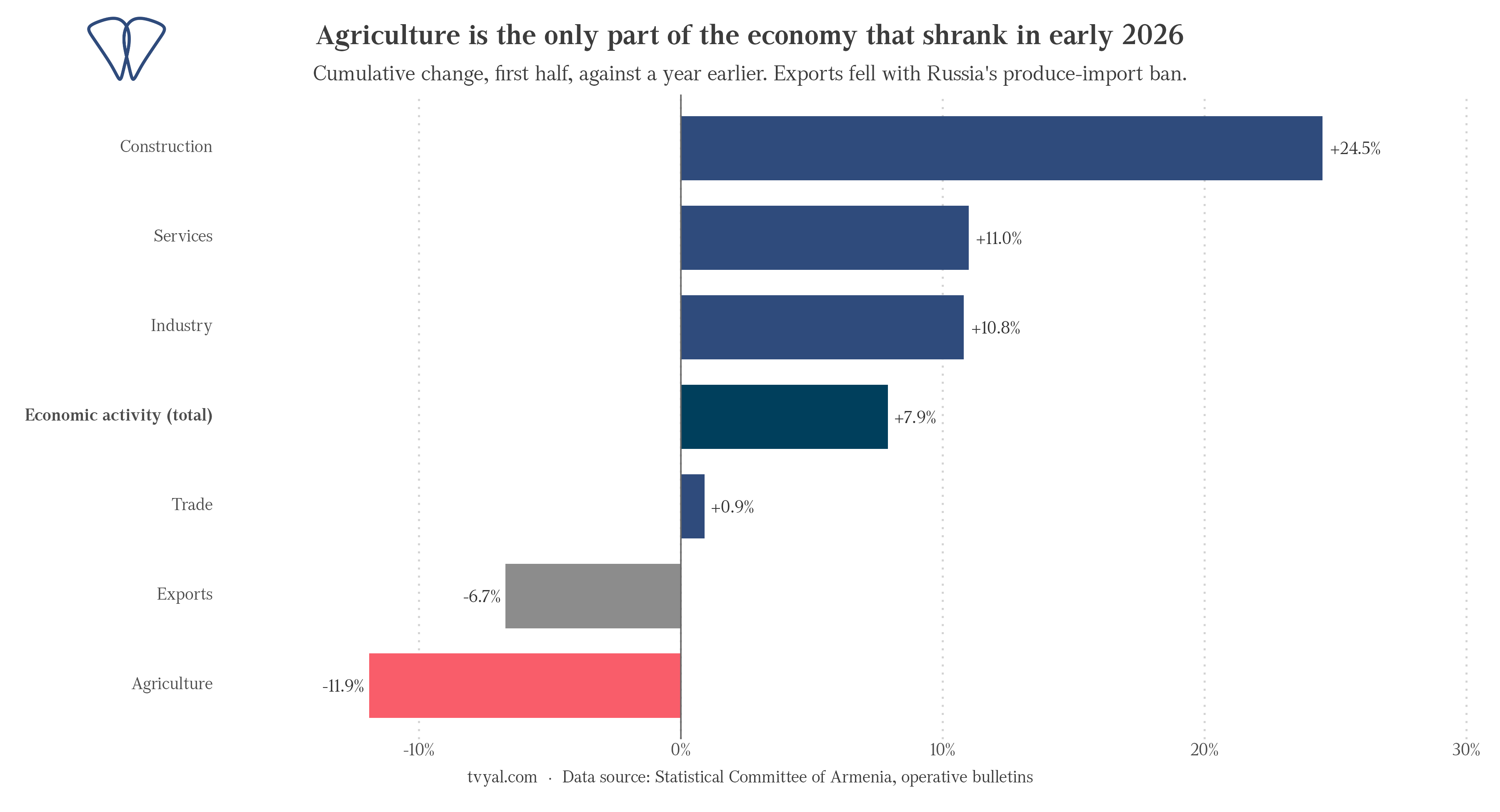
In the first half of the year, the economy as a whole grew by 7.9%. Construction, industry and services grew significantly, while the trade sector held a positive trend. Only two macroeconomic indicators recorded a decrease. The first is exports, which decreased by 6.7%. This is where the impact of the Russian ban is reflected in the overall data. The second is the agricultural sector.
In this context, one significant circumstance is important. The problem is not the slower growth of agriculture compared to other sectors of the economy, but the 11.9% decline in real volumes. Even calculated at current prices (including in the context of a general increase in prices), the volume of semi-annual output continues to lag behind the previous year’s level. The sector of the economy that experiences a nominal decrease under inflation is not in a passive phase, but is undergoing a systemic reduction.
A decline that began before restrictions
Therefore, what is the reason for this 11.9% decline, if not the export ban imposed by Russia?
The main part of the decline had formed before the border was closed. The restrictions were applied by Russia in stages during the second half of spring: first, in late May, the export of cut flowers was banned, then tomatoes, peppers and strawberries, and already on June 11, a comprehensive ban was imposed on almost all perishable agricultural products [1]. At that time, the data for the first quarter had already been summarized, according to which the volume of agricultural production had decreased by 16.6% year-on-year. In the winter and early spring, before the Russian side imposed restrictions, the negative dynamics of the sector had already been outlined. In fact, the ban accelerated the decline that was already underway.
We addressed the deep reasons for the decline in production volumes back in May. The competitiveness of the agricultural sector has been declining for years compared to cheaper imported goods. The appreciation of the dram also played a role, leading to an increase in the price of local products in both domestic and foreign markets. There is also a logistical dependence on the supply of fertilizers (mainly from the Russian route). We should also note that in 2019, the optimization of the Ministry of Agriculture and the transfer of its functions to the Ministry of Economy also meant that, since 2019, agriculture has not been reflected in the economic activity index on a monthly basis, unlike its other 4 components. These problems were compounded by an unfavorable harvest, which was the reason for the winter indicators. The ban did not cause the downturn, but closed the only market that was still capable of consuming the sector’s products, and at the very time when the perishable summer harvest was ready for export. Meanwhile, the World Bank warned in July that prolonged restrictions would have a severe negative impact on economic growth, price stability, and rural incomes [3].
Not a single year, but a systemic decline
Is the reported decrease simply the result of an unfavorable agricultural season that will likely recover next year? Long-term statistical data shows the opposite.
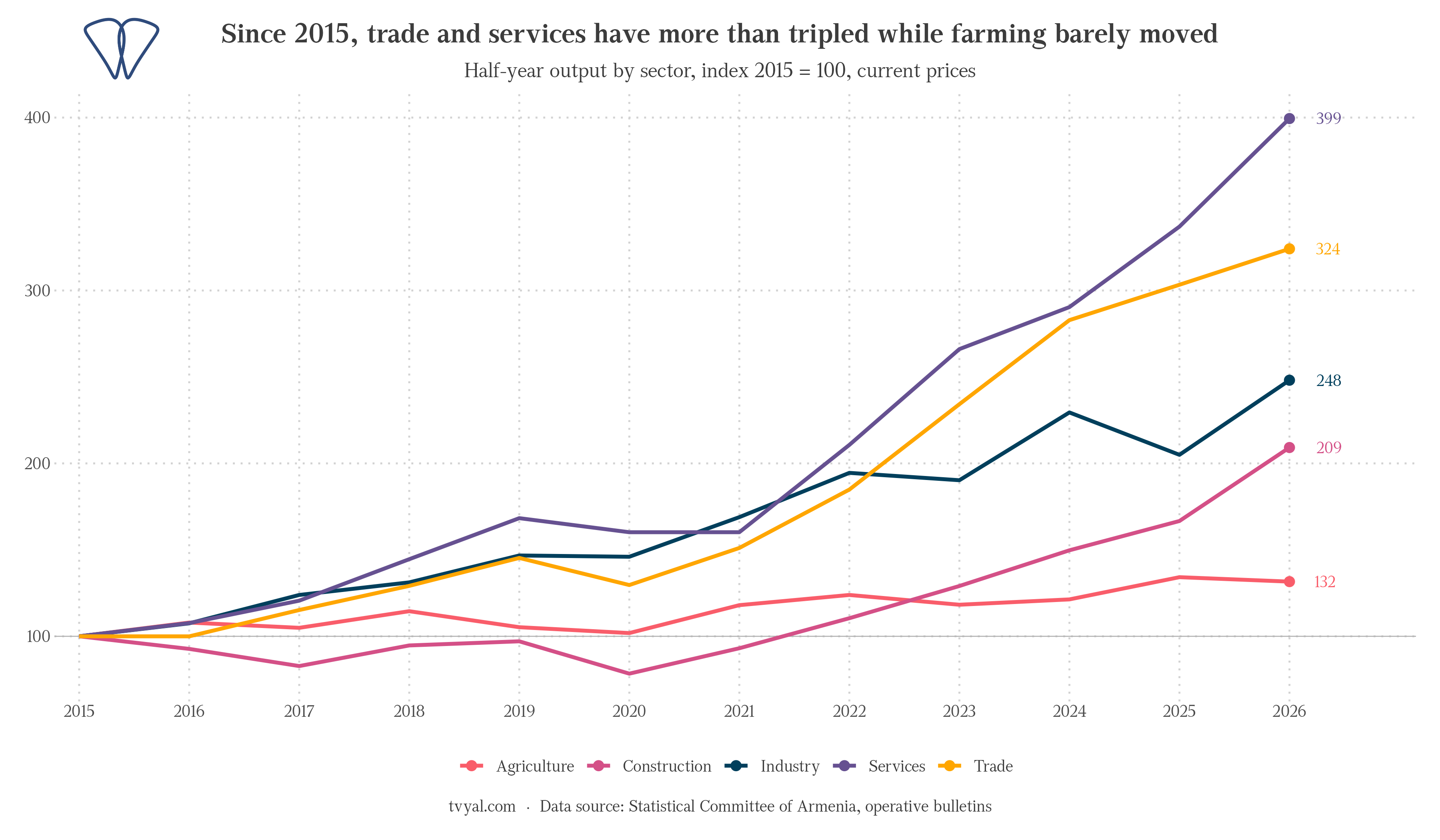
If we take the data for the first half of each year since 2015 as a starting point, it becomes clear that the volumes of trade and services have increased more than three times compared to 2015. The indicators of industry and construction also significantly exceed the starting level. The indicator of agriculture has remained almost unchanged. Part of this difference is due to price, and not volume factors (since the calculation was carried out at current prices), but the overall dynamics are clear: for a decade, other sectors of the economy have developed, while agriculture has been in a phase of de facto stagnation.
The System of National Accounts data show that the problem is not limited to purely price effects. Between 2018 and the end of 2025, agriculture was the only sector of GDP to experience a cumulative contraction of around 13% in real terms, while the economy as a whole grew by more than 50%. Over the same period, the financial sector and information technology each more than tripled in size. These are sectors of the economy largely concentrated in Yerevan. Agriculture, in turn, is the backbone of the regional economy. Consequently, the gap between these sectors also reflects the territorial disparity: the capital and its service sectors are developing rapidly, while the regions that provide the country’s food base are regressing. The 11.9% decline this year, coupled with the Russian bans, is still the lowest point on an already downward trend.
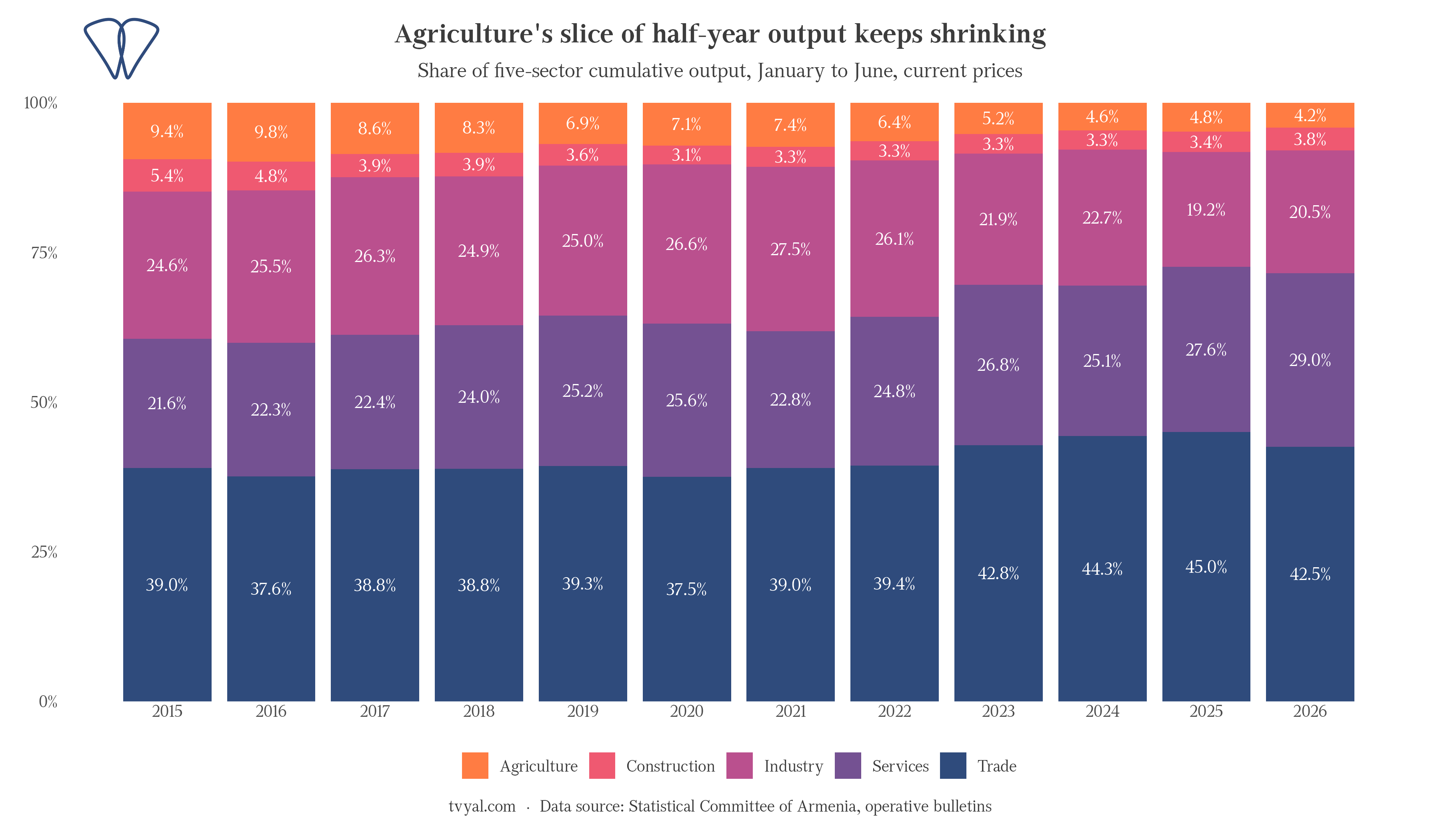
This decline is also reflected in the reduction of the sector’s share. In 2015, the share of agriculture in the gross semi-annual output of the five main sectors exceeded 9%. This year, it has approached the 4% mark. The results of 2026 did not initiate this process, but continued the negative dynamics that have existed for years.
A ban could lead to a border closure within a week. But the crisis underlying these figures has been building for a decade, and one successful agricultural season is not enough to overcome it.
Sector that is outside operational control
The absence of agriculture in the monthly statistics presented above is not accidental. Since 2019, the sector has no longer been included in the monthly publications of the Economic Activity Index (EAI). It is reflected exclusively in the cumulative, quarterly database. On a monthly basis, when the macroeconomic environment is assessed in almost real time, four main sectors are considered, while agriculture is simply ignored.
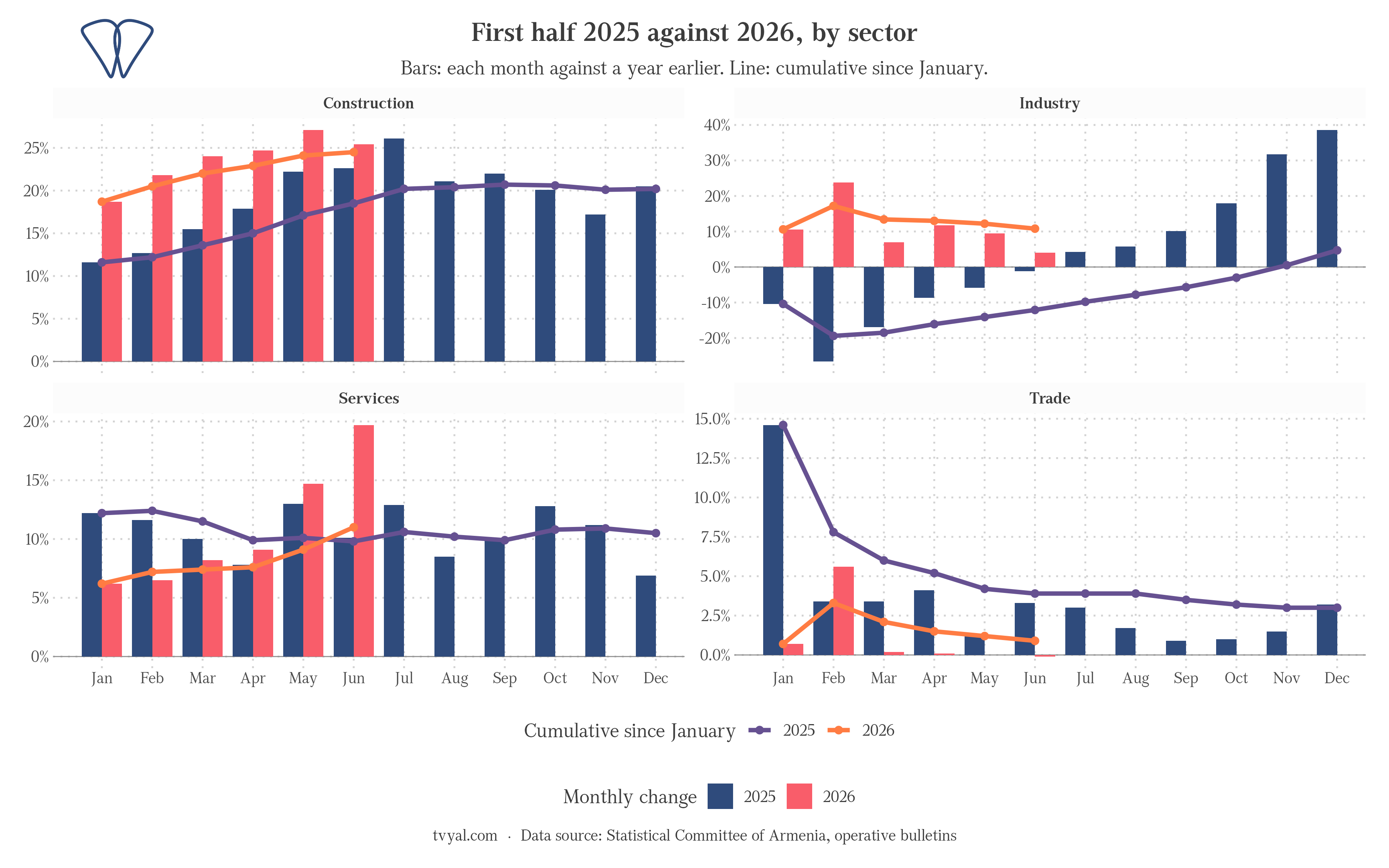
This absence itself is evidence of institutional problems. In the same year, when the Ministry of Agriculture was dissolved, the sector was also excluded from the list of key indicators that the Government monitors on a monthly basis. When any sector of the economy stops being assessed in real time, it signals that responding to it quickly has become less of a priority. While the decline in the sector continued during the winter months, the absence of monthly data in the operational control system did not allow for the formation of early warning signals. At the time of the publication of semi-annual data, the decline had already reached 11.9%.
Economic indicator that directly affects border communities
The strategic importance of this indicator significantly exceeds its purely numerical value. Agricultural activity is not evenly distributed across the country. It is the economic backbone of the regions and, above all, border communities, while economic growth in the last decade has been concentrated in the capital. When agriculture ceases to be profitable, households involved in the sector face difficult alternative decisions, as a result of which many resort to emigration or internal migration.
The consequences of this pressure are already evident this summer. With the Russian market closed and no European buyers able to replace it, cut flowers are being sold within Armenia at a fraction of last year’s price. Fish exports have been halted for all Armenian producers [5], and according to the Fish Farmers’ Union, businesses are left with about 15,000 tons of unsold produce, leading to protests in front of the government building in Yerevan. Dependence on foreign markets is almost absolute. Last year, the entire volume of tomatoes and fresh fish exported, 98% of peppers, 93% of cut flowers, and 90% of apricots and cherries, went to Russia, while exports to other markets were almost nonexistent. For households engaged in the production of these crops, the current season’s income has effectively been reduced to zero.
The list of restrictions continues to expand. In late July, Russia also imposed a ban on the import of dairy products [4]. This product group has a small share in the export structure, providing about twenty million dollars annually or only 0.25% of the total export volume. It is difficult to justify the application of a ban on such volumes on food safety grounds. On July 27, the Government of Armenia initiated a telephone conversation with the President of Russia to discuss the issue of trade restrictions [6]. Such a step at the highest state level indicates that the problem is viewed as systemic and not secondary.
In this context, macroeconomic indicators become a strategic and security factor. The state, whose priority is to ensure border security, cannot ignore the loss of jobs and sources of income in border settlements, since those are what keep the population in these areas. When economic activity in border communities decreases, the population moves to the capital, and the regions empty out. The 11.9% decline is not a purely statistical indicator for the economy; in the case of border regions, it turns into a serious demographic challenge.
The unsold batch of apricots is not just a failed commercial transaction. In economic terms, it means that a household in a border village will face a choice this winter: keep cultivating the land or move to Yerevan.
Other related analyses: Export Growth and Agricultural Decline on structural issues, A Crop Without a Market on the Russian ban, and Economic Growth Slowing on hidden risks to economic growth indicators.
* Data on the output of economic sectors are based on the monthly and cumulative operational bulletins of the Statistical Committee of Armenia (economic activity indicator). The source of semi-annual data on agriculture and crop production is the same. The shares of individual products in the volume of exports to Russia were calculated according to the 2025 statistics of the Statistical Committee and the UN Comtrade database. The calculations and the source code of the charts are available on the GitHub platform.
References
[1] Russia issues sweeping ban on Armenian imports after Pashinyan’s victory // The Moscow Times — themoscowtimes.com
[2] Russian restrictions could lead to a 2% decline in Armenia’s economy, warns Central Bank // CivilNet — civilnet.am
[3] Armenia Economic Situation Report // World Bank — worldbank.org
[4] Russia’s Rosselkhoznadzor restricts imports of dairy products from Armenia // Armenpress — armenpress.am
[5] Fish supplies from Armenia to Russia have been completely suspended // Caucasus Knot — eng.kavkaz-uzel.eu
[6] Pashinyan raises trade restrictions in phone call with Putin // Public Radio of Armenia — armradio.am