The Guests Left, the Costs Stayed: Armenia's $2.5 Billion External Gap
Four years ago, Armenia’s economy was close to self-sufficient balance, with a deficit of only $86 million. In 2025, the deficit amounted to $2.55 billion. Although this was not officially announced, and while the gap widened, the main indicators of economic growth continued to remain positive, a simple calculation nevertheless shows that in 2025 it reached 8.7% of GDP, and according to the latest data for the first quarter of 2026, it was 8.4%. For comparison, this indicator was 0.4% in 2022.
This is the main indicator that Fitch Ratings Agency points to when assessing the risks related to Armenia’s rating [1]. At the same time, it is one of the few among the main macroeconomic indicators whose importance is rarely understood outside professional circles. Essentially, the mechanism underlying it is logically similar to the management of an ordinary household.
The economic content of the current account
The state can be viewed as a household, which can be assessed by the structure of its income and expenditure.
The economy imports goods from the foreign market: food, energy, and equipment. This component, the goods account, is always negative in Armenia, as import volumes exceed export indicators. This trend is normal for small economies.
However, other income streams are also generated in the economy. These include income from tourism and exports of services, as well as remittances from workers abroad. In parallel, there are also outflows: interest payments on previously provided loans or debt, and profits from foreign investments that are taken out of the country.
The sum of all these components forms the current account, which reflects the economy’s ability to generate sufficient funds to cover its own expenses throughout the year. A negative result indicates that the deficit has been financed by external sources, which increases the country’s external debt and liabilities.
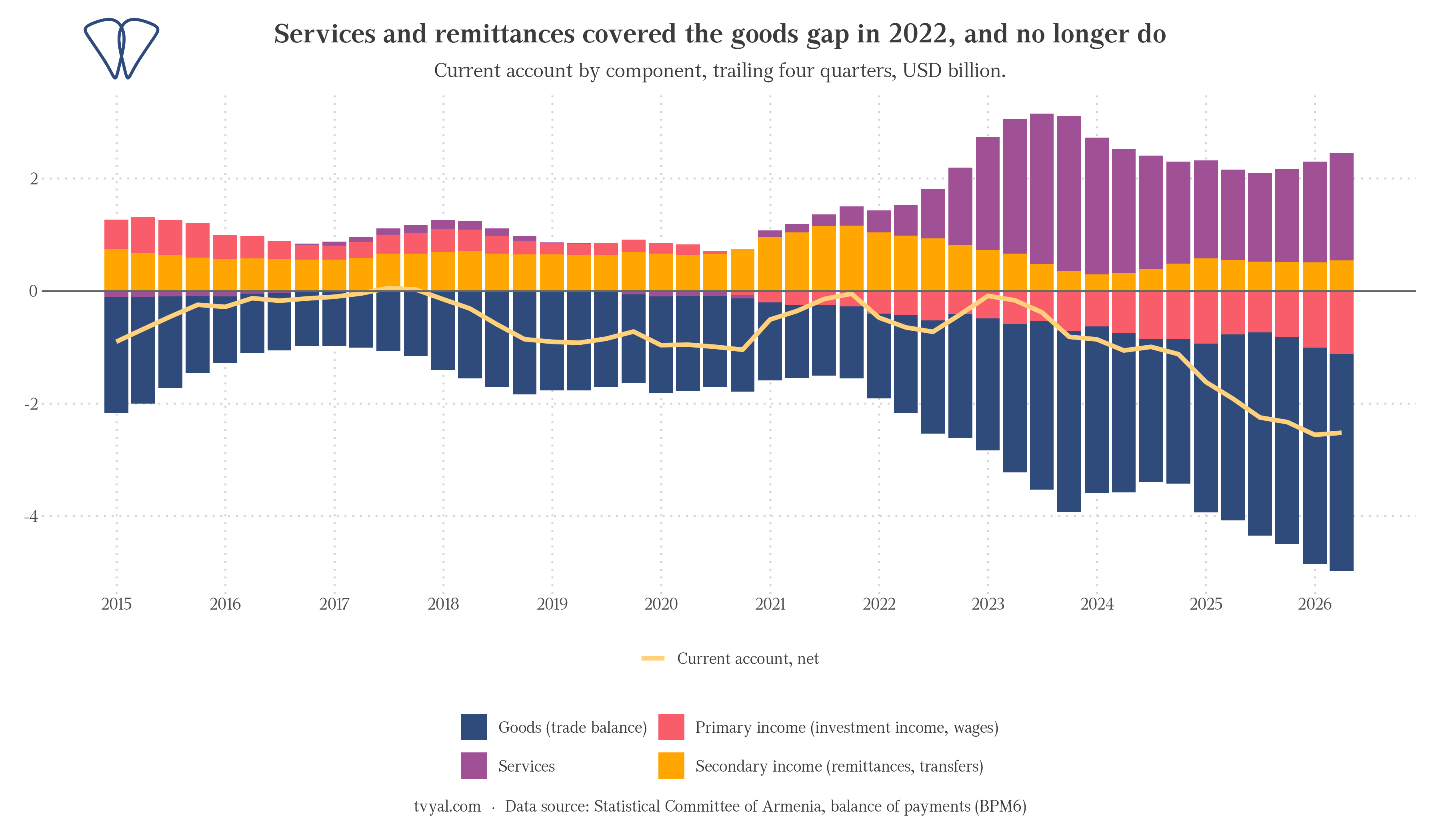
2022 saw unprecedented positive performance. The services surplus reached $2.0 billion, driven by tourism flows and services exports, compared to a small deficit three years ago. Transfers increased by another $733 million. Together, these two sources covered a $2.34 billion deficit in goods, resulting in a balanced current account for the first time in a decade.
At the time, this phenomenon was widely interpreted as a new economic model. In fact, it was largely the result of the influx of capital and human resources resulting from the start of the Russo-Ukrainian war.
Directions of the $2.5 billion deficit
By 2025, non-resident flows had largely declined, while import volumes continued to grow.
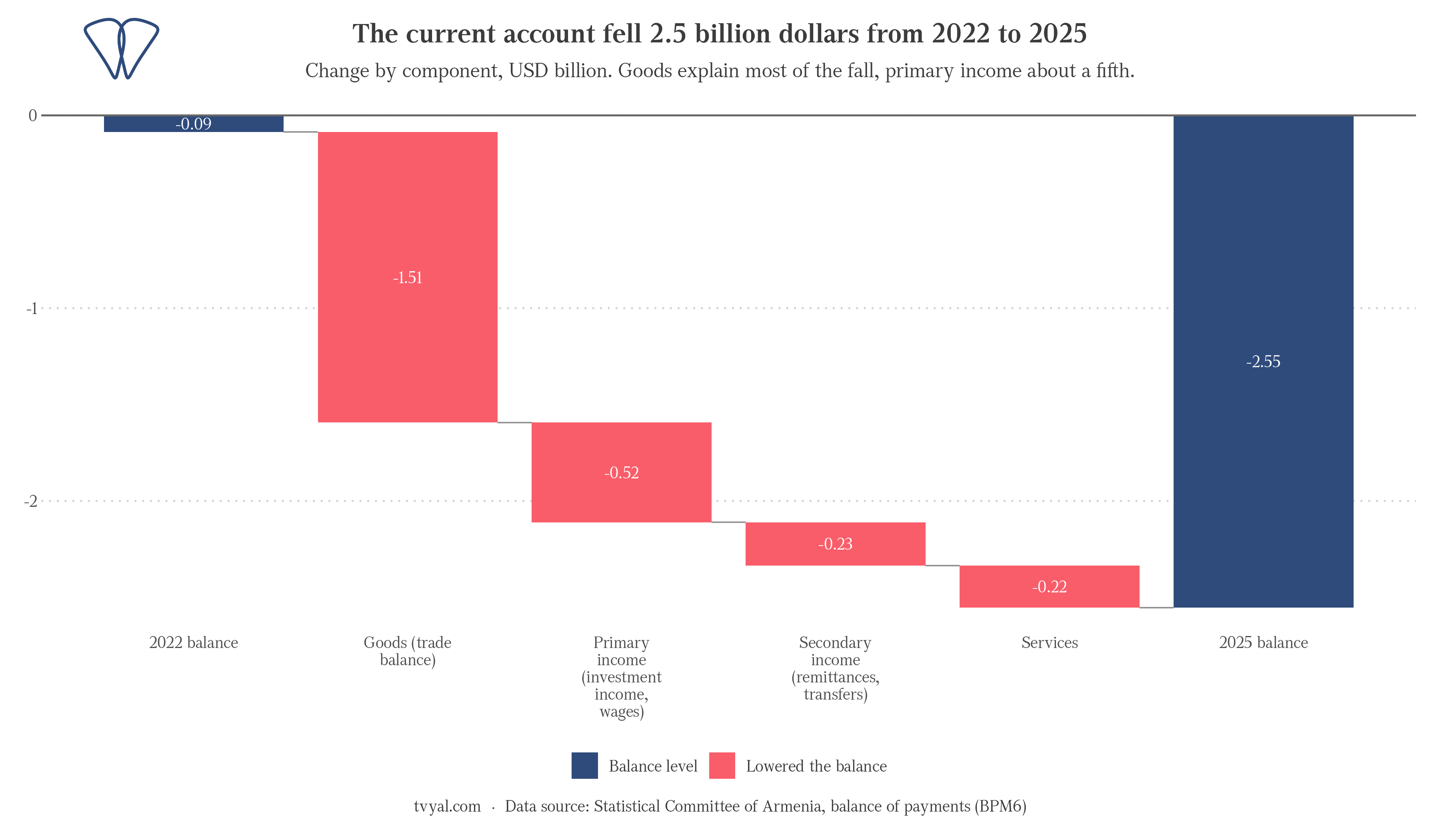
The goods deficit increased by $1.51 billion, accounting for about 61% of the overall deterioration, and is the main indicator reflected in publications. However, the second largest component, the primary income account, is overlooked, accounting for $0.52 billion of the decline.
Primary income reflects the outflow from servicing previously attracted loans and investments: interest payments on loans, profits of foreign companies and dividends. This indicator was positive in 2019, but since 2020 it has been consistently negative, and in 2025 the resulting outflow exceeded one billion dollars. This component is subject to inertial growth: even in the event of stabilization of the foreign trade balance, it will continue to deteriorate, since it represents the costs of servicing already accumulated liabilities.
The decline in services and remittances led to the remaining $0.45 billion gap. In fact, income from tourists and workers abroad has decreased significantly compared to 2022.
Sources of funding for the gap
An economy whose spending exceeds its income is forced to finance the difference. There are two options here: either foreign investors acquire assets in the local economy, or the economy borrows. In the latter case, external public debt increases.
This difference is fundamental. Investors share economic risks, while lenders require fixed payments on a set schedule, regardless of the macroeconomic situation.
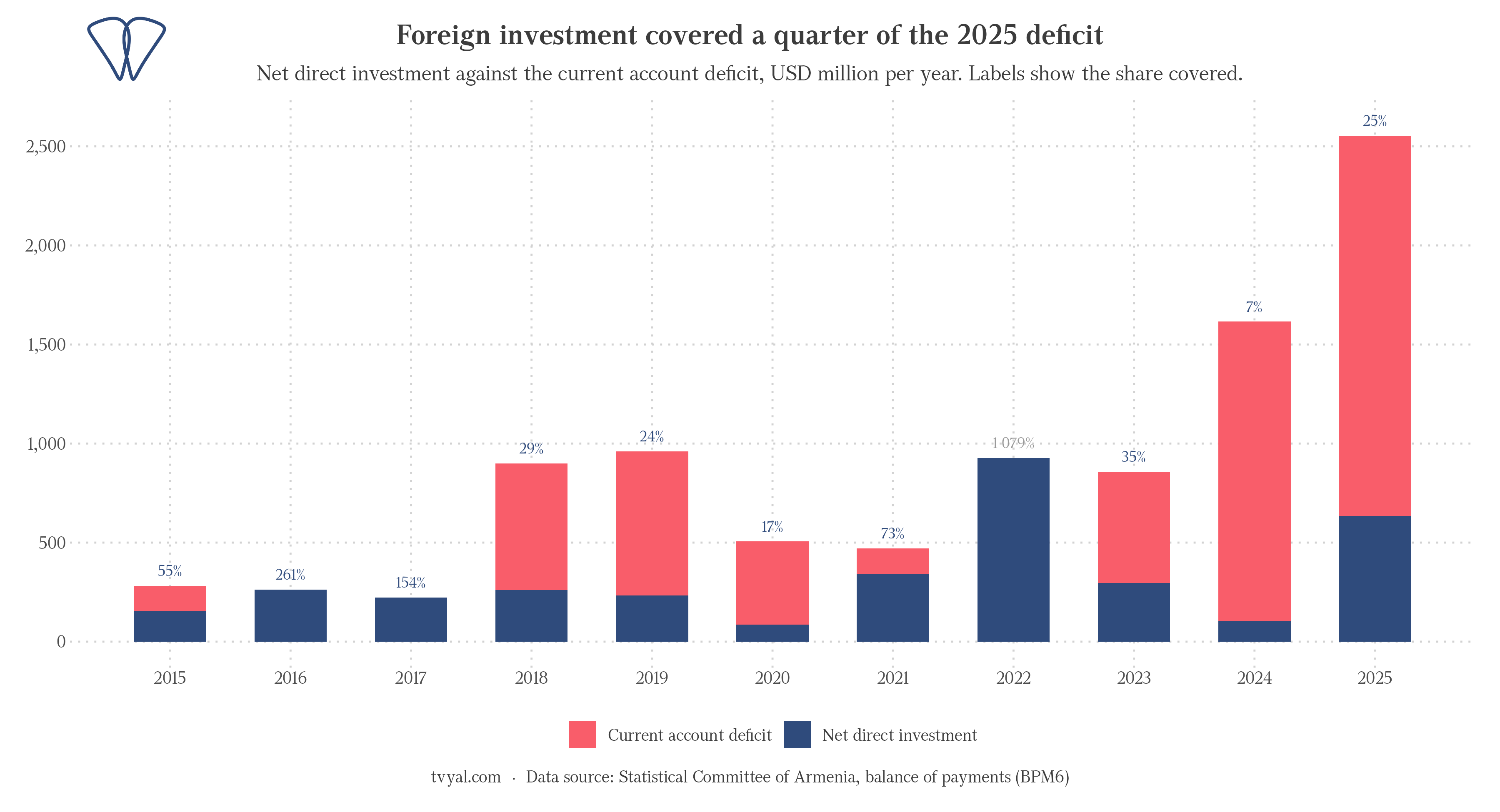
Last year, foreign direct investment (FDI) covered about a quarter of the deficit. For comparison, in 2024 this figure was 7%. The entire remaining volume was financed by loans, deposits and bond issuance, as well as the growth of total public debt. This is precisely what is causing the continuous deterioration of the primary income account: each year of lending increases the burden of debt service for the next year.
The picture is completed by another indicator: in 2025, international reserves increased by about $1.26 billion. Although the record level of reserves is a positive factor, it was also financed by a $2.55 billion increase in the current account deficit. In fact, Armenia experienced an increase in reserves due to the attraction of new debt.
The positive balance in 2022 was due to external inflows. Currently, these flows are stopping, while financial liabilities continue.
Continuous review of indicators after publication
Our program automatically downloads and analyzes balance of payments publications every quarter. Previous publications have shown significant revisions. The Statistical Committee publishes quarterly data, which are subsequently revised as more complete information becomes available. Although this is an internationally accepted practice, it is noteworthy that the revisions are in one direction.
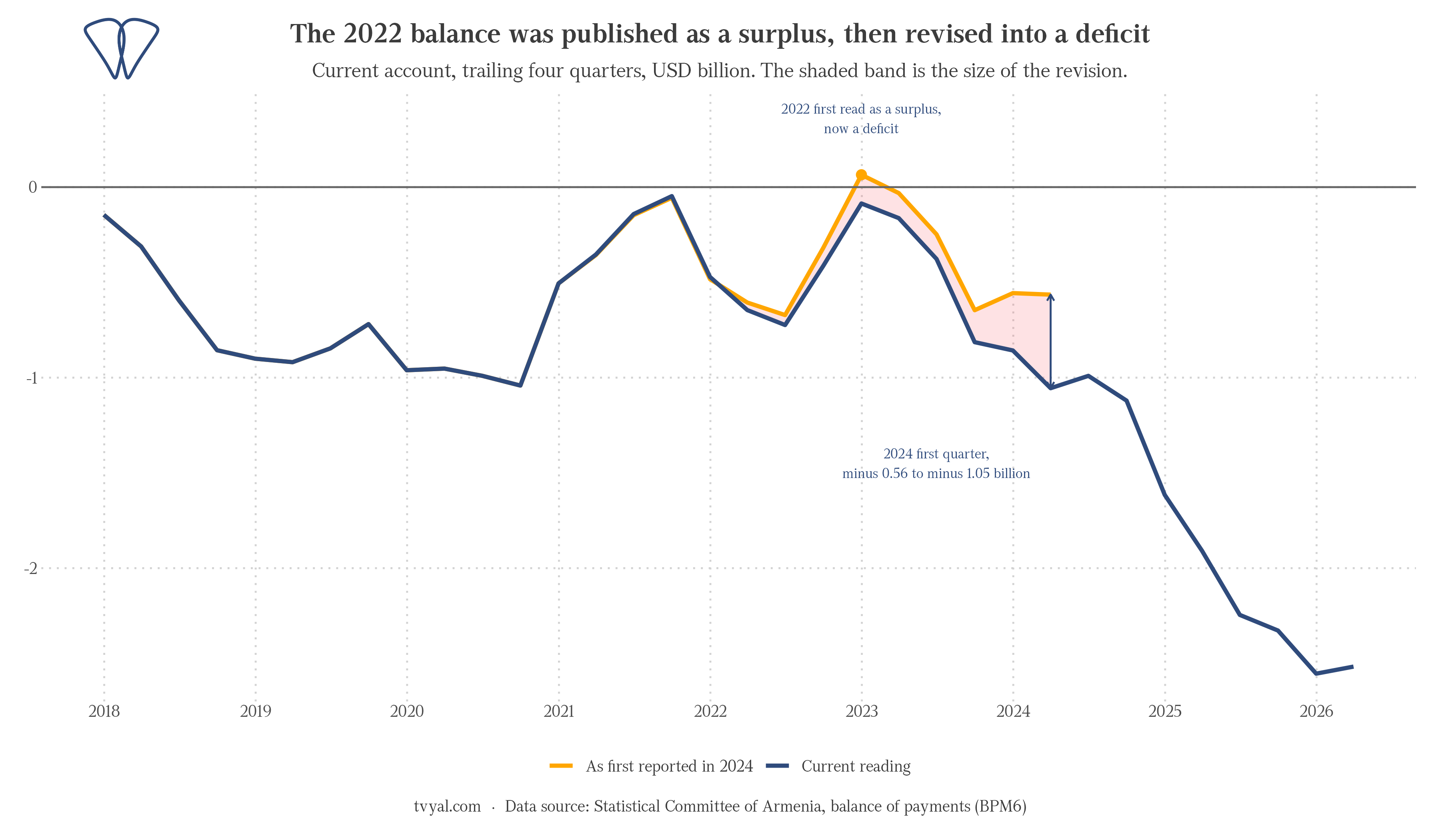
Of the ten published quarters, eight were revised downwards, and only two were revised upwards. The total adjustment for the period from early 2023 to mid-2025 was $946 million, which emerged fully retrospectively. In particular, the originally reported surplus of $202 million for the fourth quarter of 2023 has now been revised to a deficit of $138 million.
The most prominent example is the 2022 statistics. In 2024, a preliminary analysis of these data showed a small surplus, which was widely circulated. However, it is now officially recorded as a deficit.
Essentially, the $2.55 billion deficit presented for 2025 is merely a preliminary estimate. Based on the statistical logic of the last three years, there is a high probability that this figure will worsen as a result of further revisions.
Prospects and possible consequences
In itself, a current account deficit does not necessarily entail risks. Countries with developing infrastructure can operate in deficit conditions for years, which was also typical of Armenia in the previous decade. However, risks emerge when three preconditions are present, all of which are currently present in our economy.
First, borrowed funds are directed mainly to consumption and construction, rather than to the exportable sector that generates foreign exchange. Second, the continued increase in primary income outflows indicates an increase in the debt service burden. Third, these risks are already being pointed out by international partners, which is reflected in the current account warnings issued by rating agencies.
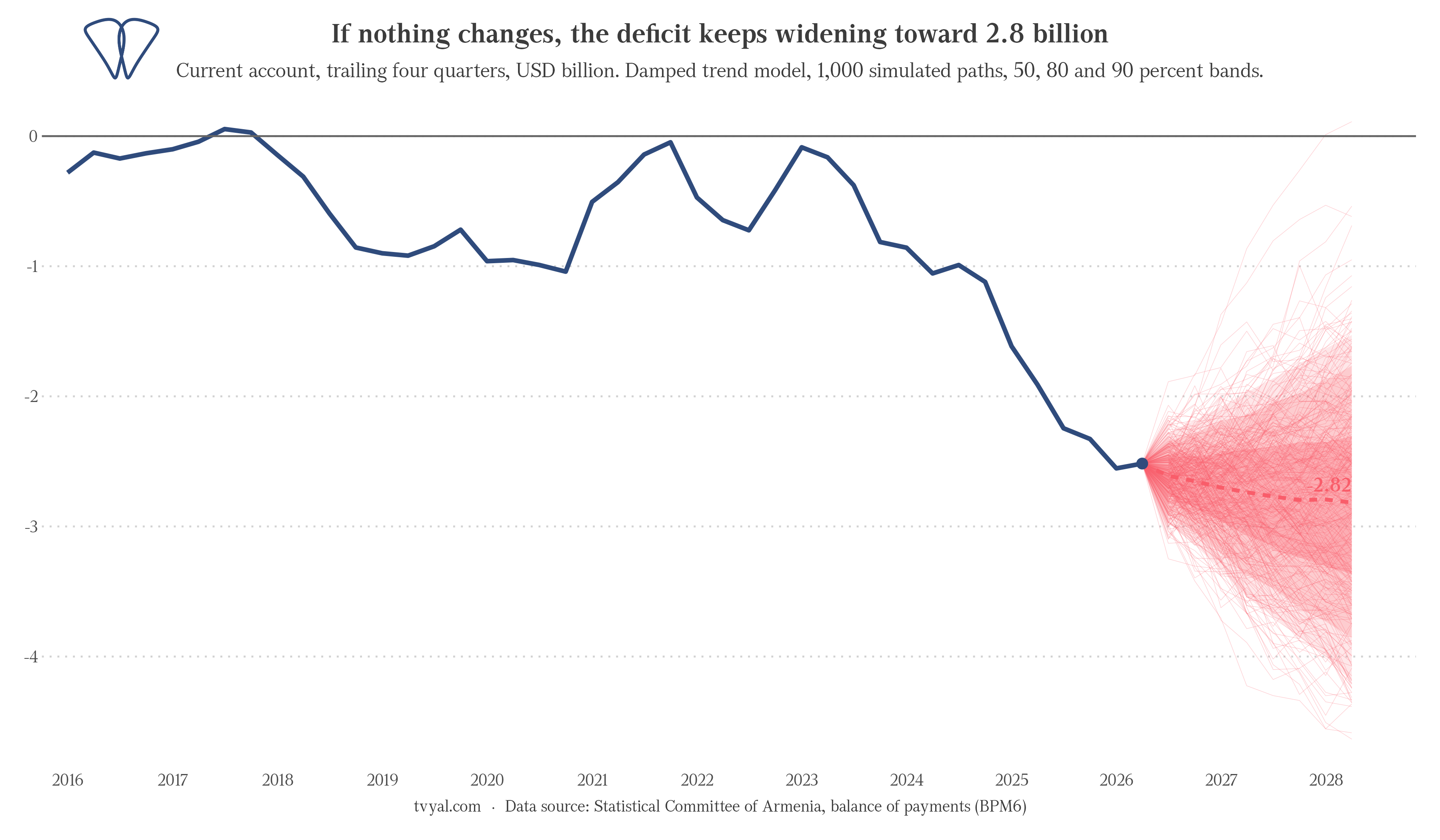
In the absence of appropriate policies or changes in the external environment, mathematical models predict that the deficit will increase to $2.8 billion by early 2028. Although the model assumes a slowdown in the pace of deterioration, the result is the same. Without structural reforms, this gap cannot be overcome automatically.
Key indicator to watch. It is necessary to monitor the share of the deficit financed by net foreign direct investment. In 2024, it was 7%, and in 2025, it was 25%. An increase in this indicator would indicate that the gap is being financed by investors who acquire real assets in the economy and share the risks. Otherwise, the main source of financing will continue to be the growth of public debt, which will further increase macroeconomic vulnerability in the following years.
Previously, the deficit was covered by external short-term inflows, while current creditors require timely fulfillment of financial obligations.
For more information on the economic growth model, see: The Growth Wave Stalled and The Iranian Wave. For export prospects to close the goods gap, see: Crisis Before the Border Closed and One Ruble, Three Prices.
* Data: Balance of Payments of the Republic of Armenia, in BPM6 format, published quarterly by the Statistical Committee. Annual indicators represent the sum of four quarters. The charts use four quarterly moving sums, which eliminates the seasonality of quarterly data. The ratio to GDP was obtained as a result of the author’s calculation. The quarterly nominal GDP in drams of the national accounts was converted at the average exchange rate set by the Central Bank for the given quarter. The analysis of revisions is based on eight archived publications of the balance of payments for the period from the third quarter of 2023 to the first quarter of 2026. The database and the source code of the charts are available on the GitHub platform.
References
[1] Fitch Ratings reaffirms Armenia’s rating at “BB-” with a “positive” outlook, July 13, 2026 // ArmBanks — armbanks.am
[2] Balance of Payments of the Republic of Armenia // Statistical Committee of the Republic of Armenia — armstat.am
[3] Balance of Payments and International Investment Position Manual, Sixth Edition (BPM6) // International Monetary Fund — imf.org