The Unchanged Minimum Threshold: The Real Cost of Raising the Minimum Wage
On August 14, a question was raised in the National Assembly of the Republic of Armenia, the answer to which has been expected for three and a half years. The government’s 2021-2026 program planned to increase the minimum wage to 85,000 drams by 2026. At the moment, however, the minimum wage is 75,000 drams, remaining unchanged since January 2023. The parliamentary majority confirmed that there was a “deviation from the pre-election program” regarding the target indicator. The MP’s question regarding the deadlines remained unanswered, and the financial cost of the salary increase was not clarified during the discussion [4].
We have carried out these calculations. They were already published 2 months ago. The data presented below is based on a study published in the journal “Economics, Finance and Accounting” [1], which examined the distribution of salaries of 784,964 people with registered employment contracts in Armenia. The study posed a clear question: if the minimum threshold is set at 80,000, 85,000 or 90,000 drams, how many employees will it affect, who will bear its financial burden, and will this increase be sufficient?
The real decline of the unchanged indicator
The minimum wage is not just an absolute number: it reflects the distance from the labor market average, which changes even if the nominal number remains unchanged.
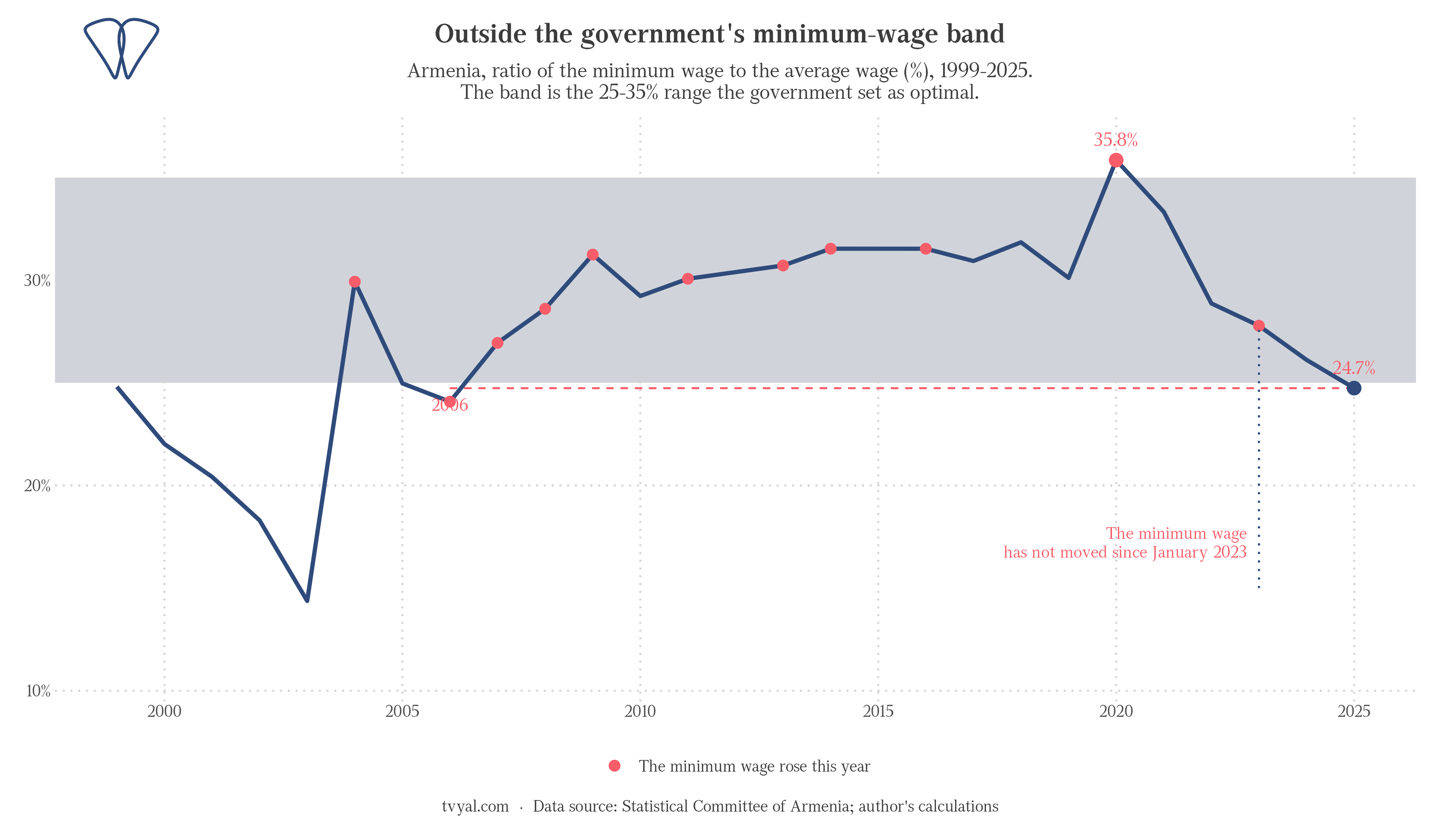
In 2020, the minimum wage was 35.8% of the average wage, and in 2025 this figure decreased to 24.7%. Since 2020, there has been a continuous decline in the indicator. It should be noted that at the moment the ratio has equaled the level of 2006.
The range indicated in the figure is based on official estimates. In 2022, a draft law was submitted to the parliament to increase the minimum wage to 100,000 drams, which the Government opposed, arguing that at 100,000 drams it would amount to “about 50% of the average wage, which is a rather high figure.” At the same time, a joint analysis by the ILO, OECD, IMF, and the World Bank was cited, according to which the optimal minimum wage should fluctuate “within 25-35% of the average wage” [2]. This guideline is officially enshrined in the Government’s legal acts.
Currently, Armenia’s minimum wage has dropped below the lower limit of the specified permissible range and reached the 2006 level.
Economic growth that did not affect the lower threshold
A key fact of the analysis, but one that often escapes public attention, is the following: In 2020-2025, the average salary in Armenia increased from 189,716 drams to 303,140 drams, which is 60% in nominal terms and about 30% in real terms, adjusted for inflation. During the same five-year period, the minimum wage increased from 68,000 drams to 75,000 drams, which provided only a 10% nominal increase, but when adjusted for prices, a decrease of about 10% was recorded.
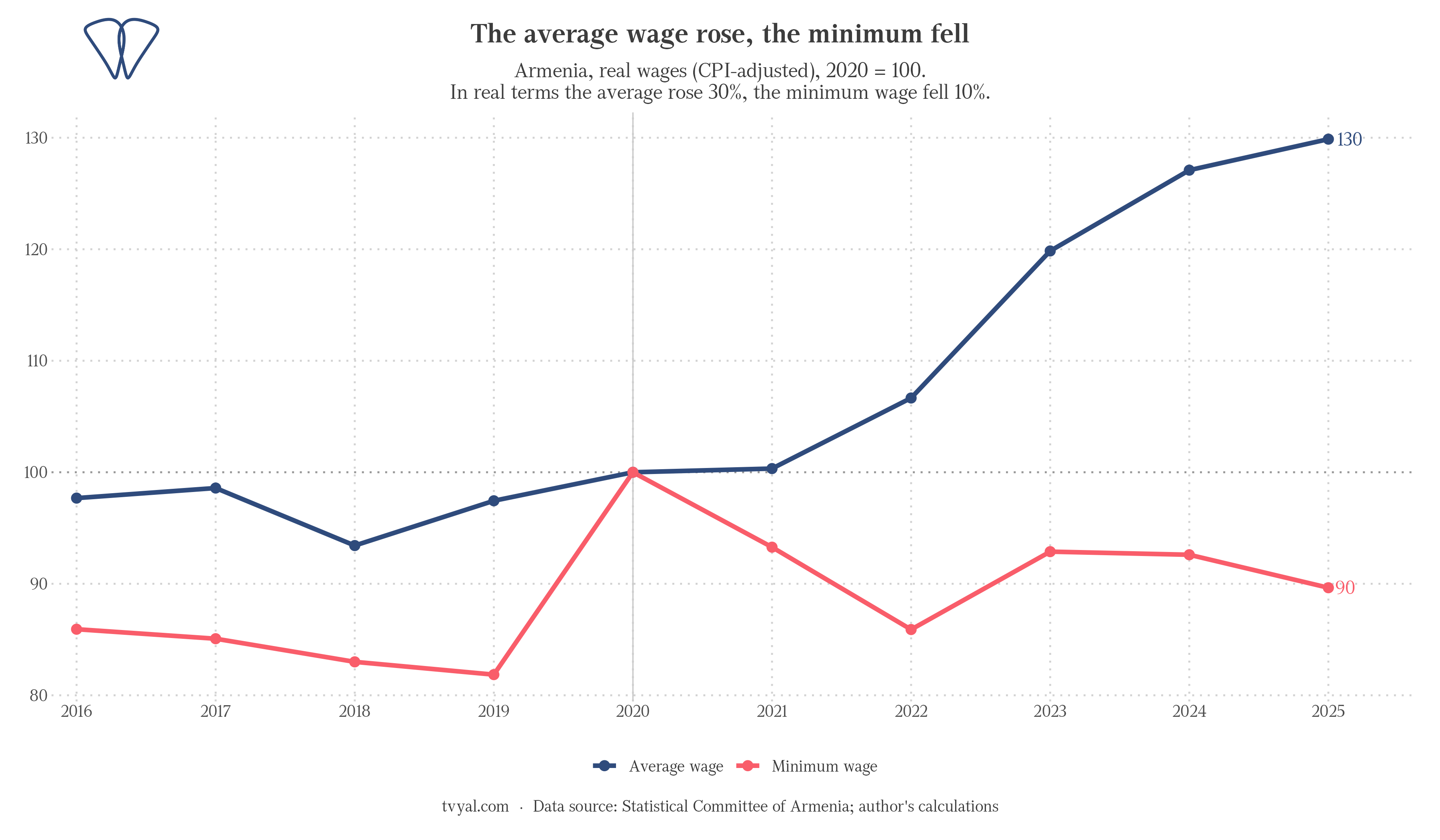
The increase implemented in January 2023 occurred at a time when inflation in 2022 had already neutralized the expected positive impact. Calculated in current prices, the real value of the minimum wage in 2020 was 83,663 drams. As a result of the 2023 increase, it amounted to 77,707 drams, and currently it is equivalent to 75,000 drams. In fact, the promised minimum wage of 85,000 drams is comparable to the 2023 figure of 75,000 drams, and this promised increase will only adjust it, taking into account inflation.
Economic activity in 2022 and 2023 was highly concentrated and temporary, which is directly reflected in household budgets. The increase in the average indicator was mainly due to increased incomes in individual sectors and a limited number of individuals. Meanwhile, there was no movement at the bottom of the income distribution, and a decline was recorded in real terms.
Financial estimate of the promised increase
To correct this discrepancy, specific financial resources are needed, the amount of which was not disclosed during the parliamentary discussion.
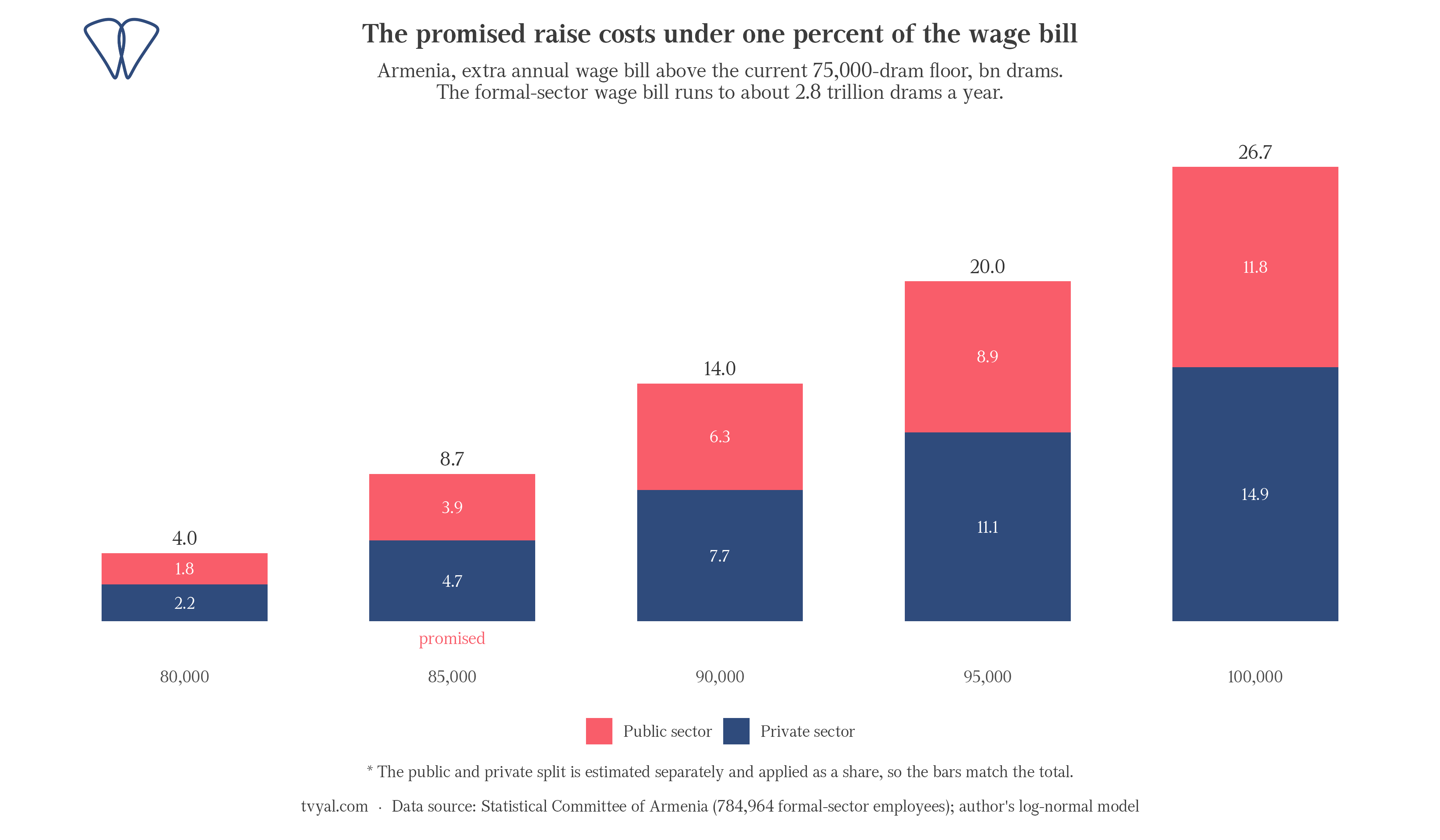
Raising the minimum wage to the promised 85,000 drams would require about 8.7 billion drams per year. In the case of setting 80,000 drams, additional state spending would amount to 3.9 billion drams, and in the case of the previously unplanned 90,000 drams, the total would be 14 billion drams, and state spending would be 6.3 billion drams. Considering that the official sector wage fund amounts to about 2.8 trillion drams annually, ensuring the promised level would require one-third of one percent of that fund, i.e. ~0.33%.
To ensure the completeness of the analysis, it is necessary to take into account two important circumstances.
First, the above figures reflect only direct costs. An increase in the minimum wage usually leads to an increase in the wages just above it. In international practice, this additional effect is estimated at around 20-30%. Therefore, 8.7 billion drams is the lower limit of costs; even in the case of 10-11 billion drams, the overall conclusion remains unchanged.
The second factor is inflation. According to the government’s 2022 conclusion, each 10% increase in the minimum wage could lead to an increase in inflation by 0.3 to 0.7 percentage points [2]. The transition from 75,000 to 85,000 drams implies a 13% increase, which, according to the government coefficient, will lead to an additional inflation of 0.4 to 0.9 percentage points. This is a realistic risk that should be planned for, but in the context of the presented data, it is not considered an inhibiting factor. It should also be noted that at the moment inflation in Armenia is on a downward trend.
The real structure of beneficiaries
The argument often presented against raising the minimum wage in Armenia is that it will lead to an increase in the salaries of officials. However, actual indicators indicate the opposite, which is easily substantiated by data.
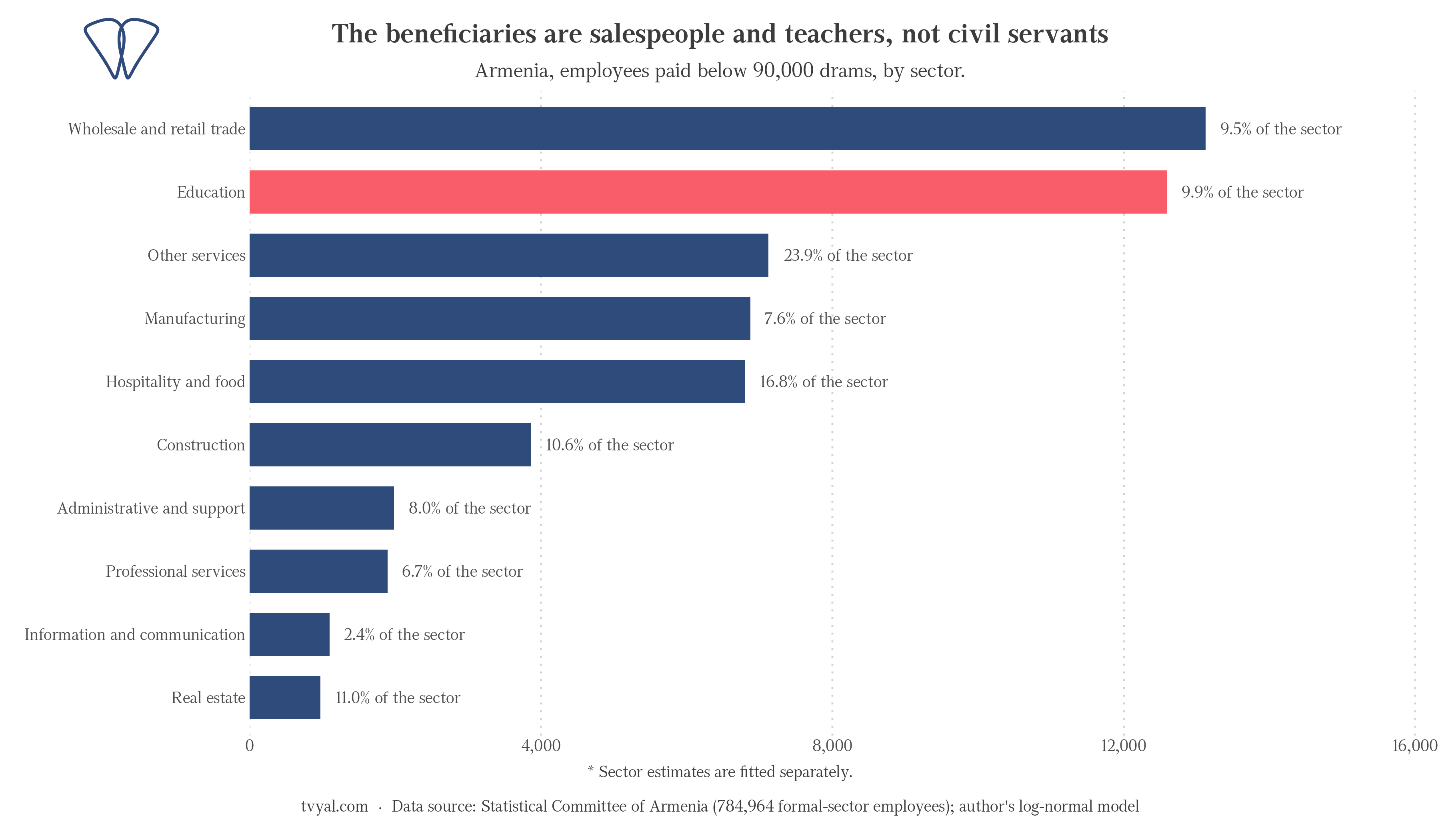
It should be noted that the salary scale for civil servants starts at a level significantly higher than the 90,000 dram threshold, therefore, the change in the minimum wage does not directly affect this sector. The state bears about 45% of the costs of the increase, but these funds are entirely directed to the public education sector. The education system is the second largest group of beneficiaries, and these funds are provided to teacher assistants, school technical and administrative staff, and not to the leadership of ministries. Thus, the increase in the minimum wage will primarily have a positive impact on the education system.
The largest group of beneficiaries is the private sector, including wholesale and retail trade. It is also necessary to review the Government’s 2022 justification, which stated that raising the threshold would harm export competitiveness, since the majority of minimum wage earners work in the manufacturing industry. A study of statistical data shows that the manufacturing industry ranks fourth on this list, behind trade, education, and other services.
None of the 41,247 people working in the state administration system have a salary lower than 90,000 drams. The state’s financial burden is directed to schools.
The analysis of the figure reveals two more systemic risks that should be clearly stated. The sectors with the highest vulnerability to the minimum wage are other services (23.9%) and accommodation and catering (16.8%). It is in these sectors that raising the legislative threshold often leads not to an increase in official wages, but to an increase in shadow payments, therefore any increase should be accompanied by a tightening of tax administration. In addition, about a third of the employed in Armenia are in the informal sector [6], where the official minimum wage mechanisms do not operate. The poorest workforce in the country is concentrated in this sector, and ignoring this fact is unacceptable. Workers in this sector are mainly blacklisted by the banking system and generally cannot be registered as official employees, see Support Program for Unreliable Borrowers: A Populist Move or an Economic Necessity?.
The neutralizing effect of the tax burden
Even in the event of an immediate increase in the minimum threshold, a second systemic problem arises, which is considered in our research.
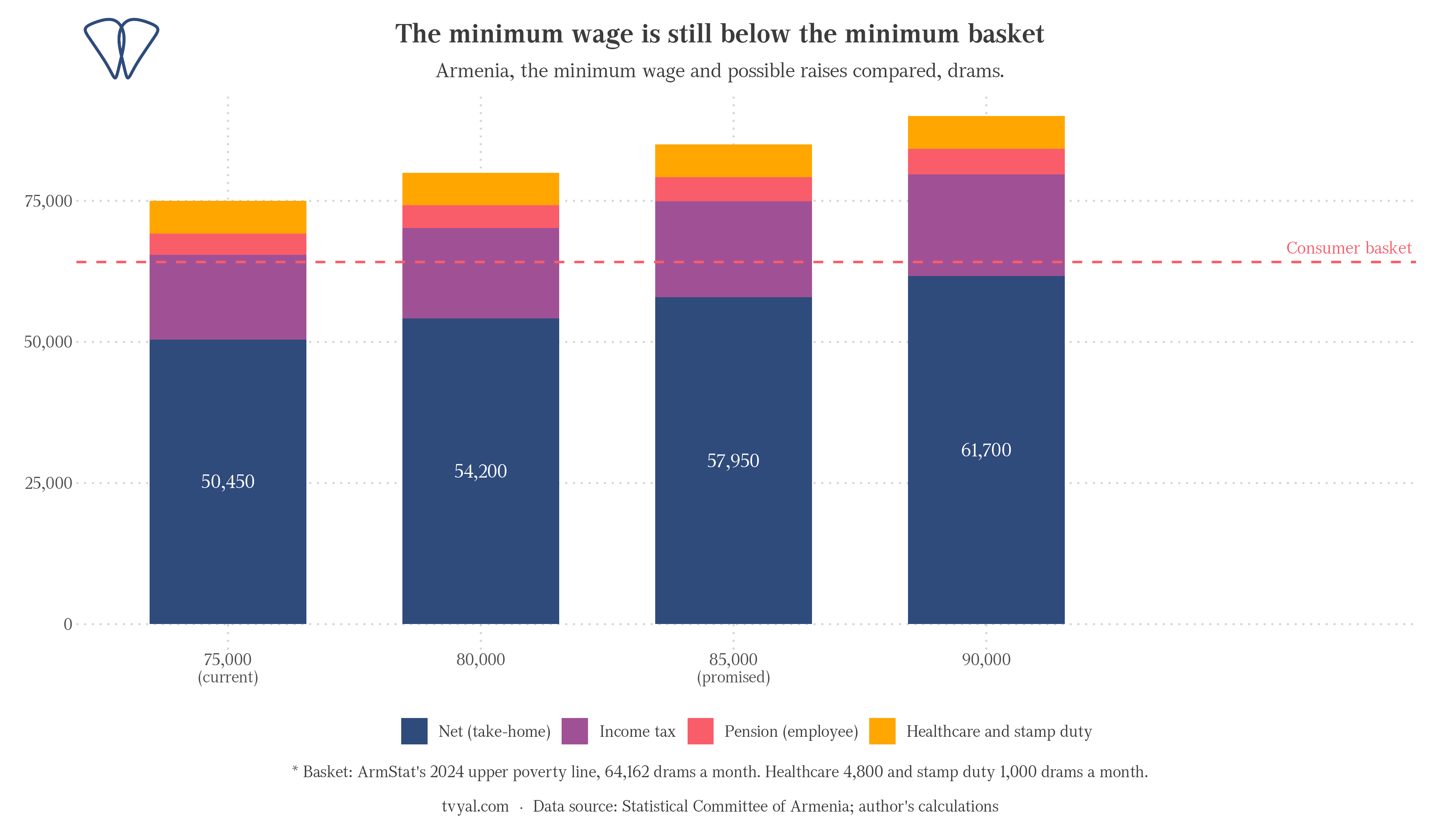
In the case of the current gross salary of 75,000 drams, the employee’s disposable net income is 50,450 drams. In the case of the promised 85,000 drams, the net salary will be 57,950 drams. The value of the official consumer basket (upper poverty line) used as the poverty threshold, according to the latest data of the Statistical Committee of the Republic of Armenia for 2024, was 64,162 drams.
Therefore, after the planned increase, the net salary will remain about 10% below the poverty line. Even if set at 90,000 drams, it will still fall below the poverty line by about 4%.
In fact, in the event of an increase in the minimum wage by 10,000 drams, about 2,500 drams is collected back by the state in the form of income tax. In Moldova, where more ambitious targets are set, an effective 0% income tax is applied to the minimum wage threshold. Due to this, the wage increase immediately translates into an increase in consumer spending. In Armenia, there is no such systematic mechanism.
The results of this analysis may provoke conflicting discussions between the parties. Supporters of raising the minimum threshold must admit that under the current tax system, this will not ensure a living wage. And for parties concerned about the financial burden, it is important to note that a targeted reduction in the tax burden for salaries up to 100,000-150,000 drams per month will provide the same beneficiaries with greater disposable income at lower costs for the state than an increase in the gross wage rate.
Our website offers two analytical tools that allow you to assess the position of individual wages in the overall distribution. tvyal.com/wages allows you to find out the percentage distribution of wages both at the level of the general economy and at the level of a specific sector, and to calculate the gross to net wage in accordance with the latest tax regulations. tvyal.com/wages/trends provides a comparative analysis of nominal and real (inflation-adjusted) indicators by sector, as well as the dynamics of the upper and lower parts of the income distribution. This calculator is the main tool that our research recommends to policymakers and is equally applicable at the household level. It should also be noted that with these tools you can see the position of your wages in the overall distribution.
Expected processes
The promise of a wage increase was initially conditioned by macroeconomic factors. The draft law setting the current 75,000 drams and the Government’s 2022 conclusion stipulate that the increases are implemented “taking into account the country’s macroeconomic indicators,” which are reviewed annually within the framework of the medium-term expenditure program and presented when appropriate [3]. In essence, there is an annual assessment mechanism in place, which has reaffirmed the same result for the past three years.
There is also a specialized institute responsible for the aforementioned calculations. The 75,000 dram figure was not an arbitrary decision. The Ministry of Labor and Social Affairs had commissioned the National Institute of Labor and Social Research to model the optimal threshold and its budgetary impact, as a result of which the model guaranteed exactly 75,000 drams for 2023 [3]. The main question now is what results the same model would produce today.
In parallel, a separate draft is under public discussion, which envisages revising the remuneration system of state officials and civil servants from January 2027, increasing base salary coefficients and adding performance-based bonus mechanisms [5]. In fact, there are two independent sets of instruments and two decisions, only one of which is in the stage of practical implementation.
It is necessary to consider the key indicator presented in our first chart: the ratio of minimum to average wages. Currently, it is 24.7%, while the permissible range set by the Government starts at 25%. To return to that range, at the current average wage level, a minimum of around 76,000 drams would be required, while in the case of the promised 85,000 drams, the indicator would be around 28%, remaining within the permissible limits, but still falling below the poverty line after taxation.
Regardless of the ongoing debate over the indicator, the direct beneficiaries of this decision are public school teacher assistants and retail service workers.
On economic growth and inequality: The Growth Wave Stalled: What the New GDP Figures Reveal. On the concentration of wages in the country: 80% of Armenia’s Wages are in Yerevan. On the official sector, on which this analysis is based: Out of the shadows and into Yerevan: what created 300,000 registered jobs.
* Wage and employment data: Statistical Committee of the Republic of Armenia, monthly wages and salaries and number of employees in the formal sector by NACE Rev. 2 sectors and ownership, covering 784,964 registered employees. Estimates of distribution and expenditure are taken from the published survey linked below. The long-term series presented in the first figure crosses two methodological changes: 2012-2013, when the income tax law was changed, and 2018, when the source was moved from surveys to the tax administration database, so comparisons between the mentioned years should be viewed in this context. The decline from 2020 to 2025 is entirely after these two changes. Sector-level indicators are modeled separately from the totals and are not directly comparable with them. Net wages are calculated using the 2026 tax structure and compared to the 2024 poverty line (64,162 drams), which is the most recent official figure. The data archive and the chart code are available on GitHub.
References
[1] Tavadyan A. (2026). How much can the minimum wage be increased? Sectoral analysis of the 80,000-90,000 AMD range // Economics, Finance and Accounting, ISSN 2953-8009, 2026, No. 2 (18), p. 15 – DOI 10.59503/29538009-2026.2.18-15
[2] Decision of the Government of the Republic of Armenia on the proposal of the Government of the Republic of Armenia on the draft law of the Republic of Armenia “On Amendments to the Law “On Minimum Monthly Wage”” (draft Kh-124-23.12.2021-AS-011/0) // Legal Information System of Armenia – arlis.am
[3] Reference-Justification on the Draft Law “On Amendments and Supplements to the Law “On Minimum Monthly Wage”” // Unified Website for the Publication of Draft Legal Acts – e-draft.am
[4] How do you imagine the minimum wage increase and when? Yolyan to Tunyan // Panorama.am, August 14, 2026 – panorama.am
[5] Salaries of state officials will increase: the government proposes a new system // Iravaban.net – iravaban.net
[6] Statistics of the Informal Economy // International Labour Organization – ilostat.ilo.org