Two economies and one average: 6.7% growth and a historic decline in agriculture
At yesterday’s government session, the Prime Minister of Armenia noted the following: “In the first half of 2026, we no longer had an indicator of economic activity, but a 6 percent GDP growth” [1]. And he is right, the numbers show it: according to national accounts, the growth in the first half was 5.97%, and in the second quarter alone, 6.7%, which exceeds the indicator for the same period last year. During those same six months, however, Armenia’s agricultural sector recorded the deepest quarterly decline in the entire statistical history. Both observations refer to the same economy, the same half-year, and the same official statistics report.
Revised indicators of the June report
In June, we published the analysis “The wave of growth has stopped”. It was based on the preliminary estimate of 3.95% for the first quarter of 2026 by the Statistical Committee, which was circulated in the press as “4 percent growth” [2]. The wave of financial inflows from Russia is still continuing and with renewed vigor: in the indicators published in August, the growth for the first quarter of 2026 is 5.15%.
We have compared the two statistical publications branch by branch. The publication for the second quarter of 2026 has a fundamental revision compared to the first quarter. The volume of financial and insurance activities has been increased from 241.6 billion drams to 267.6 billion drams, as a result of which the 13.0% decline has become a 3.6% decline. The revision is 26.0 billion drams. The revision of the overall economy indicator is also 26.0 billion drams. That is, the entire upward revision of Armenia’s first quarter is the change in one branch’s indicator.
This is crucial, because the June analysis was based on data from the financial sector itself. The driving force of our economy is the banking or financial system, and the initial 13% decline in the first quarter signaled a halt in financial flows. These flows have been the external driving force for significant growth in our economy since 2022. We wrote that, along with the decline in Iranian capital flows, the absorbing effect of the banking system is weakening, which was justified by a sharp decline from +27% to −13%. Currently, the −13% indicator has been revised to −3.6%, and in the second quarter, the financial sector grew by 22.4%. The wave of capital coming from abroad has not yet exhausted itself and has even gained new momentum since the second quarter of 2026, which is also evident in the revival of the real estate market and the number of tourists from Russia compared to last year. Financial flows simply slowed down over the course of a quarter, according to an initial estimate, which was later revised.
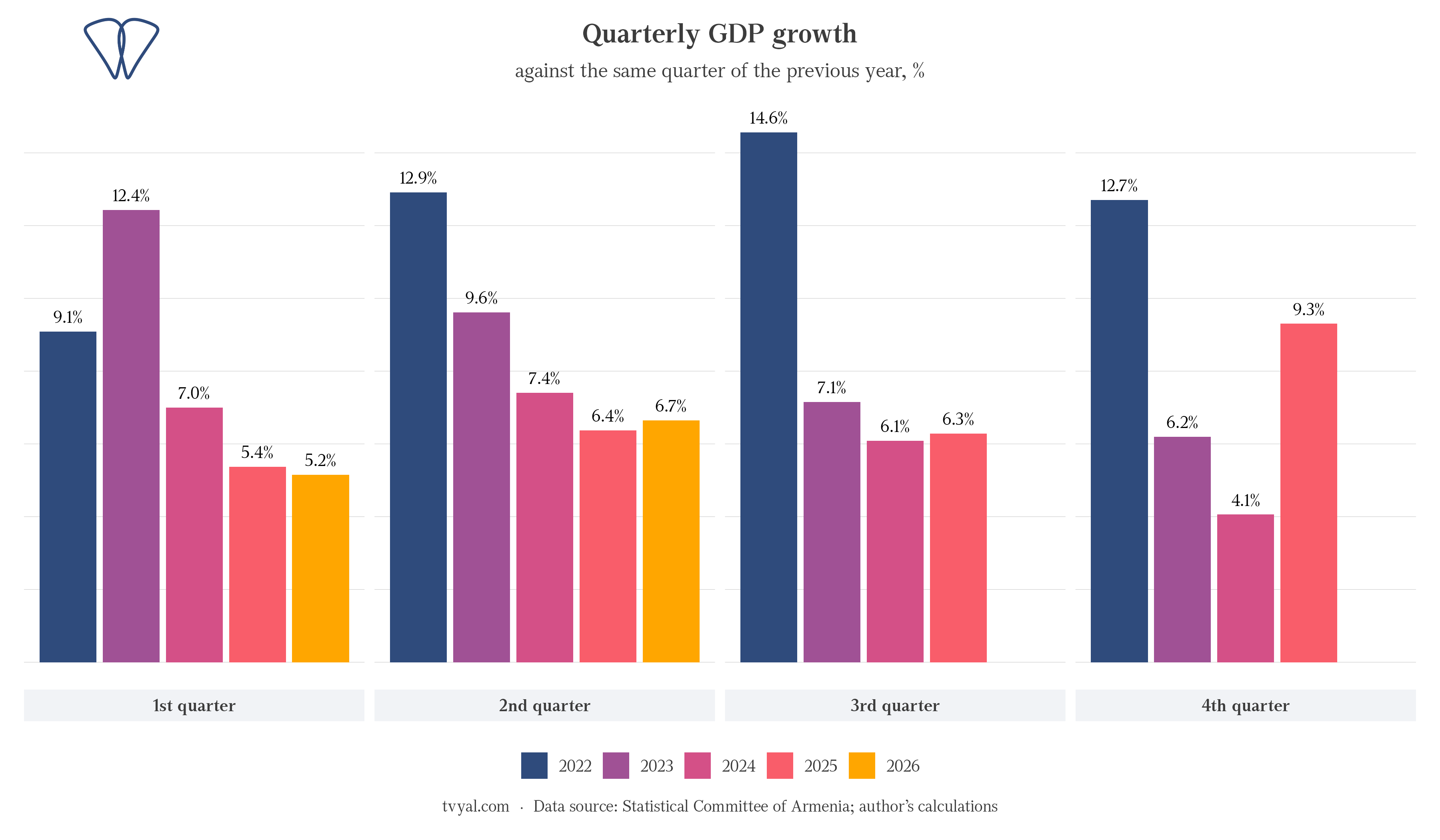
We’ve written about statistical revisions several times this year, and they’ve usually contradicted the official picture. This time, the revision is consistent with it. But the conclusion is the same in both cases: a preliminary estimate is not a final figure.
Growth in all sectors except one
In other words, there was no retreat of the wave. What actually happened?
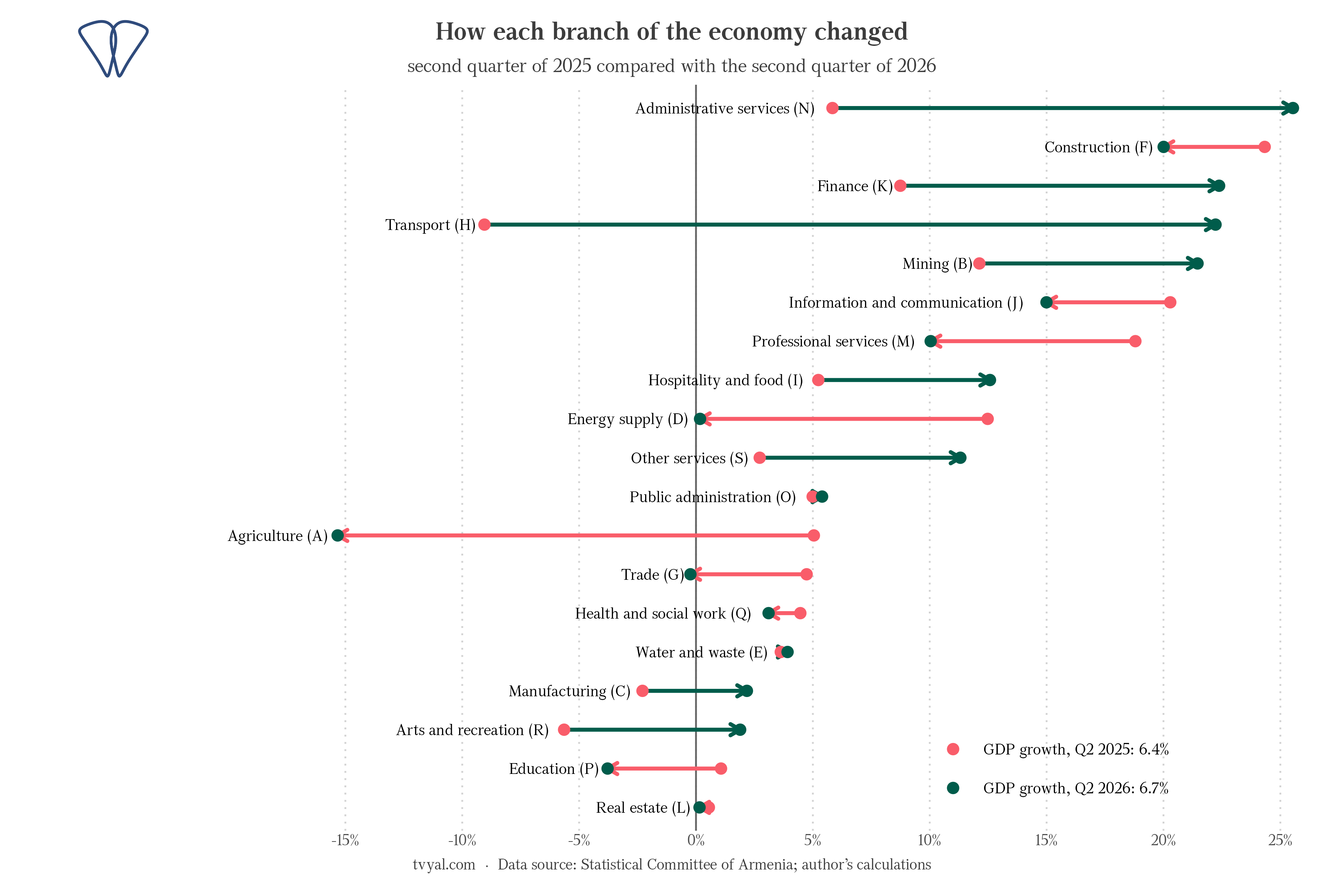
Seventeen of the twenty sectors monitored by the Statistical Committee recorded growth in the second quarter. Only three sectors saw a decline, and in two of them the changes were insignificant: the volumes of the education sector decreased by 3.8%, and the indicator of the trade sector remained almost unchanged at −0.2%. The third is agriculture, where the decline is a significant 15.3%, or almost one-sixth of all agriculture.
This is the economic picture of the second quarter. This picture was formed not by a systemic slowdown, but by a general pickup in economic activity, with a deep crisis in one sector.
Growth structure
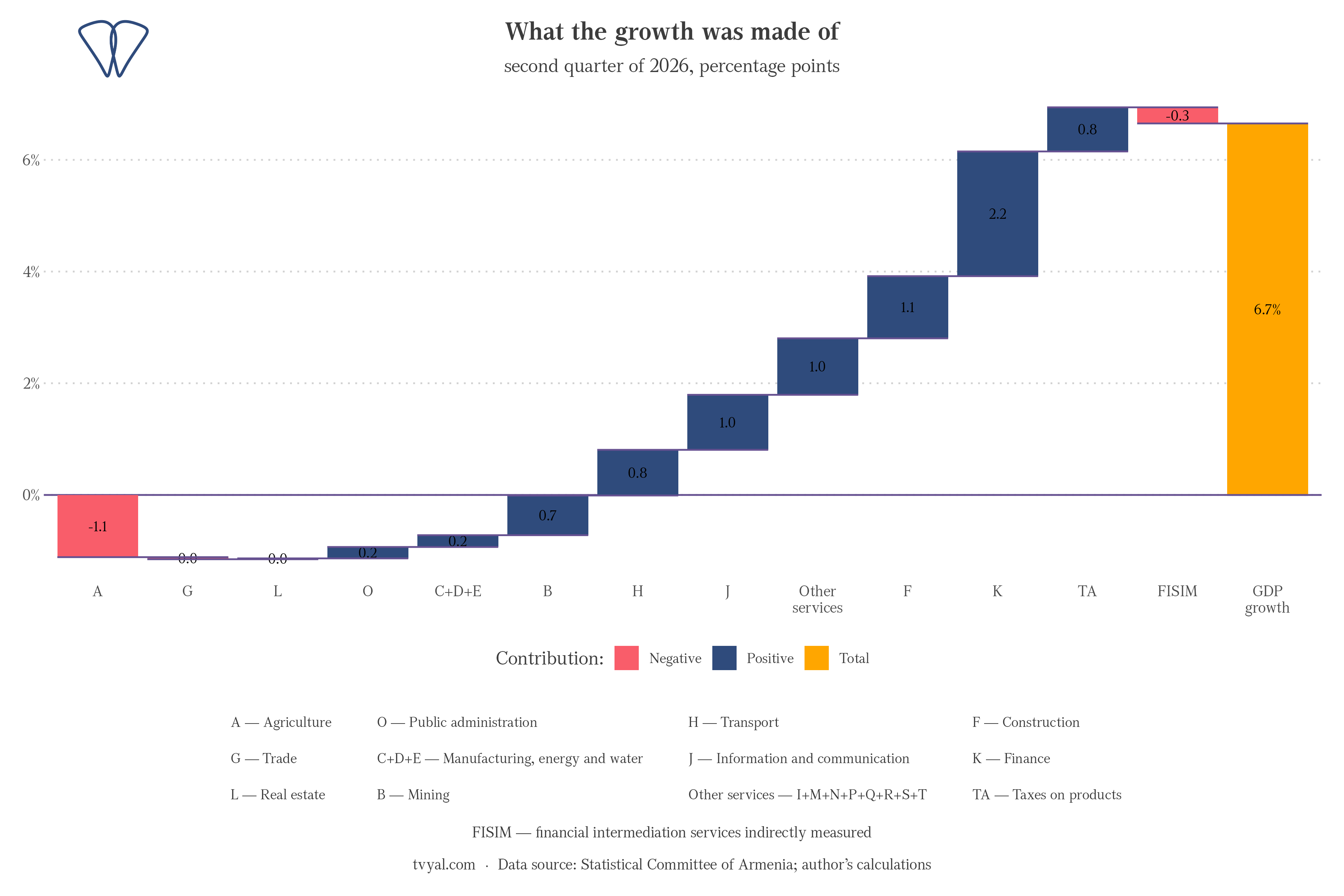
The upturn in the financial system alone provided 2.2 percentage points of the 6.7% growth, which is one third of the quarterly growth. Construction contributed 1.1 percentage points, information and communication - 1.0, transport - 0.8, mining - 0.7. In other words, if there were no new external financial flows, economic growth would be estimated at about 4.5 percent, compared to 6.7 percent. At the same time, in agriculture, overall growth was reduced by 1.1 percentage points.
Thus, if it were not for the economic embargo imposed by Russia, overall growth could have been almost 8%. Agriculture, which accounts for only about 7% of GDP, and 16.4% in 2016, reduced the main indicator of economic growth by more than a full percentage point in one quarter, shrinking by almost one-sixth.
Of course, we must remember what the growth of the construction and financial system consists of. That money must be invested somewhere, and in Armenia the best investment is construction. Capital is invested, directed to the service sector, new institutions are opened, which is fully accounted for as economic growth. Although this is actual growth, it is largely formed at the expense of transit foreign capital, the inflow of which can just as easily turn into an outflow.
The worst quarter for agriculture
Over the past twelve years, periods of decline have been observed in agriculture before: in the third quarter of 2017 - −13.4%, at the end of 2018 - −12.0%. However, this year’s spring decline is unprecedented in the entire recorded statistical series.
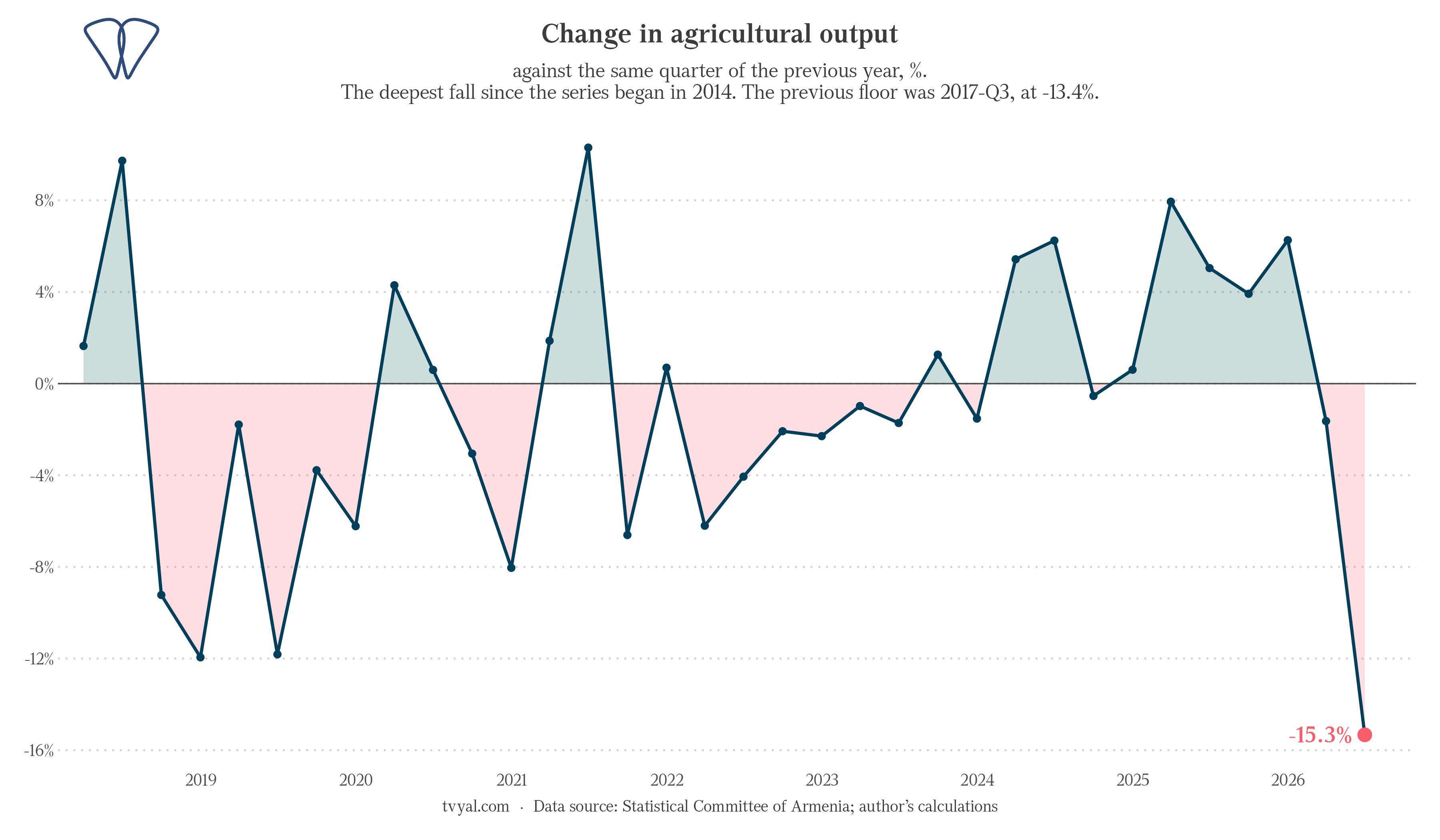
The severity of the situation is even more evident in the context of the previous year’s base. In all four quarters of 2025, agriculture grew by 7.9%, 5.0%, 3.9%, and 6.3%, respectively. Then, a 1.6% decline was recorded in the first quarter of the current year, and a 15.3% decline in the second.
In the previous article, we noted that the decline in agriculture began before the border closure, which is confirmed by the data for the first quarter. In the winter, before the Russian side imposed its restrictions, agriculture was already in the negative zone. However, the restrictions were imposed in the second quarter, which coincides with the main harvest phase. In June, we cited the Central Bank’s assessment that prolonged restrictions could lead to a loss of up to 2% of GDP [3]. Currently, the first actual data confirming this forecast are available. In one quarter, the decline in the agricultural sector alone reduced growth by 1.1 percentage points.
Moreover, the damage is not limited to physical loss. The majority of agricultural farms have attracted credit funds to carry out their activities. More than half of these people work on credit, and they must return the money to the banks. Unsold crops mean the loss of one season’s income. Meanwhile, the loan obligations assumed in return are long-term, deepening the financial burden.
Two economies in one country
The economic growth indicator that we have does not reflect individual sectors of the economy. It is an average indicator: one part of the economy may experience a decline, while another part, the banking and financial system, may grow three times.
When viewed over an eight-year period, the average picture is as follows.
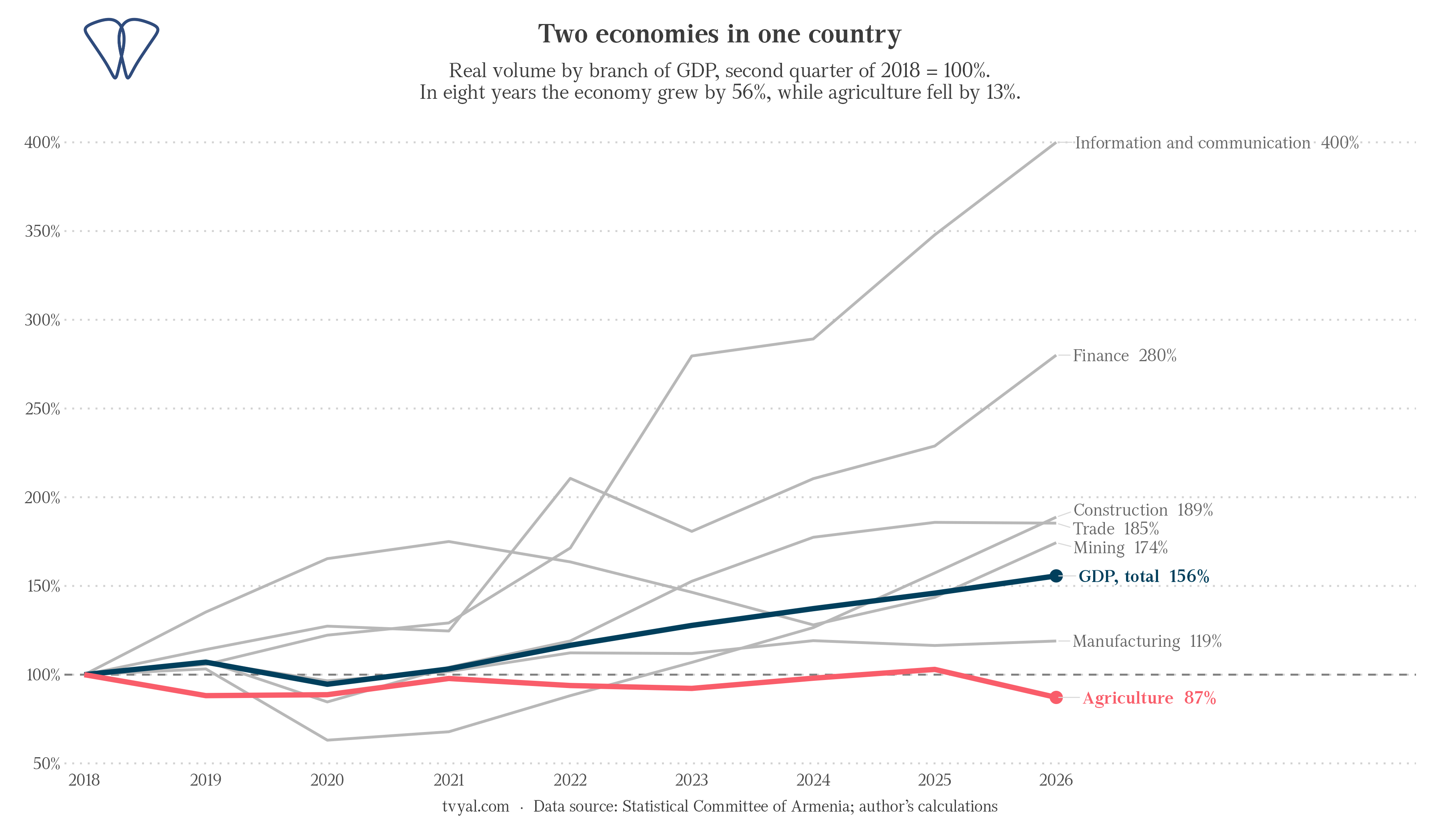
Compared to the second quarter of 2018, the volume of the overall economy increased by 56%. The volume of the information and communication sector has quadrupled. The financial system has almost tripled. Agriculture is the only sector whose indicators have been below the baseline level for eight consecutive years, and although it had almost recovered last summer, the decline observed this spring has worsened the situation again.
The distribution of economic growth is highly uneven across regions. The IT, finance, and related service sectors are concentrated in the capital. Since 2018, the main growth has occurred in Yerevan, in the center of Yerevan, as a result of which the capital’s share of the total wage bill has increased from about 72% to about 80%. At the same time, the main economic sector in the regions is agriculture. This also leads to internal migration: a farmer who has been working at a loss for several years is forced to leave his land and move.
Why hasn’t this problem been solved yet? We don’t have a general agriculture, livestock, and land distribution master plan to understand what we should produce. Every enlarged rural community should have an agronomist, a veterinarian, an artificial insemination technician, a business consultant, and a logistics coordinator. The problems of water management and drip irrigation have not been solved.
As an example of alternative development, one can consider the flower export sector. Since 2018, its volumes have increased by about five times, providing annual exports of $60-70 million almost exclusively to one market. However, this growth was largely due not to increased domestic productivity, but to external restrictions and re-exports. A business built on geopolitical contingency stops working the day geopolitical financial waves change their direction.
Key indicators to watch
The government’s target economic growth rate is 7% per year, set in 2021. Moreover, according to the assessment of the Prime Minister of the Republic of Armenia, an average growth of 7.9% was actually achieved [1]. This indicator corresponds to reality for the period 2021-2025. Meanwhile, compared to 2019, which preceded the pandemic, the average growth rate using the same calculation methodology is 5.2%. Both indicators are statistically accurate and differ only in the choice of the starting year of the calculation. Historically, Armenia’s long-term average economic growth rate has been around 4.5%. Macroeconomic systems tend to return to their average statistical levels. Thus, if the flow of external financial waves changes, Armenia will face the problem of ensuring its economic growth.
The third quarter agricultural indicators, to be published in December, are of key importance. The third quarter coincides with the main harvest, exceeding the second quarter in terms of volume several times, and at the same time is the first full period during which Russian restrictions have been in effect continuously. If the 15.3% decline in the second quarter led to a 1.1 percentage point reduction in economic growth, then maintaining similar dynamics in the third quarter will lead to much more severe macroeconomic consequences. In addition, unlike the financial sector, agricultural indicators are not subject to retrospective revision. Agricultural products are either sold on time or physically destroyed.
We should not confuse a good average index with a healthy economy. The 6.7% growth is a fact. The field in the region, whose harvest no one buys, is also a fact.
On the revised quarterly growth: “The Growth Wave Has Stopped” and “The Iranian Wave”. On the state of agriculture before the border closure: “Crisis before the border closure” and “Export Growth and Shrinking Fields”. And on the ban itself: “Harvest without an Address”.
* The data source is the National Accounts of the Statistical Committee of the Republic of Armenia (quarterly and annual series). The June and August reports compared in the first section are archived versions of the same table of the Statistical Committee. For an annual estimate of the same series, see the May analysis. The source code and database for the charts are available on GitHub.
References
[1] “In the first half of 2026, we had not just an indicator of economic activity, but a 6 percent GDP growth.” Pashinyan // 1lurer.am, August 27, 2026 — 1lurer.am
[2] GDP in Armenia grew by 4 percent in the first quarter of 2026 // Armenpress, June 2026 — armenpress.am
[3] Russian restrictions could lead to a 2% decline in Armenia’s economy, warns the Central Bank // CivilNet — civilnet.am
[4] National Accounts, Gross Domestic Product by Economic Activity, Quarterly // Statistical Committee of the Republic of Armenia — armstat.am