The Temporary Tourist: A Record Season and Its Effect on Yerevan's Rental Market
In the first half of the current year, Armenia’s state border registered 1,041,598 visits, which the Tourism Committee described as a record figure for the January-June period since independence [1]. In late July, the Armenian press circulated another figure: according to real estate agents, rents in the capital have increased by about 30 percent in three months [2][3]. This data also corresponds to reality.
40 percent of the record figure
Of the 1,041,598 visits, 416,743 were from citizens of the Russian Federation. This is 40 percent of the total, but more significantly, 59 percent of the total increase was due to Russian citizens. Compared to the first half of last year, the number of visits increased by about 134,000, with approximately 60 percent of this additional flow due to the increase in visitors from Russia.
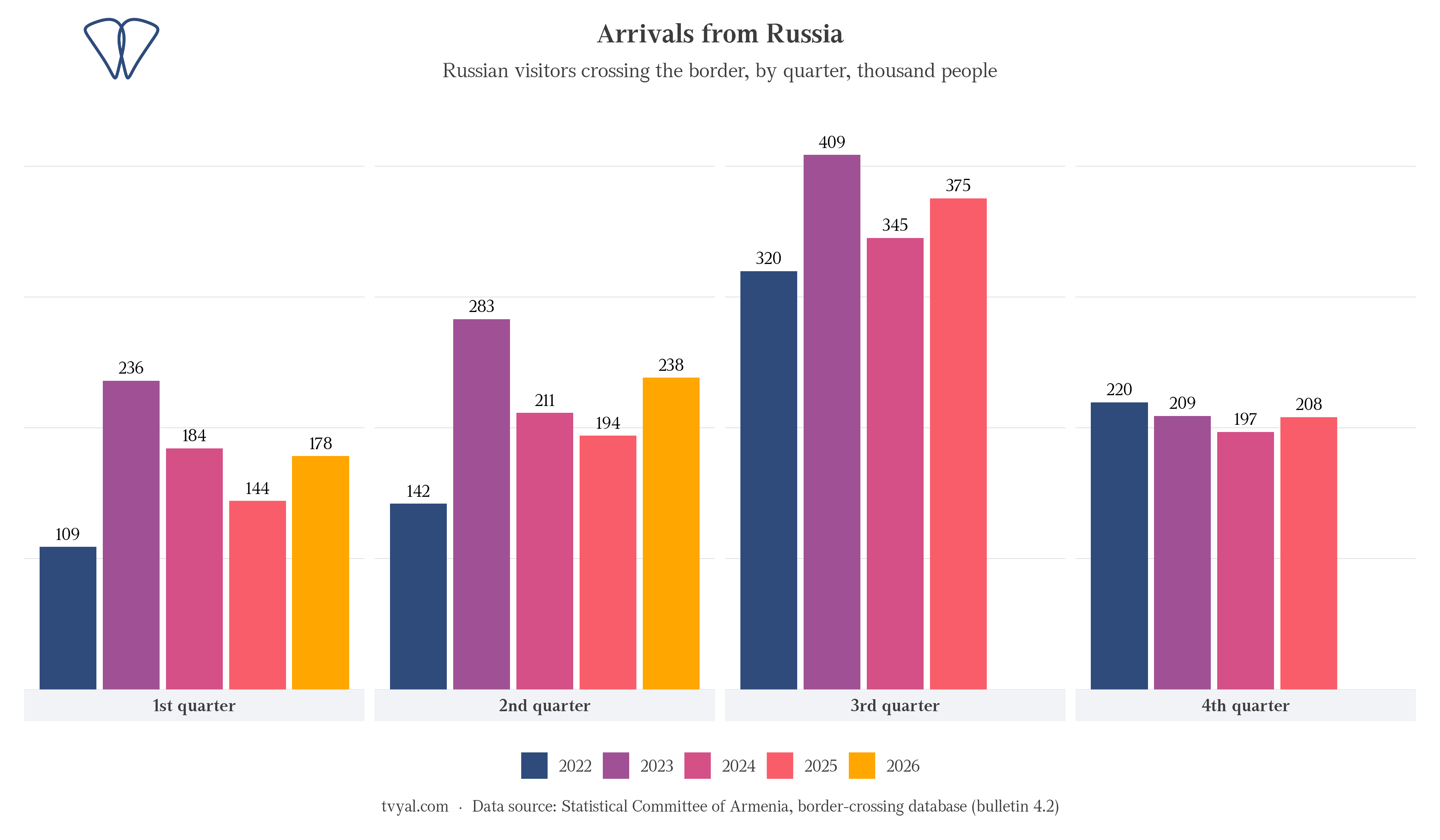
A large amount of rubles comes to the Republic of Armenia, a very large amount, through tourists, through people who leave the Russian Federation and come to the Republic of Armenia. This is a component of tourism statistics that is often ignored. Arrivals are counted, a record estimate is given, and the whole process is viewed exclusively in the context of the hospitality sector. However, the statistical data on border crossings do not reveal the real purpose of the visit: whether the person arrived for tourism purposes or with the expectation of signing an apartment rental contract.
2022 wave comparison
The July analyses considered 2022 as the main comparative base.
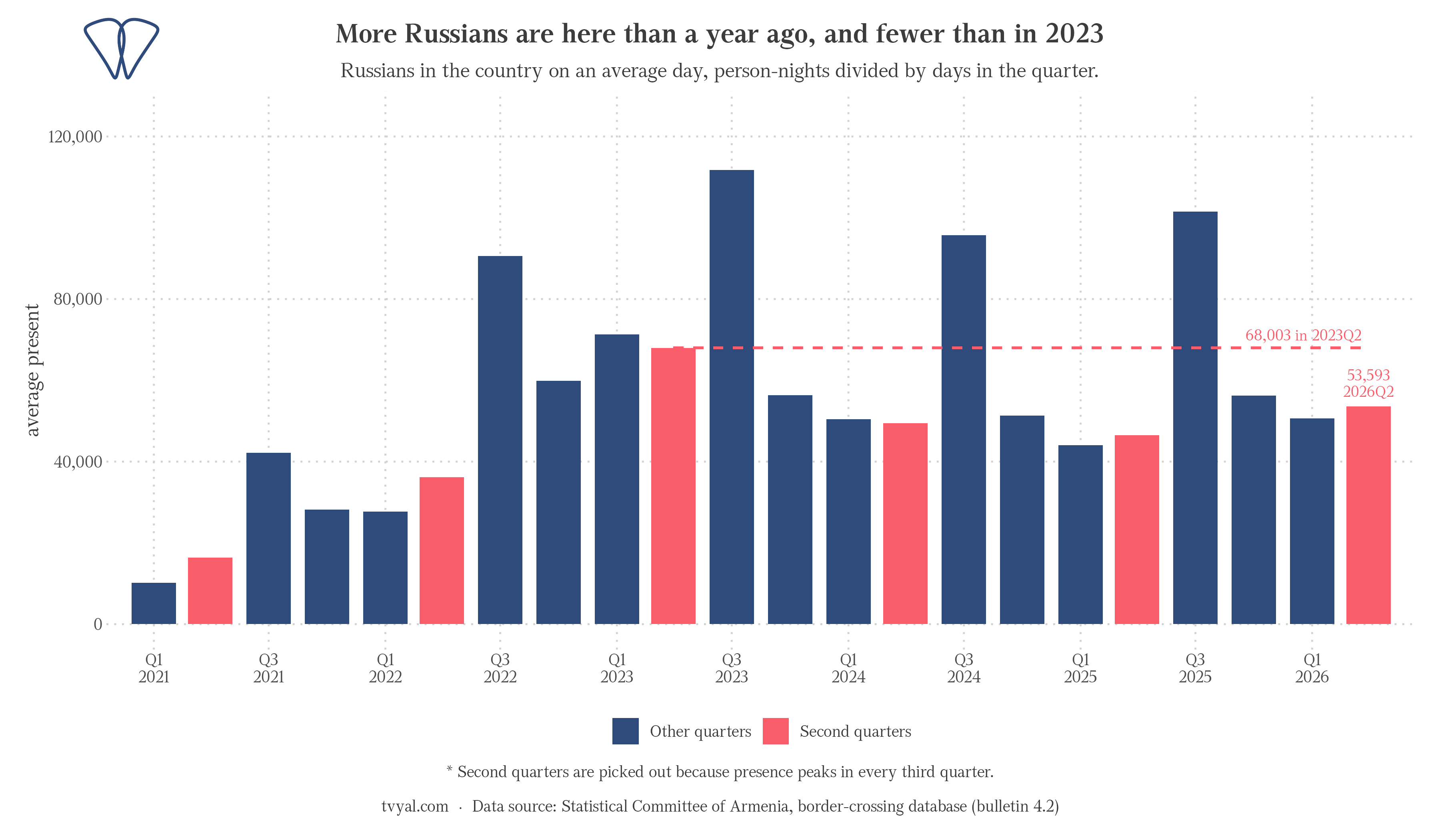
It is difficult to compare the indicators for 2022 and 2026, since tourism stopped in 2020 due to the pandemic, after which it began to recover. So the comparison of 2021 and 2022 is not appropriate, since it is also related to recovery. The indicator of tourists’ physical presence in the country at the moment forms a more accurate picture. This is calculated by dividing the average number of overnight stays by the duration of the quarter. In the second quarter of the current year, 53,593 Russians were in Armenia on an average day, 15.1 percent more than in the same quarter of the previous year, and 21.2 percent less than the peak of 68,003 in the second quarter of 2023. At the same time, the number of arrivals increased by 22.9 percent, and the presence by 15.1 percent. The difference is due to the reduction in the duration of stay from 21.8 days to 20.5 days. In fact, arrival statistics overestimate the growth in housing demand by one and a half times.
The first wave’s structural features are worth examining. At that time, approximately 120 thousand Russians left and came to the Republic of Armenia, of which about 40 thousand were Armenians with Russian passports, and approximately 60 percent remained in Armenia. A macroeconomic shock of such a magnitude shows up in the real estate market as a one-time, sharp increase. The current dynamics form a gradual pressure: presence has increased from 36,181 in the second quarter of 2022 to 53,593, but continues to lag behind the level of the same quarter of 2023.
Behavior of a tourist from Russia
The average length of stay of visitors from Russia in Armenia in the spring of this year was 20.5 days. This is the lowest figure in the series compared to previous years, which has been showing a downward trend for four years in a row.
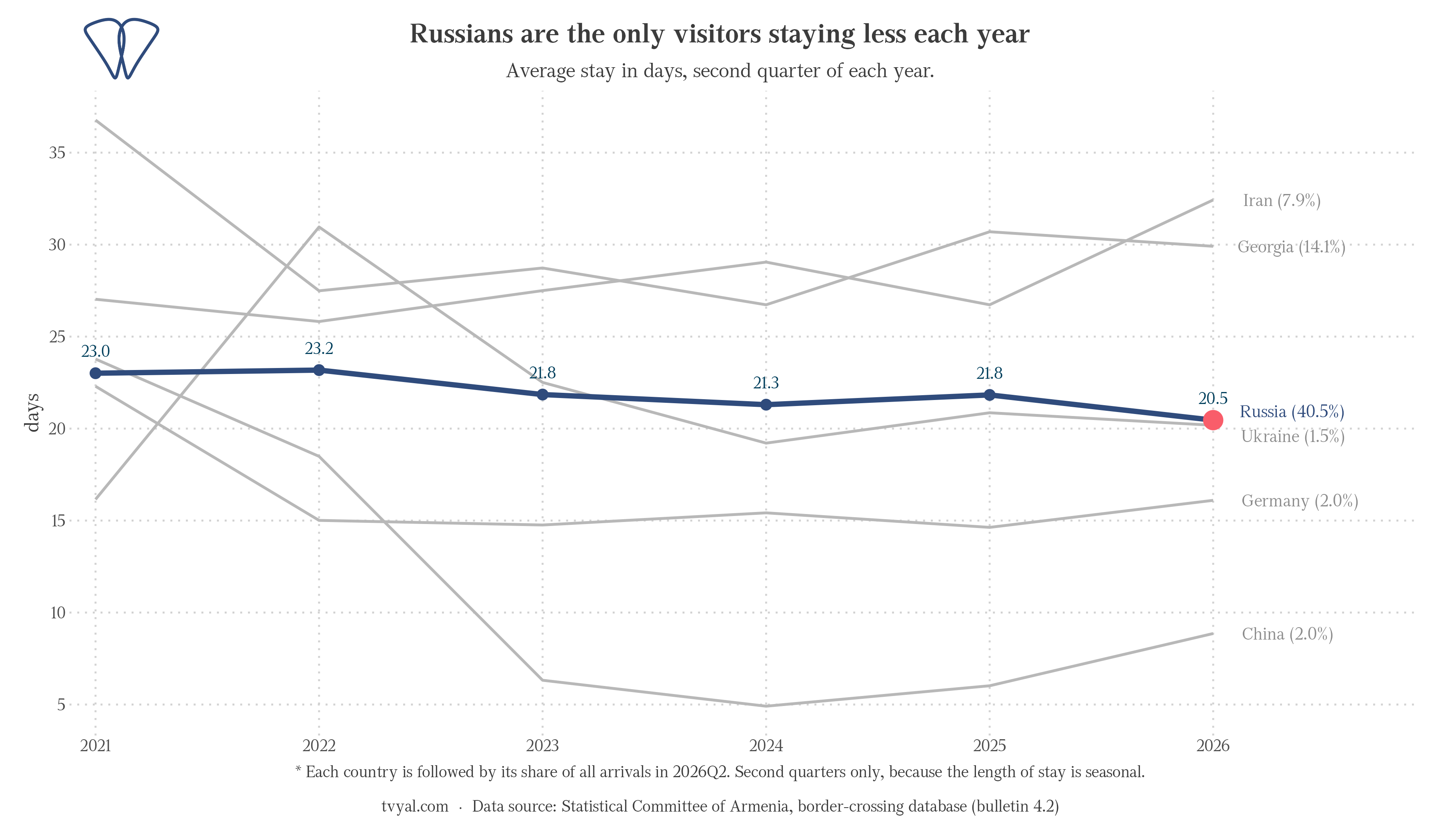
Statistical data show that among the countries with large tourist flows, Russia is the only one in which the duration of the visit is continuously decreasing. However, it is not the dynamics that are more important, but the absolute indicator. For example, the duration of stay of visitors from China is 8.9 days, from Korea 3.3 days, and from Italy 8.3 days. This is characteristic of classical tourism. The twenty-day period indicates a different purpose of the visit.
It is difficult to justify a visit lasting an average of twenty days as purely touristic, especially considering the pricing policy of Yerevan hotels. During the quarter, people arriving from Russia provided a total of 4.88 million overnight stays. Due to this circumstance, the demand for housing concentrates in the rental market, directly competing with local tenants.
Demand allocation
This analysis includes our own observations of the proposed rents presented on the list.am platform as of May 13 and August 29. The basis is not the averaged data of the published general announcements, but the results of monitoring the price dynamics of apartments.
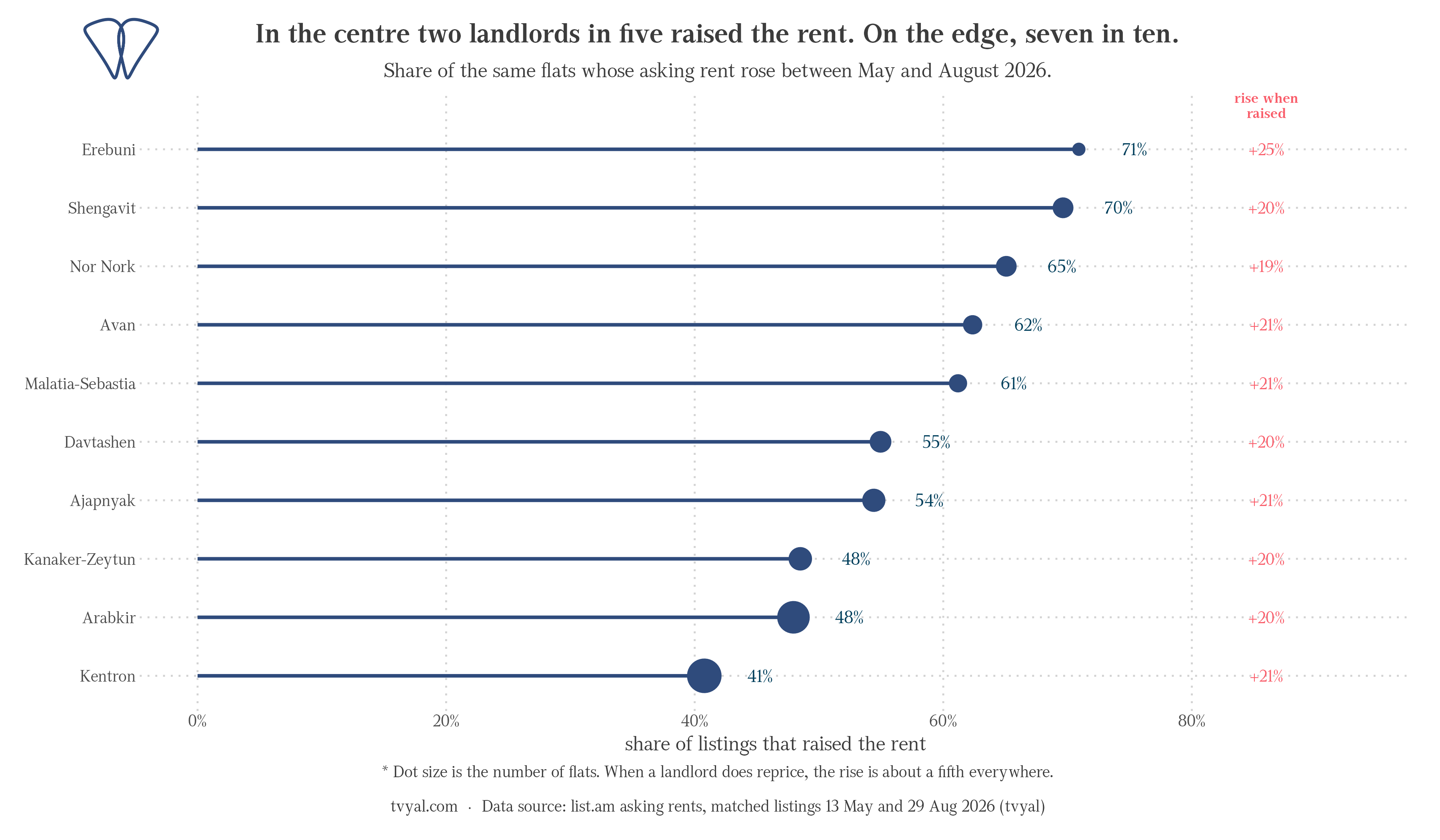
For almost half of the apartments observed over the three months, the price offer remained unchanged. In cases where inflation has occurred, owners have increased the rent by about 20 percent (approximately 50,000 drams). Moreover, it is not the amount of inflation that differs across administrative districts, but the proportion of owners who have revised the price.
In the center of the capital, two out of five landlords have increased their rent, while in the suburbs, seven out of ten. Therefore, the average percentage figures circulated in the press often distort the real picture. The apparent stability in the Kentron administrative district is due to less frequent price revisions, not market passivity. However, when prices are revised in Kentron, the size of the surcharge is the highest in the city, amounting to an average (median value) of 70,000 drams per month.
The mechanism of the nearly 30 percent increase in rent
If we compare the average values of all advertisements published in Yerevan in May and August, we get a 24 percent increase in rents. The indicator is close to the data real estate agents provided to the press and objectively reflects the current price picture in the rental market for those who form new demand.
In fact, however, this does not reflect the actual behavior of current landlords. A study of the dynamics of price offers for the same apartments shows that the real growth during the comparable period was 9.3 percent.
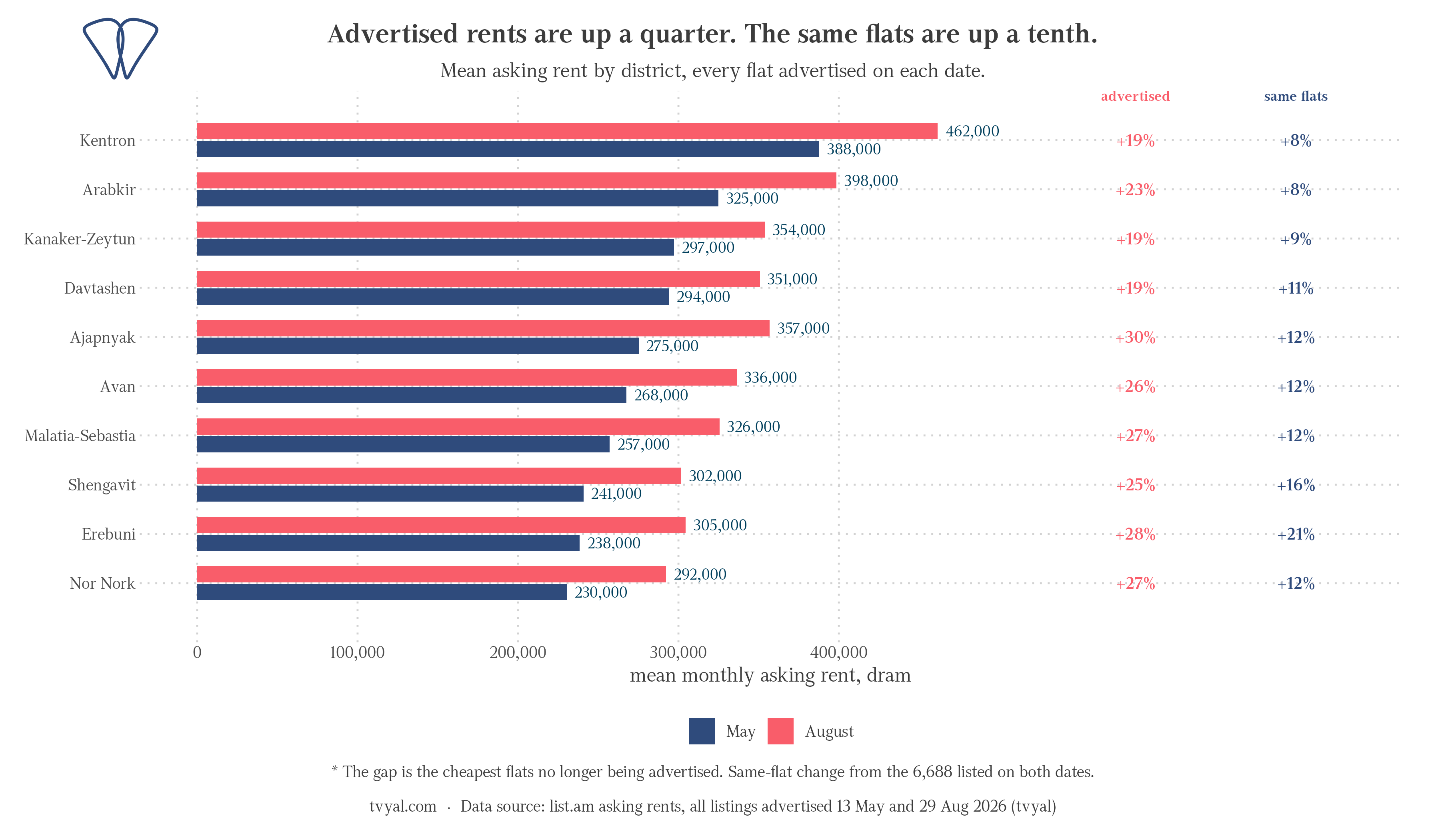
The difference between these two indicators reveals a fundamental problem in the market. In May, the rent for half of the apartments offered in Yerevan did not exceed 300,000 drams per month, while by the end of August the share of this segment had decreased to 19 percent. The price of the most affordable apartment on the platform in the center has increased from 50,000 drams to 100,000 drams. Moreover, affordable apartments have not become more expensive, but have left the supply market due to being effectively rented.
Apartment prices have not actually increased by a quarter, but the supply of affordable housing has simply been exhausted.
The two indicators mentioned above indicate various systemic problems. If rents were to increase by 30 percent, this would relate to pricing mechanisms. However, a study of statistical data makes it clear that there is currently a shortage of the affordable segment, which requires more long-term and structural solutions. It should also be noted that there are parallels between the 2022 and 2026 seasons. 2022 was temporary in nature, due to the start of the active phase of the Russian-Ukrainian war. It can be expected that this wave is also temporary in nature, depending on the parliamentary elections in the Russian Federation.
Enrichment of the center, emptying of the regions
In the second quarter, the Armenian economy grew by 6.7 percent, one-third of which the financial system provided exclusively. In the absence of external cash flows, economic growth would have been about 4.5 percent. Financial resources flowing from external sources are directed to the banking system, which in turn redirects them to the construction sector, since capital in Armenia is mainly concentrated in this sector. At the same time, the agricultural sector declined by 15.3 percent in the same quarter, the deepest decline in the entire statistical period.
In 2022, similar financial flows had other macroeconomic effects. The arrivals brought savings with them, as a result of which the banking system’s profits almost tripled in one year, reaching 255.6 billion drams [4]. Moreover, the formation of profits was determined not by deposits, but by the instability created around them. Non-interest income quadrupled, making up 41 percent of banks’ gross income, as the dram appreciated from 480 drams to 405 drams [5]. Each currency conversion, as well as each account or card opened for newly arrived individuals, entailed charging appropriate commissions.
Currently, the dram exchange rate fluctuates between 360-370, and the Central Bank of Armenia tends to maintain this level. Currency exchange offices operate with a margin of about one percent. In the first half of the current year, the banking system’s profit increased by 9.5 percent [6] compared to a 20.5 percent increase in the previous year [7]. Funds sent for personal purposes (flows aimed at household consumption) amounted to $770 million for seven months. This indicator is 20 percent higher than the level of the same period last year, but 29 percent lower than the results of 2022. Financial inflows continue, but currently they are not being converted into bank profits, but into loans. Over six months, the loan portfolio grew by 11.5 percent [8].
In fact, a record tourist season and a historic decline in the agricultural sector belong to the same economy, during the same six months. One of these phenomena is spatially concentrated in a few square kilometers of the center of Yerevan, while the other spreads across all regions of the country.
Key indicators to monitor
The sales price per square meter for Yerevan and the regions, as well as forecasts, are available on the tvyal.com/real-estate platform, which publishes cadastral values per square meter by month, from 2002 to the present, including a 24-month forecast interval. Two of the presented administrative districts, Avan and Shengavit, coincide with the regions observed in the rental charts, which provides an opportunity to compare the dynamics of sales and rental prices.
What matters is not the average proposed rent, which is growing this year due to the structural effect, but the share of landlords in the center who have revised their prices. Currently, this indicator is 41 percent in the center, and about 70 percent in the outskirts. If the dynamics of the Center approach the indicators of the outskirts during the fall, this will indicate a deepening of the wave. Otherwise, the market is clearing out the lower, more affordable segment, which has limited room to keep going.
Another important date to watch is November 4, when the Statistical Committee will publish the third-quarter border-crossing data. The third quarter is the peak of the tourist season and the first full quarter of the observed wave. The new data will show whether the 22.9 percent increase was the ceiling of demand. This wave will continue in the third quarter, due to the Russian parliamentary elections. However, we believe that this is temporary, like in 2022.
Currently, the statistical picture is clear. The physical presence of Russians in the country has increased by 15.1 percent, not doubled. Rents for the same apartments have increased by 9.3 percent, not 30 percent. Moreover, half of the landlords in Yerevan have left their price offers unchanged since spring.
Additional information on two different economies encapsulated in one economic growth indicator is presented in the analysis “Two economies and one average”. The impact of external flows on the dram exchange rate is detailed in the article “One Ruble, Three Prices”. The developments in the agricultural sector in the same half-year are addressed in the article “A Harvest With Nowhere to Go”.
References
[1] In the first half of 2026, tourist visits to Armenia reached 1.042 million, a record // MegaNews.am — http://meganews.am/articles/139921
[2] Armenia’s rental market has picked up: a new influx of Russians is observed // Lurer.com, 29 July 2026 — https://lurer.com/article/744240/am
[3] Media: demand for apartments from Russians in Armenia has risen // PanARMENIAN.Net, 28 July 2026 — https://www.pan.am/335430
[4] Net profit of Armenian banks in 2022 // Modex.am — https://modex.am/net-profit-2022/
[5] Armenian banks record 3-fold growth in net profit in 2022 // Finport.am — finport.am
[6] Armenian banks increased net profit to 219.7 billion drams in the first half of the year // ArmBanks.am, 21 July 2026 — armbanks.am
[7] Armenia’s banking sector profit in H1 2025 increased by 20.51% to AMD 200.7 bln // ArmBanks.am, 4 August 2025 — armbanks.am
[8] Armenian bank assets grew by 8.1% in the first half of the year, reaching 13.8 trillion drams // ArmBanks.am, 4 August 2026 — armbanks.am