Gasoline price shock: where did the Russian fuel disappear to?
During these six months, the market recorded two shocks. These shocks changed the Armenian fuel market not only in price, but also in structure: within a year, Armenia was deprived of Russian fuel. This is a fundamental change that is not reflected in prices and is not widely discussed publicly at the moment.
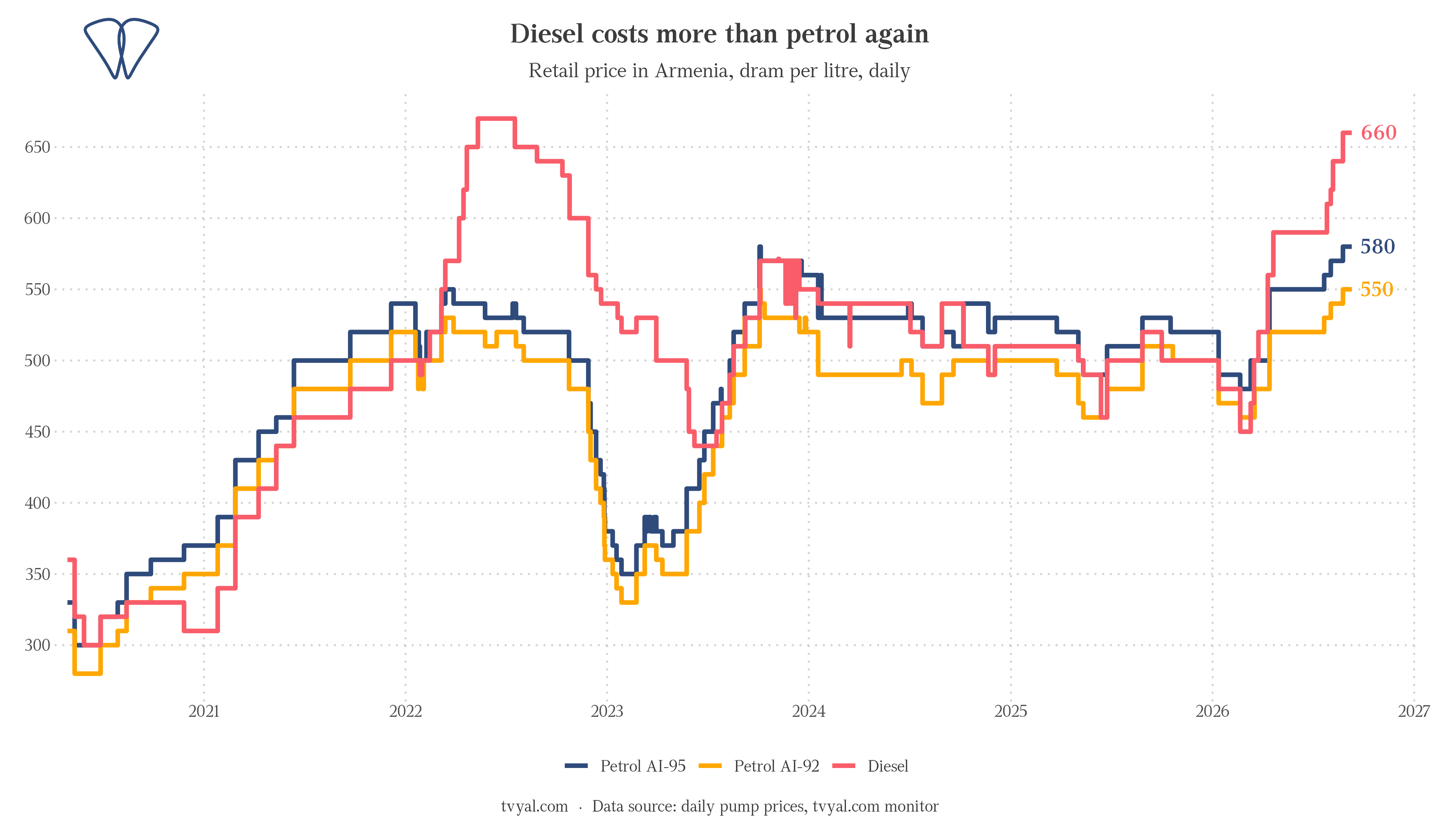
As of September 11, the price of one liter of AI-95 gasoline in Yerevan is 580 drams, AI-92 is 550 drams, and diesel fuel is 660 drams. Since March 25, the price of diesel fuel has exceeded the price of gasoline. Since February 20, gasoline has increased in price by 21 percent, and diesel fuel by 47 percent. February 20 was the last calm day in the market before the shocks recorded in the oil market, which were due to geopolitical events. In dollar terms, one liter of diesel fuel now costs 1.81 USD. This is a record high in the history of our daily observations over the past six years, which is also due to the appreciation of the dram compared to 2022.
Two shocks in six months
Such a shock was also observed in 2022. From March 2022 to November 2023 (for twenty months), the price of diesel fuel exceeded the price of gasoline. It reached its maximum in May 2022, amounting to 670 drams, and at the beginning of 2023 the price difference against AI-95 gasoline was 180 drams. If at that time the increase in prices was due to the beginning of the active phase of the war in Ukraine, then currently two fundamental factors are at work at once.
The first factor is global crude oil prices. In December, the average price of Brent crude oil was $62 per barrel. Already in April, it reached an average of $117, recording up to $138 in one day. This was due to the reduction in production volumes in the Middle East (withdrawal of about 6–7 million barrels of oil from the market per day) and the cessation of normal navigation in the Strait of Hormuz [1]. Later, prices decreased to the range of $90–100, which, however, exceeds the previous year’s figure by about 50 percent. It should be emphasized that the price of fuel in Armenia is not determined by oligopolistic agreements: the local market is quite competitive. Pricing is based mainly on global crude oil prices with a 6-month time lag. Therefore, the increase in oil prices in the global market is reflected in the Armenian market after about 6 months, which is what we are seeing at the moment.
The second shock to Armenian prices concerns Russian diesel. In July, following a series of drone attacks on oil refineries, Russia completely banned diesel exports, with the ban extended until the end of September [2]. The ban on gasoline exports, in effect since August 2025, has also been extended until the end of the year [3]. Russia and Armenia are members of the same customs union, and on paper, EAEU member states are exempt from such restrictions. This has not been a problem in recent years. However, the trade data below shows that in practice these privileges are frozen.
One barrel of Brent crude oil contains 159 liters. Based on this indicator and the daily exchange rate, we can calculate the cost of one liter of crude oil in drams by comparing it with the average prices at Armenian gas stations. In the spring of 2022, the price of one liter of crude oil reached 430 drams, and that of diesel fuel reached 670 drams. Currently, one liter of crude oil costs 220 drams, and that of diesel fuel — 660 drams. The chart shows the impact of the global shock on the domestic market. After these two shocks, the increase in the price of diesel fuel at domestic gas stations is comparable, while the price of crude oil is about 2 times lower than before the previous shock. This also indicates a certain discrepancy in the pricing of crude oil in the international market.
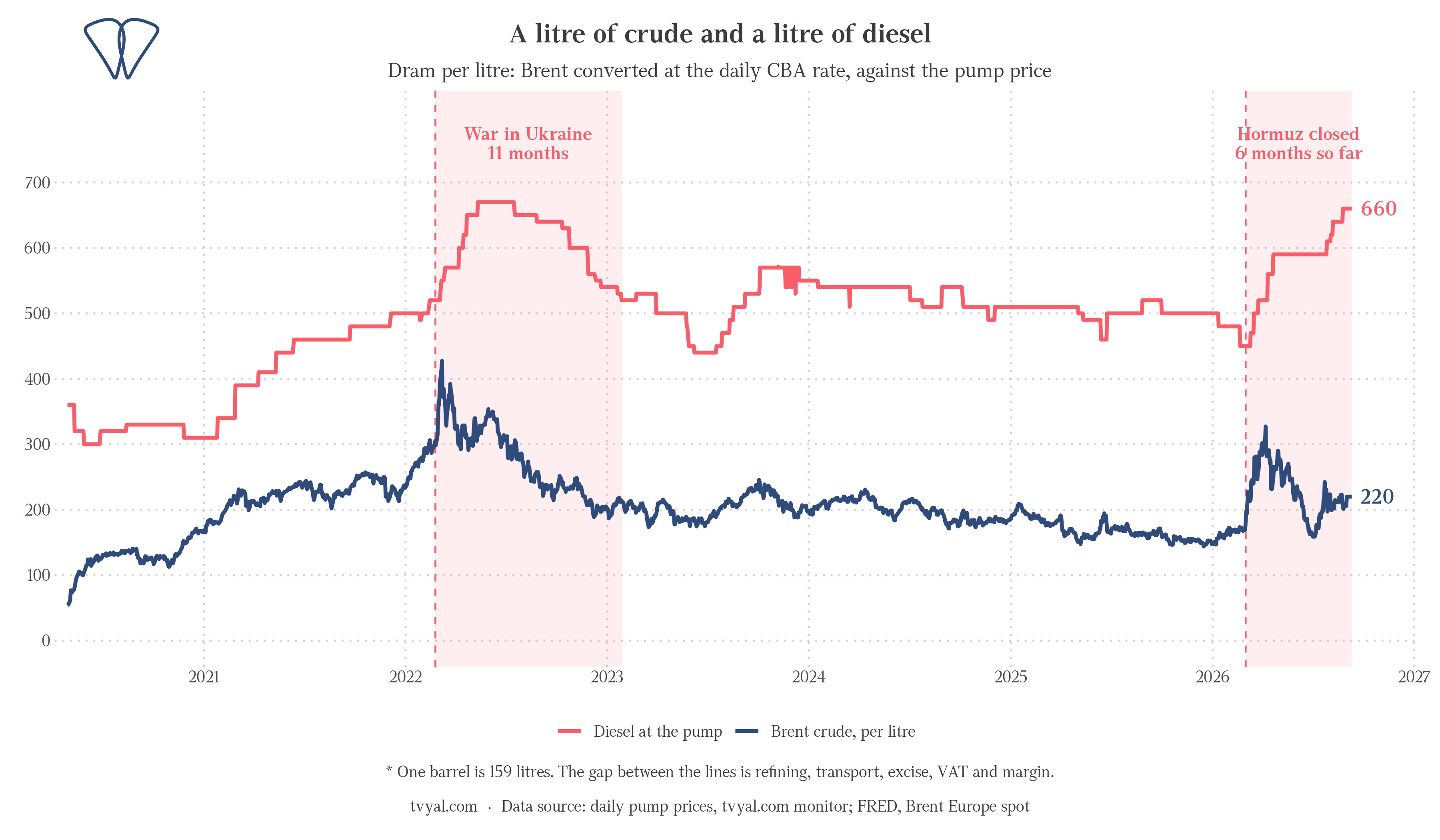
In practice, the domestic price is based on the cost of gasoline and diesel purchased at the border. In 2022, the border price of diesel fuel dynamically responded to fluctuations in the price of crude oil, first increasing and then decreasing. Prices at gas stations also followed this trend. Eleven months after the start of the 2022 Russian-Ukrainian conflict, the price of diesel fuel returned to the level at the beginning of the war. Currently, customs data show that the border price of diesel fuel was 318 drams per liter in February and 462 drams in May. A 45 percent increase was recorded in three months, while the price of crude oil increased by only a third in dram terms. This additional cost reflects the surcharge on refined diesel fuel, as well as the cost of new logistics chains replacing Russian routes. The 2026 trend depicted in the following charts has been going on for six months now. It took 11 months for the market to stabilize in 2022, but now there are two shocks at once that could prolong the period of high prices. Time will tell how long the high prices in the market will last.
Russian gasoline imports stopped in August 2025
Where does Armenia import fuel from? In 2023, the picture was unambiguous: Russia provided 90 percent of gasoline imports and 56 percent of diesel fuel. Since 2015, over a decade, Russia’s share in total imports has been about 75 percent, and in the case of diesel fuel, about 60 percent. It should be noted that compared to the Russian market, the price of oil products imported from Russia is higher, which is due to logistical costs and corruption risks at the border. However, importing fuel from Russia was economically more profitable, since it was more affordable compared to alternatives, and, moreover, the EAEU agreement allowed for duty-free import. This picture was analyzed in our March 2024 and December gasoline market analyses and has remained unchanged for ten years. Now the market has faced a second fuel shock in the form of attacks on Russian refineries, which has radically changed the situation.
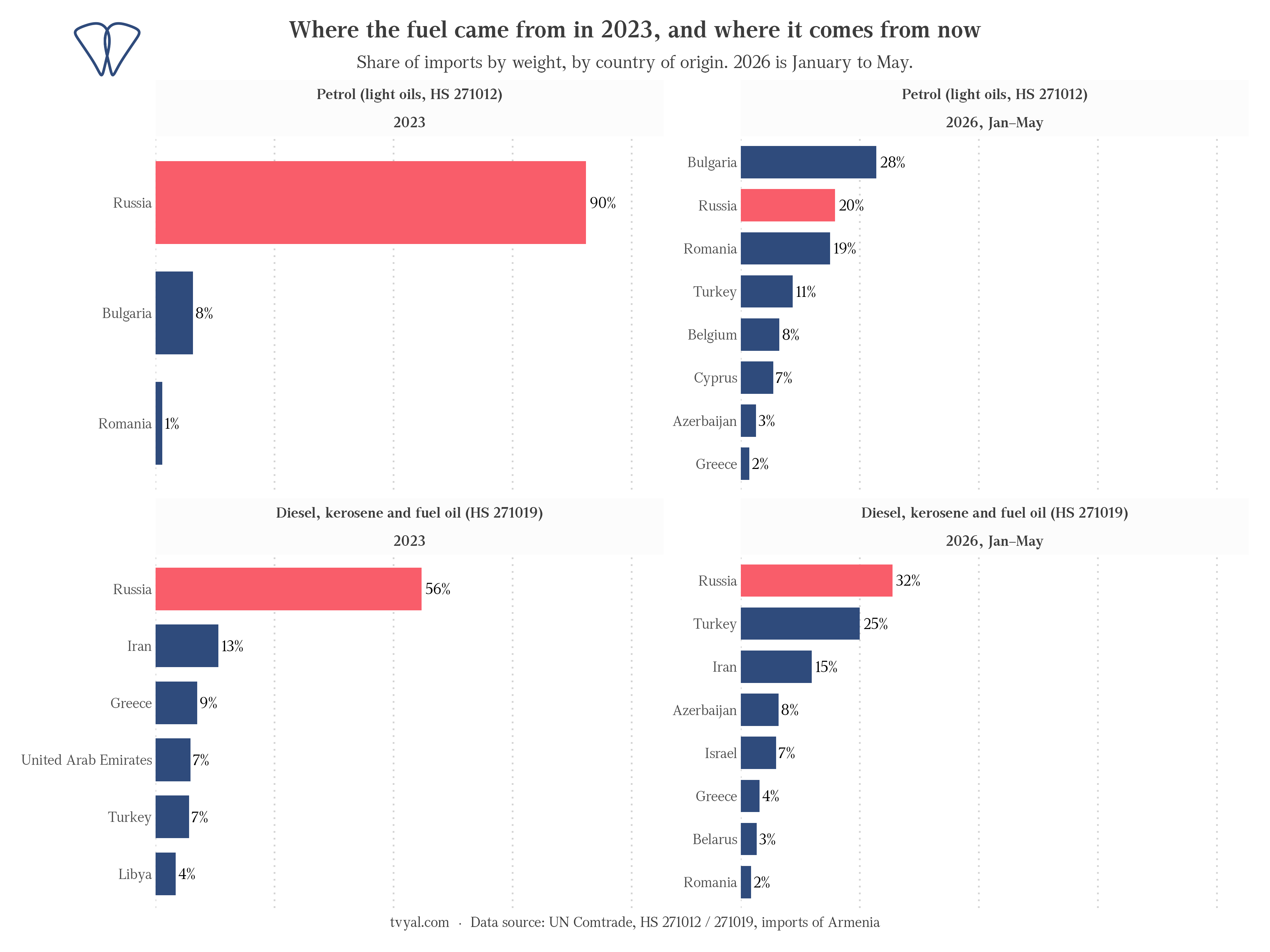
Russia is no longer Armenia’s main fuel supplier. In the first five months of 2026, only 20 percent of gasoline and 32 percent of diesel were imported from Russia. Moreover, the reduction in gasoline supplies was not gradual. Until July 2025, Russian supplies accounted for between one-third and two-thirds of monthly imports. It should be emphasized that this trend is ongoing, and by the end of the year, Russia’s share may decrease further. This trend had already begun in August 2025. August 2025 was the month when the Russian ban on gasoline exports came into effect. The Armenian market began looking for alternative routes six months ago, before the closure of the Strait of Hormuz.
What are the alternative sources? For gasoline, Bulgaria, Romania, Turkey, Belgium, Cyprus, and even Azerbaijan. These are oil refineries in the Black and Mediterranean Sea basins, from where the fuel is transported by ships to Georgian ports, and then by road and rail to Armenia. The main new suppliers of diesel fuel are Turkey, Iran, Azerbaijan, and Israel. The deliveries of Azerbaijani cargoes, which received public attention in December, are reliable: they account for 3 percent of gasoline imports and 8 percent of diesel fuel this year, and these indicators have a growing trend.
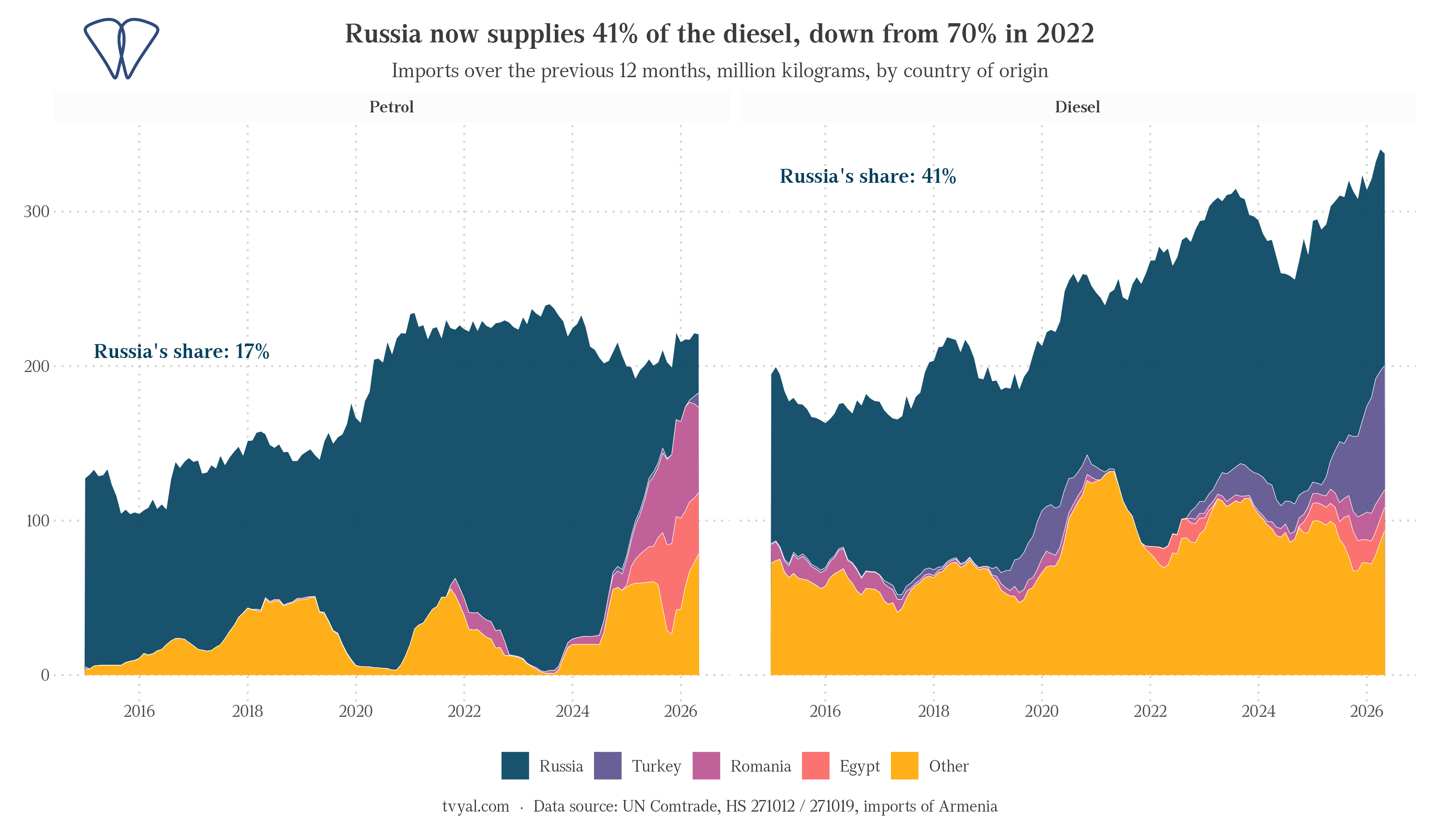
There has been no decline in import volumes. In 2025, Armenia imported more fuel than in any previous year, and the indicators for the first seven months of 2026 maintain the dynamics of the previous year. The country buys the same amount of fuel, but from new, more distant sources and at world prices. It should be noted that Armenia is part of the EAEU common market, and, according to the EAEU agreement, a common energy market should operate, which is currently not in effect. The common energy market was also not in effect in 2025.
Russian gasoline pricing was based on the Russian domestic regulated market and was delivered by rail through Georgia. Mediterranean gasoline pricing is based on Platts quotes, plus sea freight and Georgian transit costs. In 2022, the price gap between a liter of crude oil and a liter of fuel sold at a gas station widened by about 100 drams and has never recovered.
Regional price comparison
Compared to its regional neighbors and the EAEU member states, the price of gasoline in Armenia was the highest. This was the first sentence of our March 2024 analysis, which needs to be corrected today. Armenia is third in the region by diesel fuel prices, second only to Ukraine and Moldova, countries at war or directly bordering it. Georgia and Turkey currently surpass Armenia in gasoline prices. Our oil-producing neighbors have a lower price. In Azerbaijan, it is 235 drams, in Kazakhstan — 276 drams, in Russia — 353 drams.
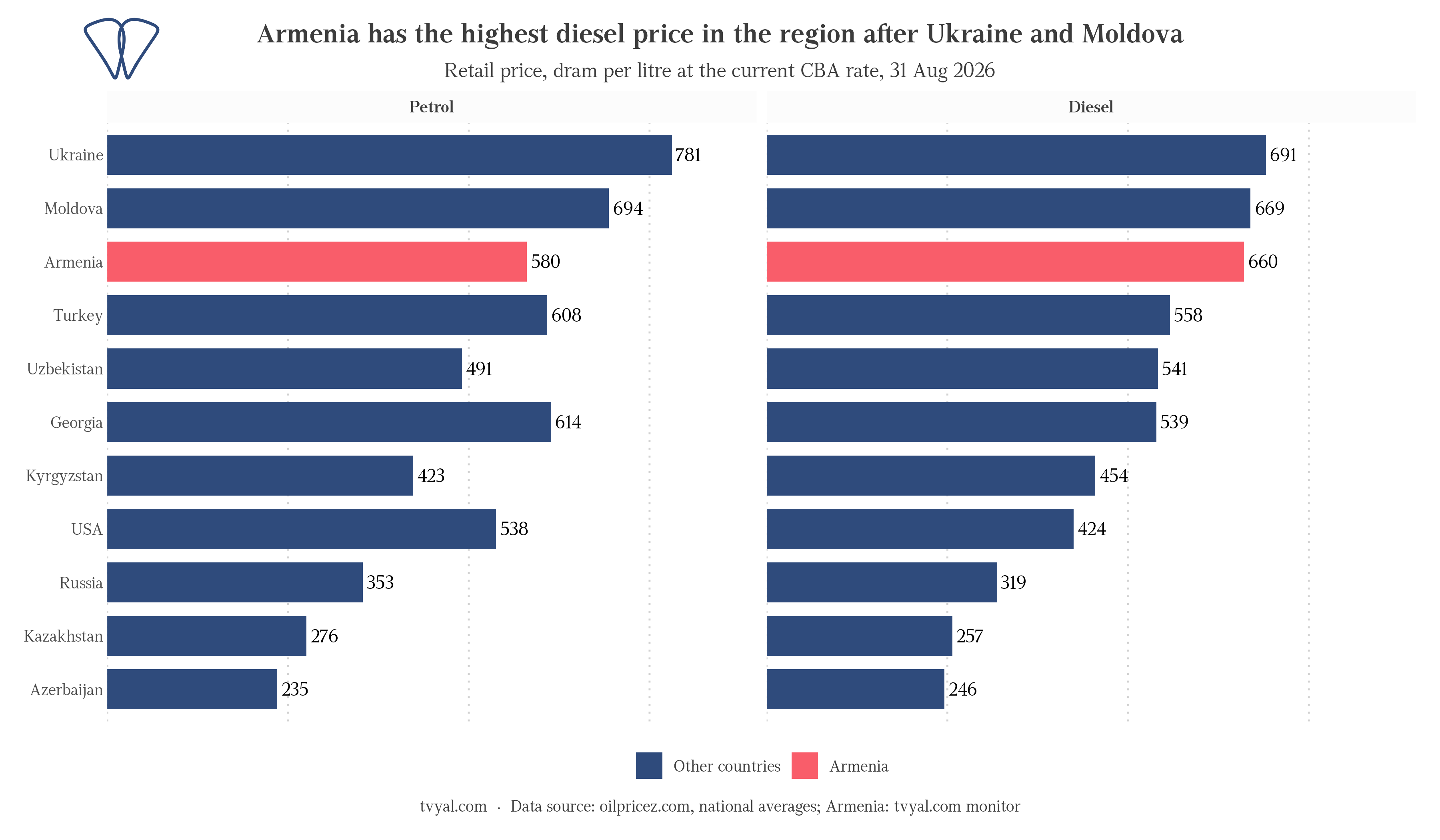
Georgia’s figure requires special consideration. Georgia, like us, buys most of its fuel from the same Black Sea sources and is logistically closer to the source of supply, but gasoline is more expensive there than in Armenia. The Armenian price is logical for a country that imports all of its fuel first by sea and then via difficult mountain roads. The discrepancy only becomes apparent when this price is compared to the prices previously paid for Russian fuel.
Public discussions and statistical data
In April, when Russia extended its gasoline export ban, the Economy Minister announced that Armenia, as an EAEU member, benefits from quotas and will not face any problems [4]. In July, Sputnik Armenia published an article stating that Russia is irreplaceable in the energy and food sectors [5]. For gasoline, substitution has already become a reality this year. For diesel fuel, Russia remains the largest supplier, providing about a third of the market. However, this share is still at risk, due to the fuel export bans imposed by Russia in July. A return to Russian fuel will be possible only with the stabilization of global energy markets, the restoration of normal operations of oil refineries in Russia and the Middle East, and the easing of geopolitical tensions. If the above factors are ensured and the economic obligations of the EAEU are fully implemented, imports from Russia will once again make economic sense. Currently, however, the economy of the Republic of Armenia is in the process of diversifying its import sources.
As already mentioned, there is no agreement between importers and the state to artificially increase prices: domestic prices are based on world prices with a certain time lag. The domestic price includes excise tax, VAT, border costs, possible corruption risks, as well as the importer’s margin, calculated per liter. A study of customs data shows that in February-May the price of diesel fuel at the border increased by 45 percent.
The Russian ban on diesel exports expires on September 30. If, due to a certain lag, the price of diesel in Yerevan continues to remain above 450 drams, then the period of high prices in 2026 depicted in the second graph will exceed the seven-month mark. For comparison, in 2022 this cycle ended after eleven months.
* Daily prices at gas stations are taken from the tvyal.com fuel monitoring system, which collects prices displayed at gas stations in Armenia. Data on import volumes and countries of origin are based on monthly statistics for Armenia from the UN Comtrade database (until May 2026, commodity groups: HS 271012 (gasoline) and 271019 (diesel, kerosene and fuel oil), import flow, all modes of transport). The border price was calculated by dividing the customs value by the net weight and multiplying by the density coefficient (0.750 kg/liter for gasoline and 0.885 kg/liter for diesel), as well as by the monthly exchange rate of the Central Bank of Armenia to the dollar. Brent crude oil price is based on daily data from the European spot market FRED, converted to 158.987 liters per barrel and calculated at the daily exchange rate of the Central Bank of Armenia. Regional prices are national averages according to oilpricez.com and the Central Bank of Armenia exchange rate as of September 10, while Armenia data is taken from our own monitoring. Iran is excluded from the analysis, as the subsidized price expressed in rials does not reflect the real market situation.
References
[1] Short-Term Energy Outlook, global oil markets, September 2026 // U.S. Energy Information Administration — https://www.eia.gov/outlooks/steo/report/global_oil.php
[2] Russia bans diesel exports after Ukrainian attacks, straining already tense global market, 9 July 2026 // CNN Business — https://www.cnn.com/2026/07/09/business/russia-diesel-ban-ukrainian-strikes-intl
[3] Russia extends gasoline export ban until end of 2026, 27 July 2026 // S&P Global Commodity Insights — https://www.spglobal.com/energy/en/news-research/latest-news/crude-oil/072726-russia-extends-gasoline-export-ban-until-end-of-2026
[4] Բենզինի արտահանման սահմանափակման մասին ՌԴ որոշումը չի ազդի մեզ վրա. Գևորգ Պապոյան, 4 April 2026 // Sputnik Արմենիա — https://arm.sputniknews.ru/20260404/benzini-artahanman-sahmanapakman-masin-rd-vorvoshumy-chi-azdi-mez-vra-gevvorg-papvojan-100631947.html
[5] Էներգետիկ և պարենային ապրանքների պարագայում ՌԴ-ին փոխարինող չկա. Սարգսյան, 2 July 2026 // Sputnik Արմենիա — https://arm.sputniknews.ru/20260702/energetik-ev-parenajin-apranqneri-paragajum-rdin-pvokharinvogh-chka-sargsjan-104103058.html