The end of the era of cheap money: why has the Central Bank decided to raise interest rates?
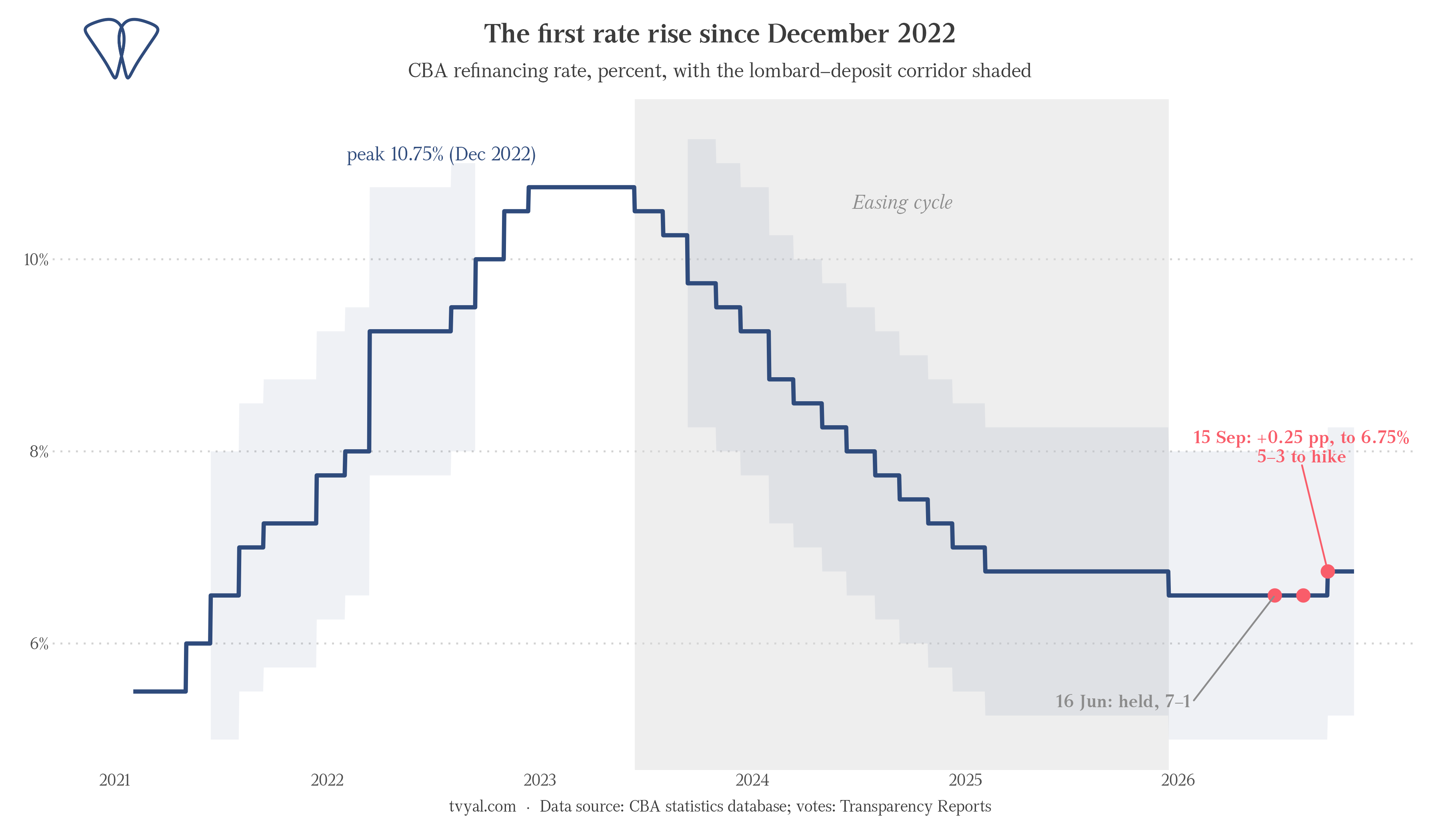
The Central Bank is an independent institution from the government that independently makes decisions on the monetary policy of the economy. In particular, the increase in the refinancing rate, which is used as the main instrument, indicates negative macroeconomic expectations. On September 15, the Board of the Central Bank decided to increase the policy rate by 0.25 percentage points, bringing it to 6.75%, which, although a small increase, is an important conceptual change. This decision is the first increase in the interest rate since December 2022, when it reached a maximum level of 10.75%, after which a long-term phase of interest rate reduction began [1].
Market players did not expect an interest rate increase, as expectations were still positive. A week before the decision, surveys conducted by the Central Bank showed that market participants expected the interest rate to remain unchanged for the next year, with a subsequent decrease [2]. The CB Board approves the refinancing-rate decision by a vote, and the picture of the vote is more interesting than the change in the indicator itself by 0.25 percentage points. In June, seven out of eight members of the Board voted in favor of leaving the interest rate unchanged, and only one member, Narek Ghazaryan, was in favor of an increase [3]. In September, at a meeting held with the same composition, five members already voted in favor of an interest rate increase [2]. In fact, four members of the Board changed their position within one quarter. Thus, expectations for the economy have changed significantly in this short period of time.
At its meeting on September 15, 2026, the Board of the Central Bank of the Republic of Armenia decided to increase the policy interest rate by 0.25 percentage points, setting it at 6.75%.
Let’s discuss why this is so important for the economy and the average citizen.
The members of the Board expressed different views on the priorities for managing the macroeconomic consequences arising from the risks in the medium-term horizon. In particular, Martin Galstyan, Hovhannes Khachatryan, Levon Sahakyan, Narek Ghazaryan and Artak Manukyan, placing greater emphasis on the need to manage the risks arising from Type A scenarios, voted in favor of raising the policy rate by 0.25 percentage points. On the other hand, Armen Ktoyan, Davit Nahapetyan and Armen Nurbekyan voted in favor of leaving the policy rate unchanged in line with market expectations. [2]
What changes occurred between June and September?
The Central Bank’s key interest rate is increased when inflationary pressures or macroeconomic risks are expected to increase in the near future. In a stable economic situation, the refinancing rate is usually kept unchanged or reduced. During the previous session, the Central Bank left the interest rate unchanged, even though a relatively high level of price growth was recorded during the given period. In particular, in April 2026, the annual price growth was about 5.3%, which exceeded the 3% (±1 percentage point) target indicator set by the Central Bank. However, this price increase was also assessed by us as a short-term shock due to the closure of the border with Iran in February-March, and the Central Bank predicted a further decrease in prices.
The June estimates and the Central Bank report reflected this approach. Although demand was assessed as expansionary, the spring inflation trends were mainly characterized as a short-term phenomenon caused by supply shocks: “In this situation, the impact of aggregate demand on inflation is assessed as expansionary, although supply factors still dominate the behavior of inflation.” [3]
In the analysis published in June, the disruptions in transport logistics were characterized as a temporary phenomenon. In our earlier analysis, it was also stated that the increase in prices in the rental market is temporary. At the same time, it was noted that the sharp increase in prices observed in the spring was due to one main factor: the blocking of the southern supply route for Iranian goods. It was predicted that as cargo transportation resumed the increase in food prices would moderate. This prediction came true: the increase in food prices decreased from 8.6% in June to 6.4% in August. In this regard, the assessments of both the Central Bank and independent analysts were realistic.
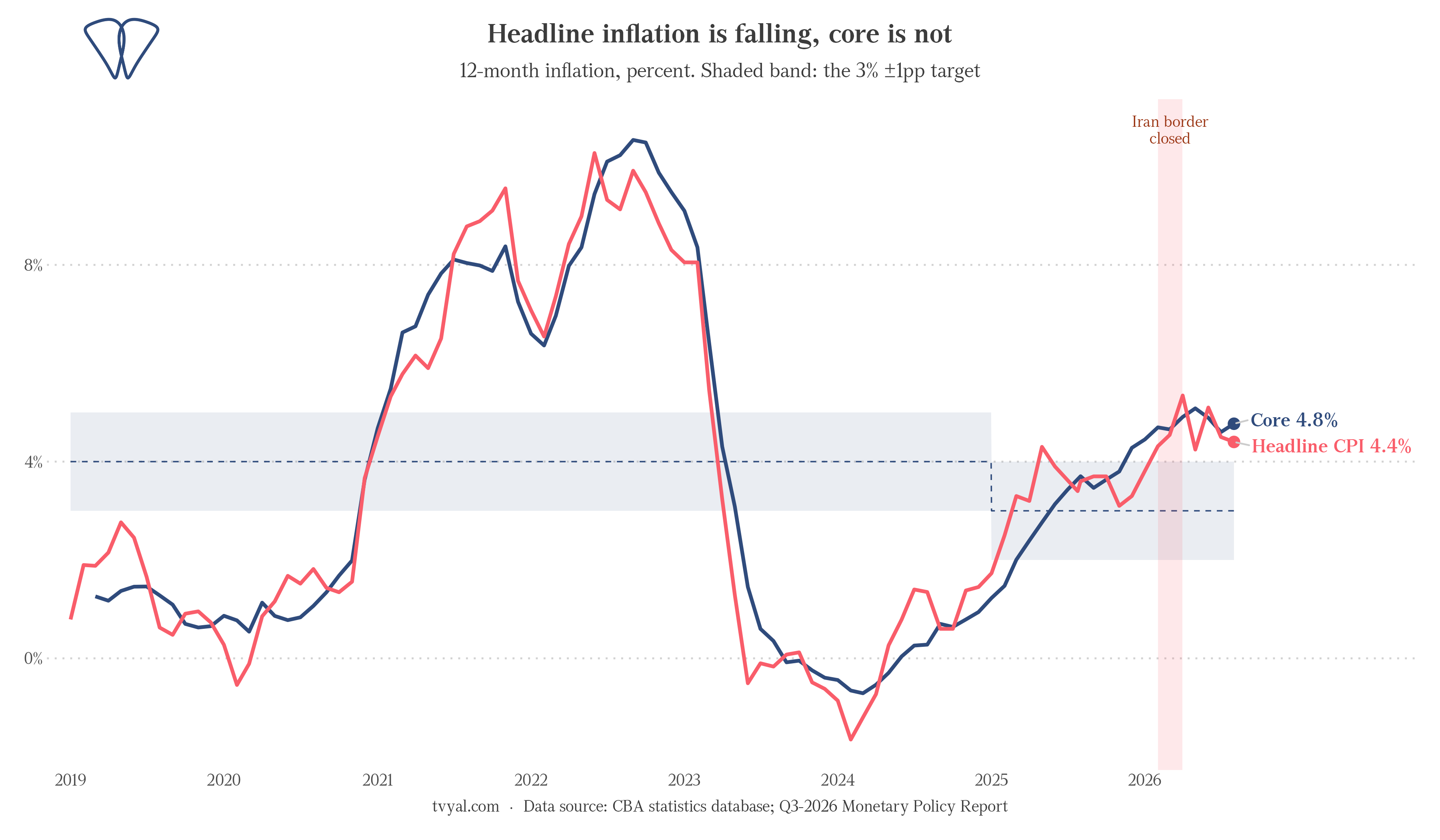
However, the situation has undergone some systemic changes. The overall price increase has decreased to 4.4%, but the core inflation, which does not include variable prices of food and energy, has not shown a corresponding decrease. It amounted to 4.8%, exceeding the 3% target indicator and going beyond the permissible range set for it. The September report describes core inflation as a phenomenon that is becoming more comprehensive: “In the third quarter of 2026, 12-month inflation continued to form at a level above the target, reaching 4.4% in August, and 12-month core inflation amounted to 4.8%.” [2]
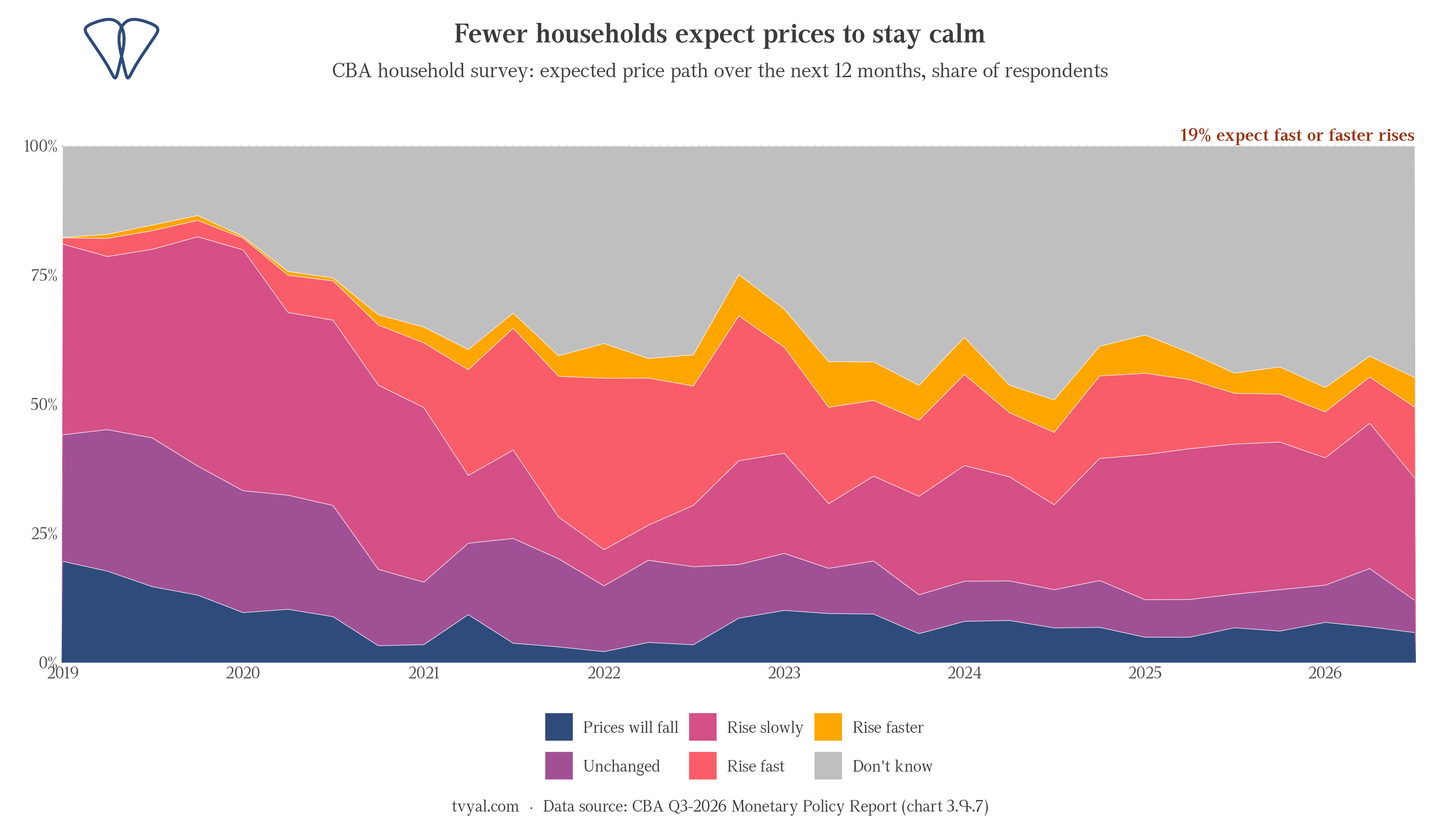
By economic logic, the shock that should have been limited to the food market gradually penetrated the rental, services and wage markets. Short-term inflationary phenomena turn into a sustainable trend when appropriate inflationary expectations are formed. According to surveys conducted among households by the Central Bank, the share of those expecting accelerated price growth increased from 13% in the second quarter to 19.5% in the third quarter, with about 45% of households finding it difficult to give a clear assessment [2]. This is a very important macroeconomic signal for monetary-policy makers.
The demand that the Central Bank Board is trying to curb
The Central Bank’s decision is directly aimed at regulating demand. Of the three Type A risks identified by the Board, the primary one is the formation of excess demand in the domestic economy.
Type A scenarios, which include: [2]
- creating conditions for excess demand in the domestic economy,
- further expansion of external demand,
- risks of increasing inflation expectations.
The growth in demand is fueled by several sources. In the second quarter, economic growth amounted to 6.7%, of which private consumption alone contributed 5.5 percentage points. Wages in the services sector outside the financial and information technology sectors are growing by 9.2% annually, which is three times higher than the inflation target. In addition, there is a new wave of arrivals to the Republic of Armenia, which was addressed in the previous analysis. This refers to people who rent apartments, use eateries and other services, making payments in Armenian drams. This phenomenon was also confirmed by the Chairman of the Central Bank of Armenia, Martin Galstyan: “Due to the new wave of arrivals to the Republic of Armenia, prices have begun to show acceleration trends.” [4]
This pattern is periodic. The shocks caused by external factors in the last four years (the inflow of Russian capital in 2022, the re-export of gold in 2023 and 2024, and the Iranian financial flows in 2025) have been reflected in economic growth indicators, simultaneously leading to an increase in rental prices and the appreciation of the Armenian dram. We have written about this many times. In the current situation, the Central Bank Board has concluded that this wave of demand will not subside on its own at a sufficient pace, and the economy is operating in conditions of demand exceeding its potential level.
The appreciation of the Armenian dram is no longer a sufficient deterrent factor
Over the past three years, the main anti-inflation tool in Armenia has been the exchange rate, not the key interest rate. Since 2022, the Armenian dram has appreciated by about 25% against the US dollar, and since a significant part of the consumer basket consists of imported goods, the appreciation of the dram has led to price restraint. As a result, there has been no need for significant interest rate intervention by the Central Bank, as the exchange rate itself has restrained inflation. This circumstance was also substantiated in a previous study on the stabilizing effect of remittances, which explains the prolonged phase of monetary policy easing in 2023-2025.
The Central Bank Chairman also confirmed this approach at a press conference: “Our exchange rate has appreciated, but that appreciation has been quite moderate. I’m not even talking about energy. Today, the price of Brent oil is already $107 per barrel.” [5]
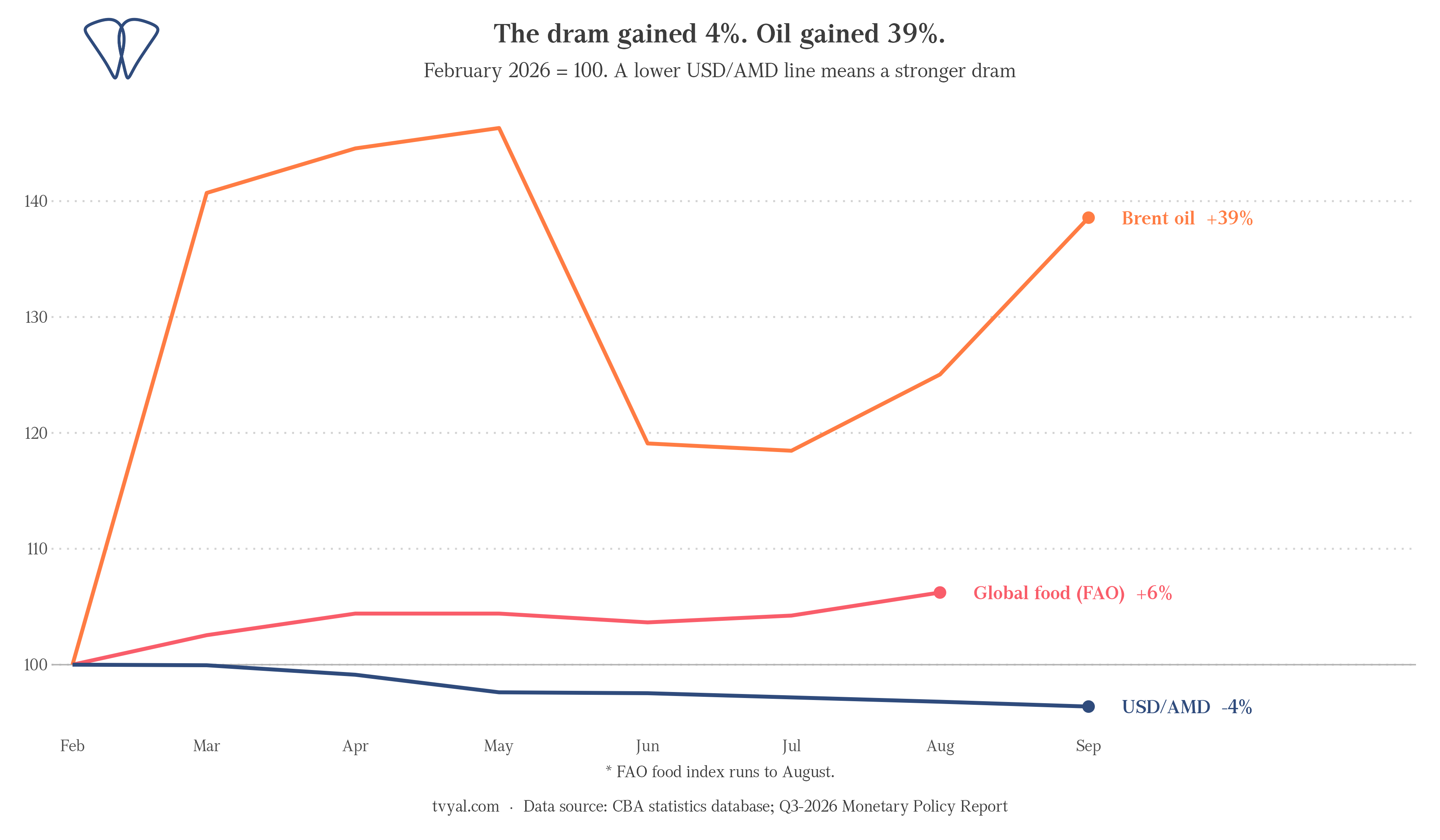
Since February, when border and oil market disruptions were observed, the price of Brent crude oil has increased by 39%, and the Food and Agriculture Organization (FAO) World Food Index by 6%. During the same period, the Armenian dram has appreciated by only 4%. In fact, the 4% appreciation was supposed to compensate for the 39% inflation shock coming from external markets. As documented in our previous analysis, diesel prices in dollar terms are the highest in the last six years. These economic factors underlie the Central Bank’s decisions. When the exchange rate is no longer able to fully absorb external inflationary pressures, the board is forced to use the CB’s key interest rate as a macroeconomic regulation tool. We should also note that since 2022, the Armenian dram has been the currency that has experienced the highest appreciation or price increase among the world’s convertible currencies. Consequently, the Central Bank and the financial market no longer have sufficient additional resources to stimulate the appreciation of the dram and thereby mitigate inflationary trends.
For a long time, the appreciation of the Armenian dram performed the function of the main interest rate, the role of which, however, is already insufficient.
For simplicity, this resembles the behavior of an ordinary family: when utility costs are covered by external financing (for example, transfers), there is no need to use internal regulation tools. When the volume of external financing decreases and the burden of costs is completely shifted to internal resources, there is a need to use one’s own savings and regulation tools. This mechanism works, but all participants in the economy feel its impact directly.
How will this decision affect businesses and citizens?
The increase in gasoline prices leads to a chain reaction of general price increases. It is important to understand how the increase in the refinancing rate will affect individual economic entities. The increase in diesel prices directly increases the cost of freight transportation and agricultural products. In addition, the possible increase in gas and other energy prices carries additional macroeconomic risks.
A one-time increase in the interest rate by 0.25 percentage points does not significantly affect mortgage loans. As Galstyan noted, an increase in the policy interest rate does not mechanically lead to an increase in bank lending rates. However, the following observation is key for borrowers: “If the cycle continues, and we see that what is happening is not a temporary phenomenon, but a trend, then yes, we should expect higher interest rates in the Republic of Armenia, as is happening in almost all countries of the world.” [5]
The real policy rate (the difference between the nominal interest rate and inflation) had fallen from a peak of 9 percentage points in 2023 to around 2 percentage points by the summer of this year. In fact, monetary conditions had been eased over the previous two years, while prices were rising in parallel, and the September decision was aimed at halting this trend. If core inflation remains within 5%, further rate hikes will become inevitable. However, in the event of a decline in inflation, the board may refrain from additional tightening. Three of the eight members of the CB board have already preferred this approach.
The indicator to watch: It is necessary to monitor core inflation in October and November. The next meeting of the Council will be held in December. If core inflation falls below 4% by then, the September decision will be considered a purely preventive measure. Otherwise, the December meeting will be followed by a second interest rate increase, which will also lead to an increase in credit interest rates. This will also indicate that the phase of easy economic growth is over.
On the food shock: Inflation at the Border. On excess demand: The Temporary Tourist. On the consumption of energy prices and the restraining effect of the Armenian dram: Gasoline price shock. On the recurring logic of external shocks: The Growth Wave Stalled.
* Historical data on the policy rate are based on the statistical database of the Central Bank of Armenia. Data on inflation, core inflation, Brent crude oil, FAO index, USD/AMD exchange rate, GDP contributions, wages and household surveys are taken from the Monetary Policy Program reports and machine-readable tables for Q3 2026. Information on the Board’s votes is extracted from the Transparency Reports for Q2 and Q3 2026. The analytical database is constantly updated, and all indicators presented in the charts have been calculated based on the indicated sources.
References
[1] ՀՀ ԿԲ գործառնությունների տոկոսադրույքները ֆինանսական շուկայում // ՀՀ Կենտրոնական բանկ — cba.am
[2] Դրամավարկային քաղաքականության վերաբերյալ որոշում, թափանցիկության հաշվետվություն և ծրագիր, 2026 թ. 3-րդ եռամսյակ // ՀՀ Կենտրոնական բանկ — cba.am/hy/reports/10608
[3] Թափանցիկության հաշվետվություն և դրամավարկային քաղաքականության ծրագիր, 2026 թ. 2-րդ եռամսյակ // ՀՀ Կենտրոնական բանկ — cba.am/hy/reports/10145
[4] Մարտին Գալստյան. ՀՀ ժամանողների նոր ալիքով պայմանավորված՝ գները սկսել են արագացման տենդենցներ ցույց տալ // Առավոտ — aravot.am
[5] Գալստյան. դրամի արժևորումը եղել է չափավոր, Brent-ի գինը հասել է 107 դոլարի, չի բացառվում նաև վարկային տոկոսադրույքների բարձրացումը // ArmBanks — armbanks.am/279655; armbanks.am/279663