4 trillion drams: What does the 2027 budget promise, and what will actually be spent?
On October 1, the Government approved the draft state budget for 2027 and sent it to the National Assembly [1]. The projected indicators are unprecedented: revenues amount to 3,604 billion drams, expenditures to 4,072 billion drams, and the deficit to 468 billion drams. The draft is under public discussion until the end of October [2]. Therefore, prerequisites are being created for a detailed study of the Government’s program before it becomes law. This analysis considers these very provisions. Instead of discussing whether the budget is the right size, we pose three main questions: where are the additional funds directed, for what purpose are they used, and what part of them will actually be spent?
Where are the additional funds going?
Compared to the 2026 budget law, expenditures have increased by about 444 billion drams, or 12%. However, this significant amount of funds is not distributed evenly: the vast majority of them are allocated to four ministries.
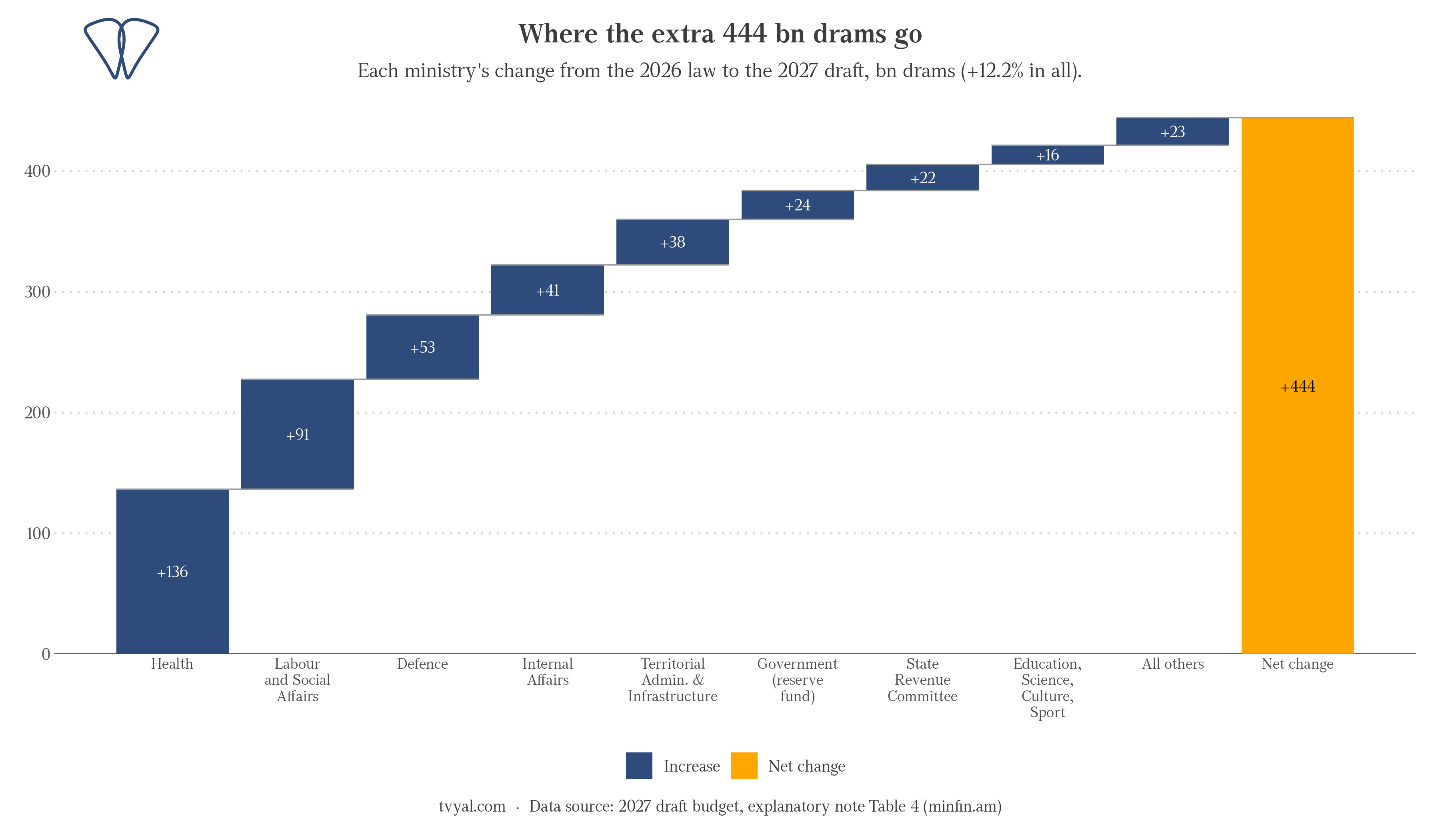
The largest share, 136 billion drams, is allocated to the healthcare sector. The Ministry of Labor and Social Affairs is increasing its funding by 91 billion drams, the Ministry of Defense by 54 billion drams, and the Ministry of Internal Affairs by 41 billion drams. The remaining ministries will receive a much smaller share of the additional spending. In essence, more than half of the increase in spending next year will go to two main sectors: social protection and security. Consequently, the budget does not distribute funds evenly, but is highly centralized.
Budget spending areas
The distribution of funds by ministry outlines the recipients of funding, while the economic classification clarifies the actual purpose of the expenditures.
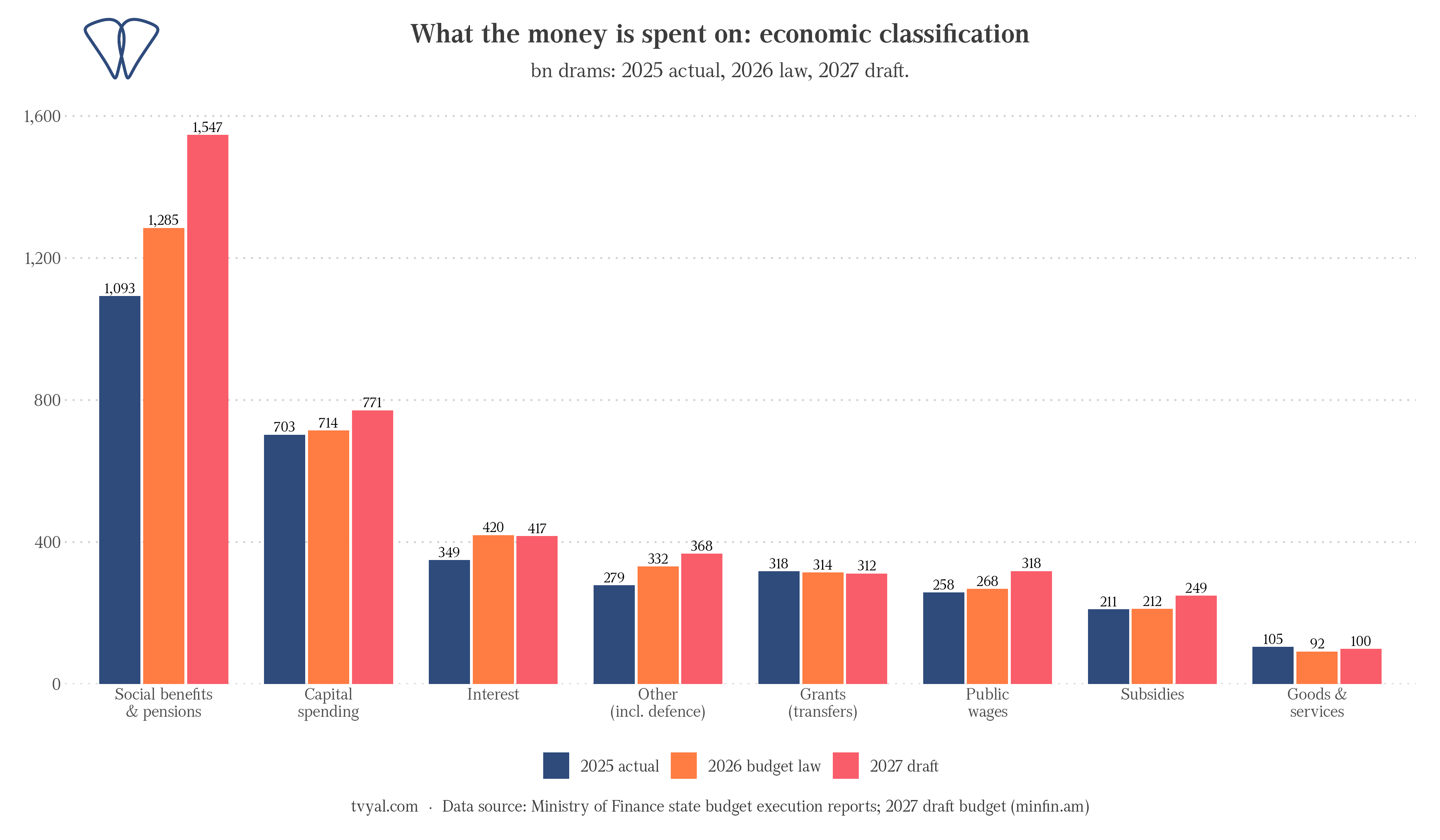
Social benefits and pensions account for the largest amount, estimated at 1,547 billion drams, or close to two-fifths of total spending. Capital expenditures, which are directed toward the construction of roads, schools, and irrigation systems, are the second largest component, at 771 billion drams. Interest payments on public debt currently rank third, at 417 billion drams. This figure has already surpassed subsidies, grants, and public sector wages. This area will be examined in more detail at the end of this analysis, as its dynamics differ from the others.
Areas with increasing and decreasing funding
Preparing the state budget is also a process of setting priorities, which is reflected at the level of individual programs. Below are the main areas whose funding has increased or, conversely, decreased the most.
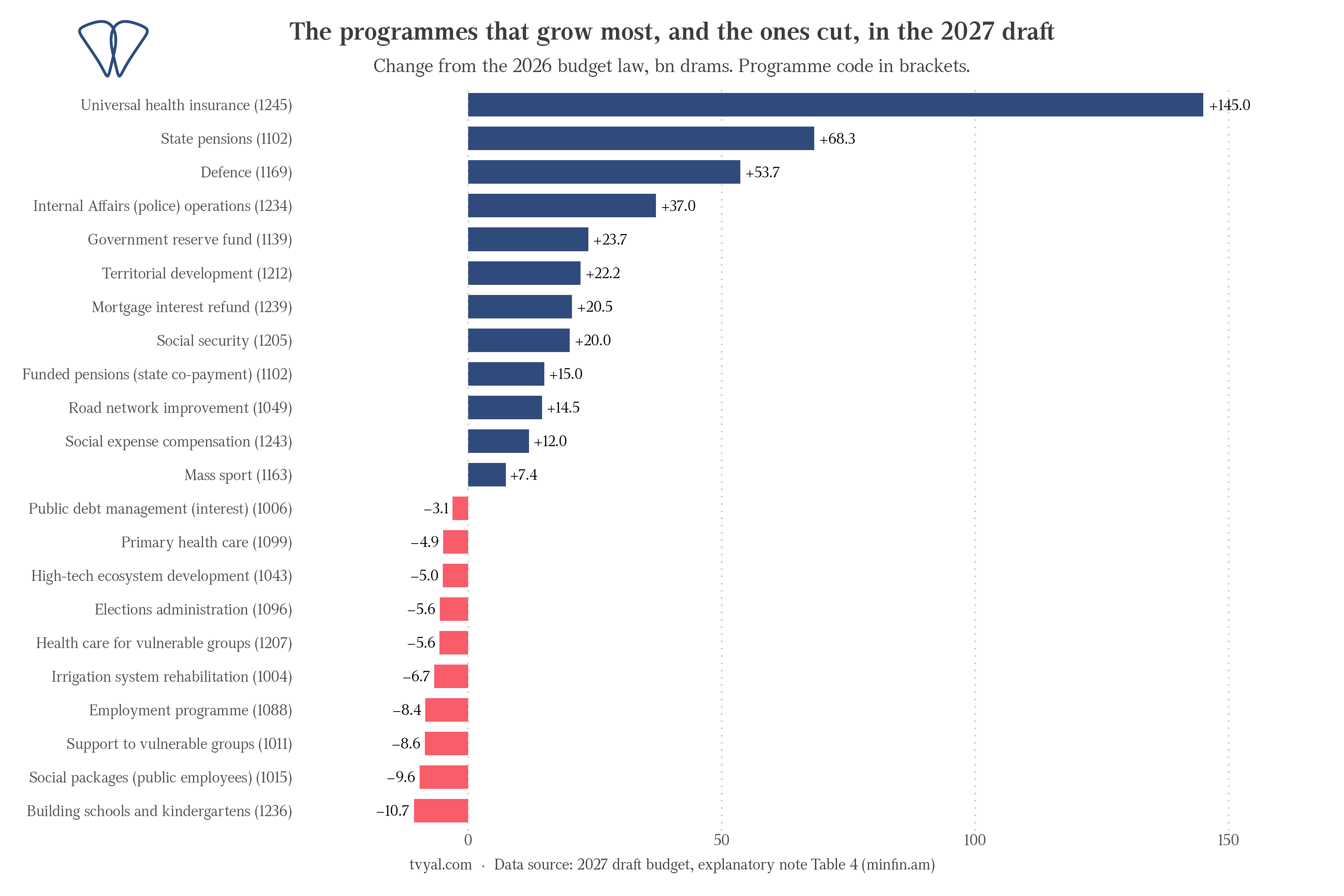
The largest of the new commitments is a comprehensive health insurance system. In 2025, the budget for this program was almost zero; according to the 2026 law, it increased to 131 billion drams, and in the 2027 draft it reaches 276 billion drams. The system should be fully operational next year, providing state-funded medical care for low-income people, the self-employed, and vulnerable groups [3]. The increase in the Ministry of Health budget is almost entirely due to this one program. The volume of state pensions increases by 68 billion drams, and defense spending by 54 billion.
The dynamics of the funds allocated to the defense sector require a separate consideration, as they deviate from the logic of the continuous growth of military spending over the past decade. Although the figure of 614 billion drams implies some growth, it nevertheless lags behind the actual expenditures in 2025, which amounted to about 675 billion drams. The sharp expansion of military spending has been stopped. The draft budget was drawn up after the Washington Declaration of August 2025 [4], which is directly reflected in the financial indicators.
On the other hand, spending has decreased in some areas. Funding for the construction of schools and kindergartens has decreased by 11 billion drams, social packages for civil servants by 10 billion drams, support for vulnerable groups by 9 billion drams, and employment programs by 8 billion drams. A significant part of the cuts falls on one-time or capital expenditures, while the increase concerns obligations that assume annual periodicity. Reviewing such obligations is much more complicated than reducing one-time expenses, and it is more important than individual numerical indicators.
Planned and actual expenses
The state budget is a policy document, and the planned indicators are not always fully implemented. In the Republic of Armenia, obstacles generally do not arise in the process of revenue collection or payment of salaries and pensions. Systemic problems are concentrated in the sphere of capital construction and infrastructure development.
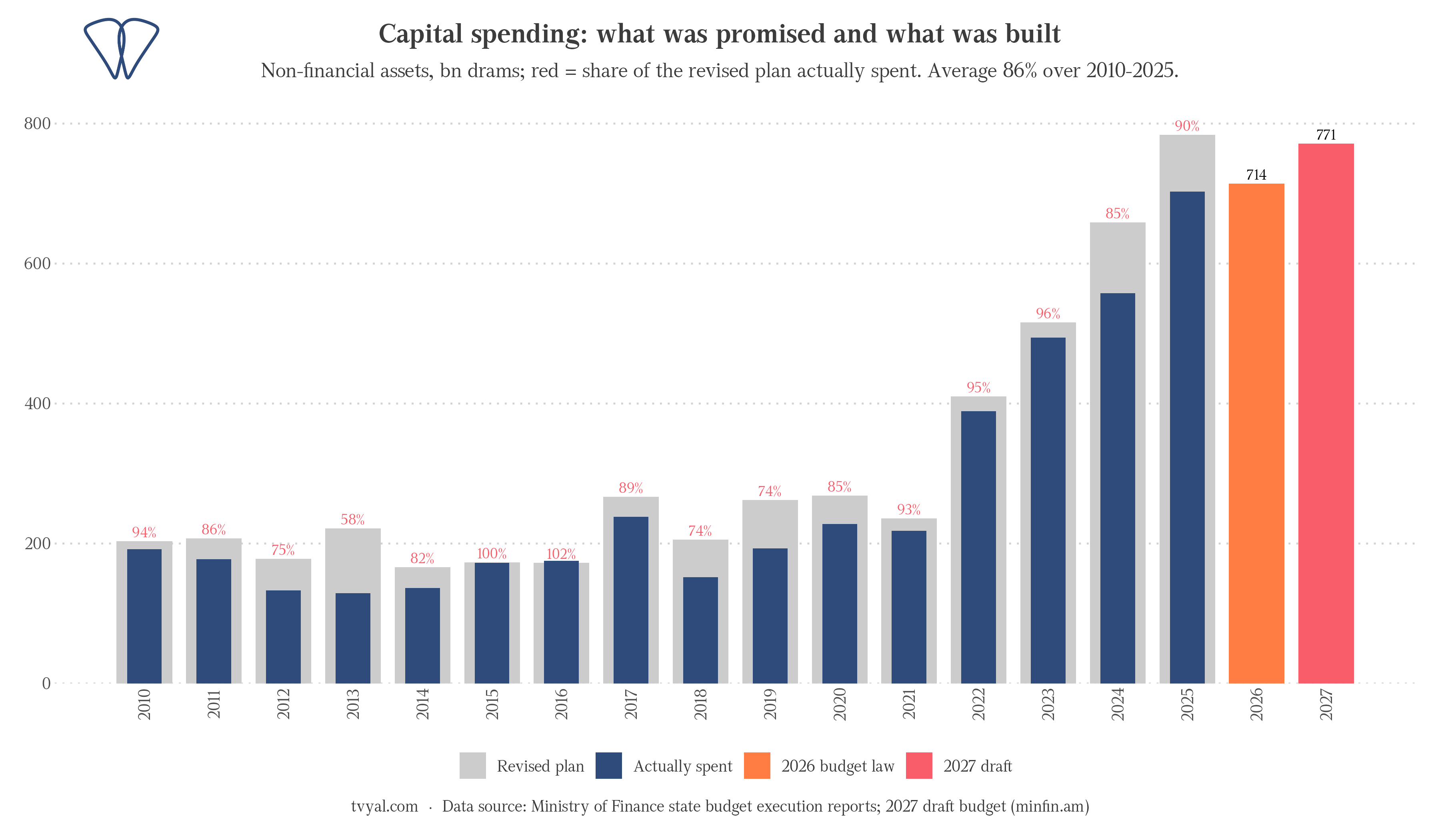
Over the past sixteen years, the Government has executed its capital expenditure budget by an average of 86%. Revenue collection is at or above the planned level each year, and current expenditure execution is close to 100%. Under-execution is mainly observed in the capital expenditure sector; in some years this indicator has even fallen below 60%. Funds earmarked by the legislature for roads and schools are often not allocated according to their intended purpose and are returned to the state treasury as a result.
This is not just a reflection of the past. The first-half 2026 budget execution ended with a surplus of 67 billion drams, while a deficit of 342 billion drams was planned. The execution of total expenditures for the given period amounted to 83% [5]. Revenues were provided at an adequate level. Expenditures, in particular capital expenditures, were underexecuted. The 2027 draft plans an unprecedented volume of capital expenditures of 771 billion drams. The actual construction of infrastructure and their approval in the budget are different issues. A study of statistical data makes it clear that there is a significant gap between these two indicators.
The budget law sets the financial resources. The execution of expenditures determines whether a given road or school is actually built or not. The discrepancy between these two indicators for sixteen years has been mainly due to infrastructure capital projects, rather than periodic current payments.
A continuously growing expense item
Among the major budget items, interest payments are the only item that keeps growing, regardless of changes in the executive branch or set priorities. This is not the result of a political choice, but rather the cost of servicing the already incurred public debt.
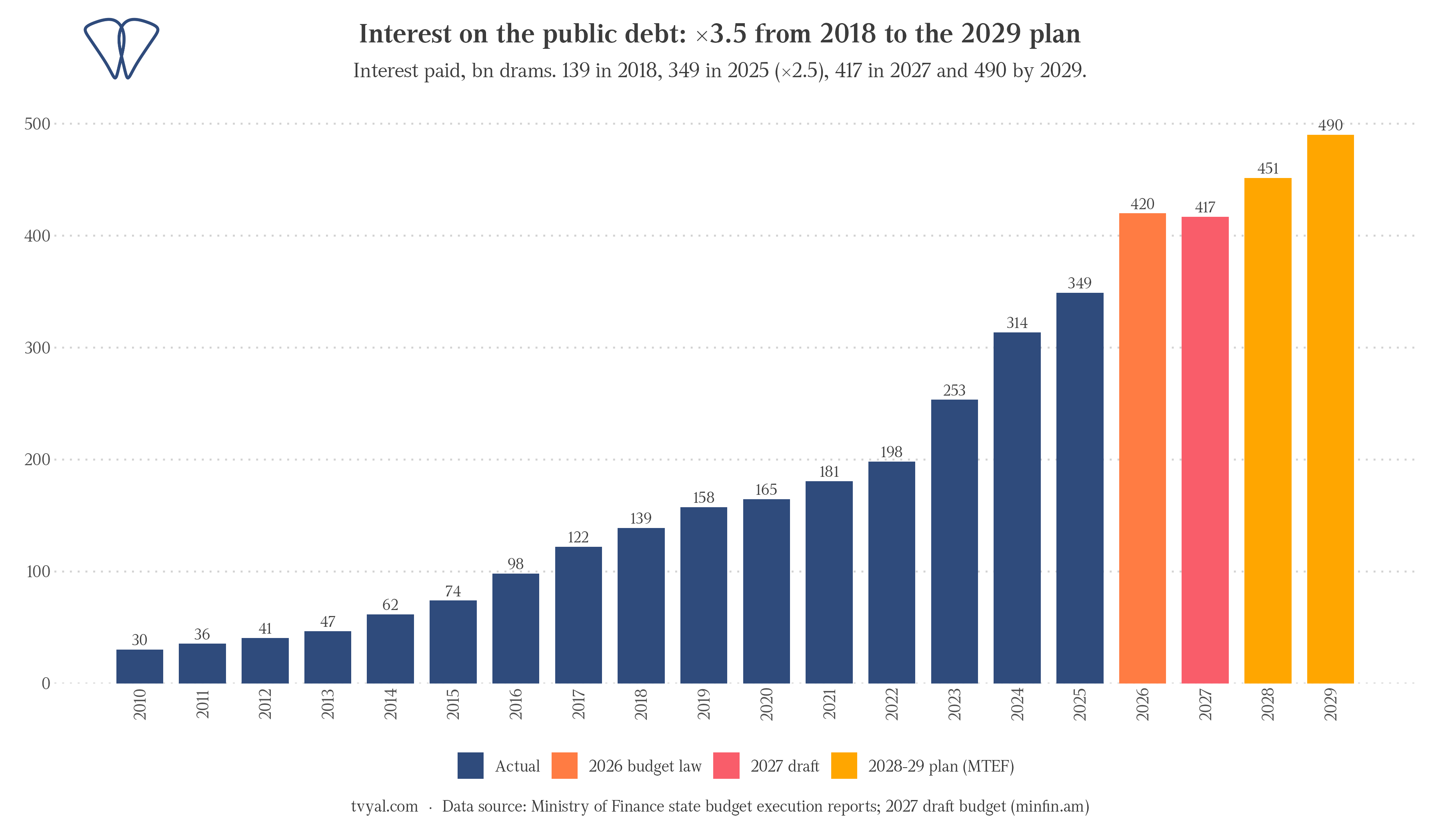
In 2018, the state allocated 139 billion drams for interest payments. In 2025, this figure reached 349 billion drams. The 2027 draft envisages 417 billion drams, and the Government’s medium-term expenditure program expects to increase it to 490 billion drams by 2029. During this period, interest payments have grown at a faster pace than the overall state budget. The economic logic of the process is clear: debt service begins to absorb a larger share of gross income not as a result of raising new loans, but as a result of the continuous servicing of previously accumulated credit obligations.
Borrowing has not stopped. To cover the deficit for the coming year, the Government plans to raise 281 billion drams from external and 188 billion drams from domestic sources. Part of the external financing is a budget support loan, which is directed to financing the deficit, and not to the implementation of specific programs. An example is the 80 million euro loan agreement signed with the OPEC Fund in June, which was raised to cover the deficit and is subject to repayment by 2044 [6]. The volume and currency structure of this debt have been examined in a previous analysis, and its service cost and repayment schedule will be discussed in a separate publication. What matters here is that service costs are already included in the budget and continue to grow.
The government is simultaneously increasing both current recurrent expenditures and the debt service burden. As a result, current liabilities are turning into permanent future expenditures. Official data published by the government directly confirm these trends. Although the situation is currently manageable, the future stability of the system will largely depend on the dynamics of interest payments.
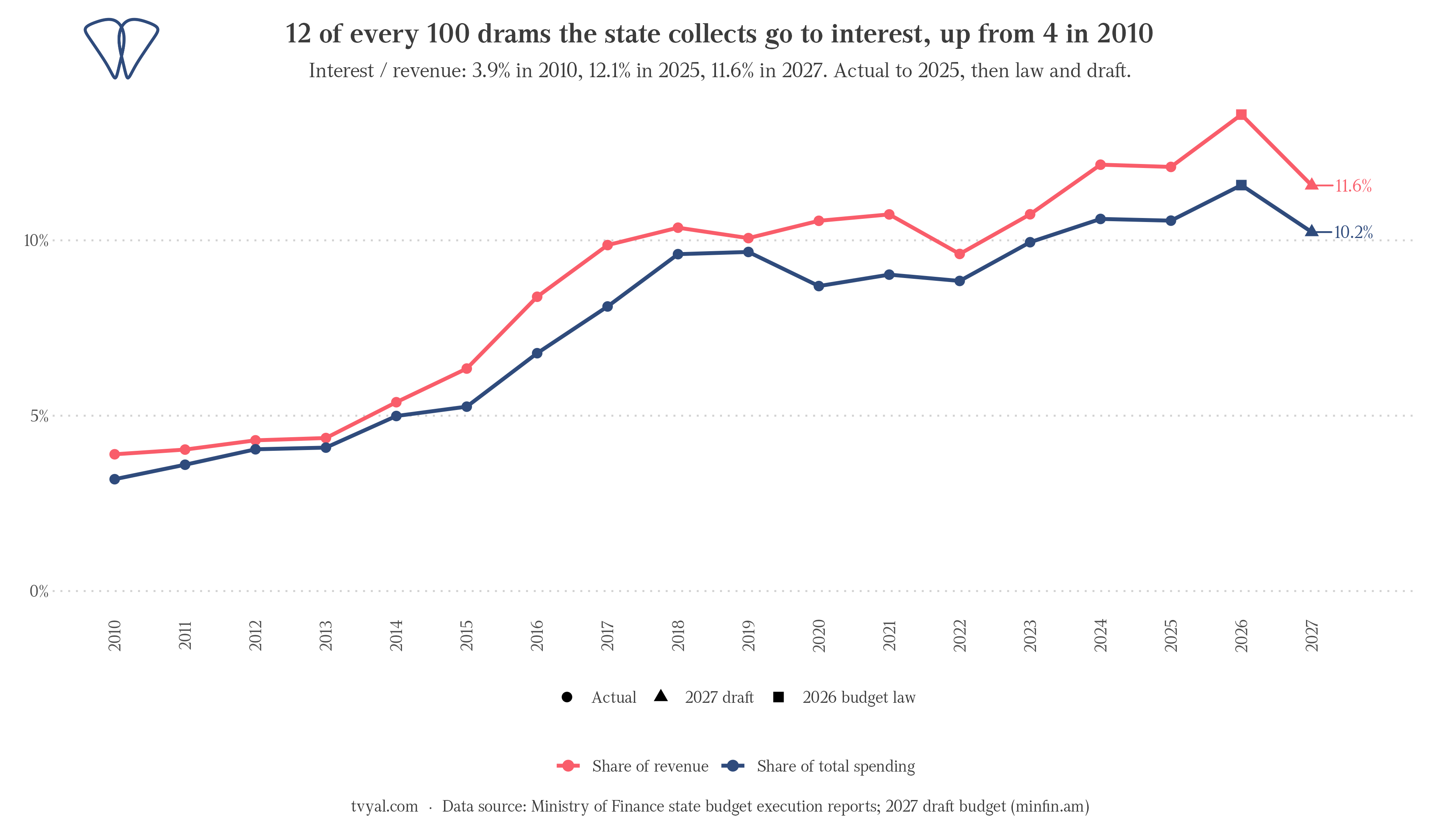
This is a key macroeconomic indicator. In 2010, about four out of every hundred drams collected by the state went to interest payments. In 2025, this indicator reached twelve. In the 2027 draft, it is maintained at twelve, which is the first time in recent years that this share has stopped rising. However, whether this stability will be maintained or the indicator will resume growth in accordance with the forecasts of the medium-term expenditure program will more objectively testify to the macroeconomic stability of the budget than only the general volume indicators.
On the debt volume and currency structure underlying interest payments: “Debt doubled, but the index decreased.” On the external deficit financed by borrowing: “The guests left, the expenses remained.” On the value of money and Central Bank policy: “The end of the era of cheap money.”
* The source of statistical data presented in this analysis is the official documents of the Ministry of Finance: the State Budget Execution Reports for 2007-2026 and the State Budget Draft for 2027 with its explanatory annexes, which are published on the minfin.am website and in the e-draft.am public discussion system. The distribution by ministries and programs is based on Table 4 of the explanatory note to the draft. The long-term series of interest payments and capital expenditures are constructed on the basis of annual and quarterly execution reports. In cases where the indicator is the author’s calculation (income share, execution coefficient, growth index since 2018), this is specifically indicated in the chart. Nominal GDP indicators are taken from the National Accounts of the Statistical Committee. In the ratios for 2026 and 2027, the GDP indicators that are included in the draft itself were used. The source code and database for the charts are available on GitHub.
References
[1] Armenian government approves draft 2027 state budget // Armenpress, October 1, 2026 – armenpress.am
[2] «Հայաստանի Հանրապետության 2027 թվականի պետական բյուջեի մասին» օրենքի նախագիծ, public consultation // e-draft.am, project 10708 – e-draft.am
[3] Armenia universal health coverage to come into full effect in 2027 // Armenpress – armenpress.am
[4] Washington Declaration: moving closer to peace in the South Caucasus, August 12, 2025 // Centre for Eastern Studies (OSW) – osw.waw.pl
[5] Discussion on the first-half 2026 state budget execution // Ministry of Finance of the Republic of Armenia – minfin.am
[6] Armenia Secures €80 Million OPEC Fund Loan to Support State Budget, June 24, 2026 // Caspian Post – caspianpost.com