Ore instead of apricots: what does Armenia export to the European Union?
On October 10, the European Union suspended tariffs on a wide range of Armenian goods for two years [1]. The EU’s official statement noted that the decision covers about 80% of Armenia’s exports to Europe. The clear goal of the measure is to support Armenia in diversifying its export structure [2]. This decision came after the Russian Federation closed its market to Armenian fruit, vegetables, flowers, fish, wine and mineral water in the summer [3]. In Yerevan, Armenian Economy Minister Gevorg Papoyan noted that exports to the EU increased by about 70% in January-August [4]. Meanwhile, in Moscow, Russian Deputy Prime Minister Alexei Overchuk announced a “dramatic decline” in trade with Armenia [5]. A combination of these two indicators may give the superficial impression that Europe is replacing Russia. Various political statements may be made on both sides, but they are often just information noise, since statistical data indicate other trends. A comprehensive analysis of trade data published until August makes it clear that the growth in Europe is mainly due to ore, and agricultural products that have lost the Russian market have not actually found new consumers. As predicted back in June, half of the Armenian products that were in the risk zone have already lost their consumer market and have not been exported.
Statistical data check
The figures published by Yerevan correspond to the data of the Statistical Committee. According to official statistics, exports to the EU increased from $391 million in January-August 2025 to $650 million in the current year. The growth was 66%, which is close to the 70% voiced by the minister. The share of the EU in the structure of Armenia’s total exports increased from 8% to 14% (for comparison, in 2012 it was 38%). Back in May, we noted that exports to the EU have remained unchanged since 2018. In 2026, this indicator recorded a certain increase.
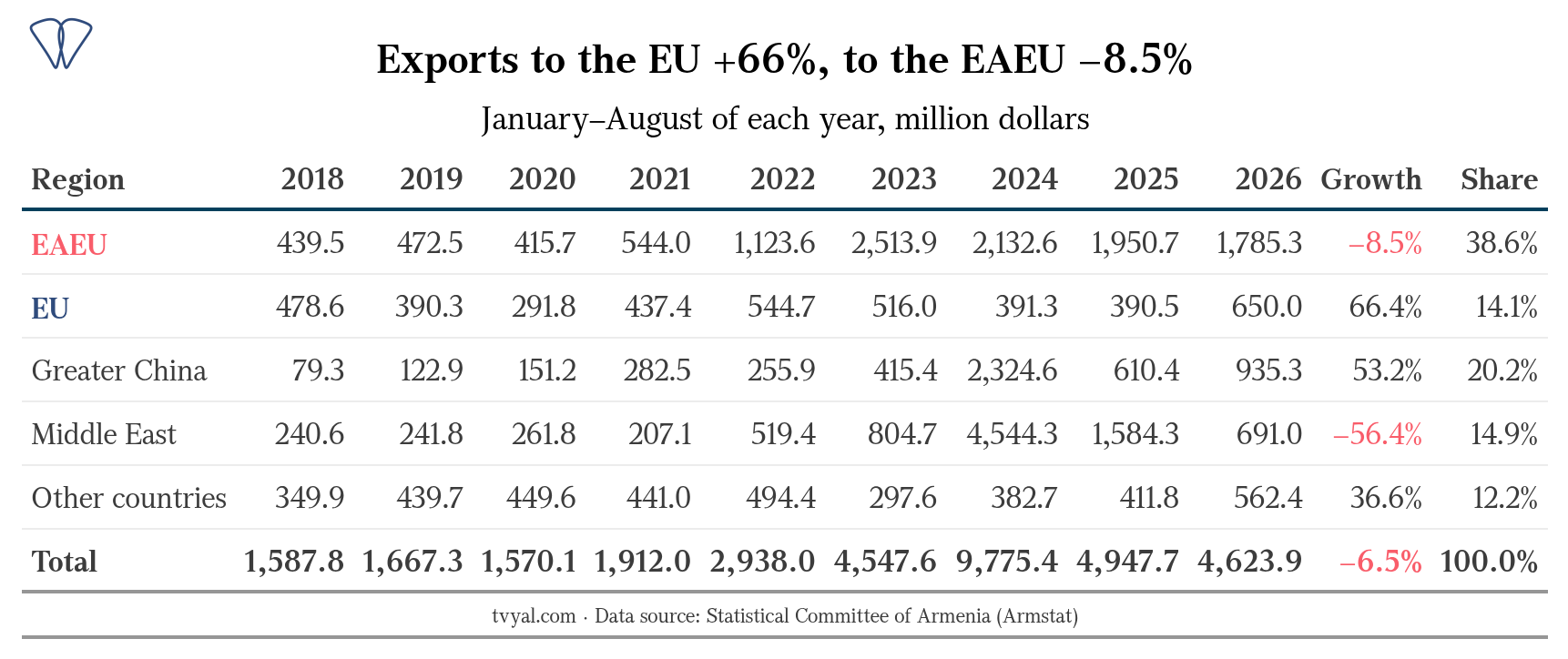
In January-August, trade turnover with Russia decreased from $4.4 billion to $3.6 billion (a 19% decrease), and exports to Russia decreased by 9%. It should be noted that even under such conditions, Russia imports two and a half times more products from Armenia than the entire European Union. The statement of the Russian Deputy Prime Minister is being circulated in two versions. According to a report released by the TASS agency, Overchuk noted that trade turnover has decreased by about two-thirds compared to 2025 [5]. According to the Interfax version, it will be about two-thirds of the 2025 figure [6], which implies a decrease of one-third. The record maximum level of about $12 billion in 2024 is considered a starting point, when Russian gold was transited through Armenia in unprecedented volumes. However, none of these hypotheses are confirmed by the currently published official data.
Exports to Europe have indeed increased. The main issue is which product groups are responsible for this increase.
What is Europe buying?
The UN Comtrade database provides an in-depth look at the structure of exports to Europe by product type for the six months already published. During this period, exports to the EU increased by $236 million, of which $206 million was accounted for by ore and concentrate (mainly supplied to Bulgaria and Belgium). In fact, mining products provided 87% of the growth toward Europe. Excluding ore, the growth of exports to the EU amounted to only 16%, which is fully within the standard range of fluctuations over the past decade.
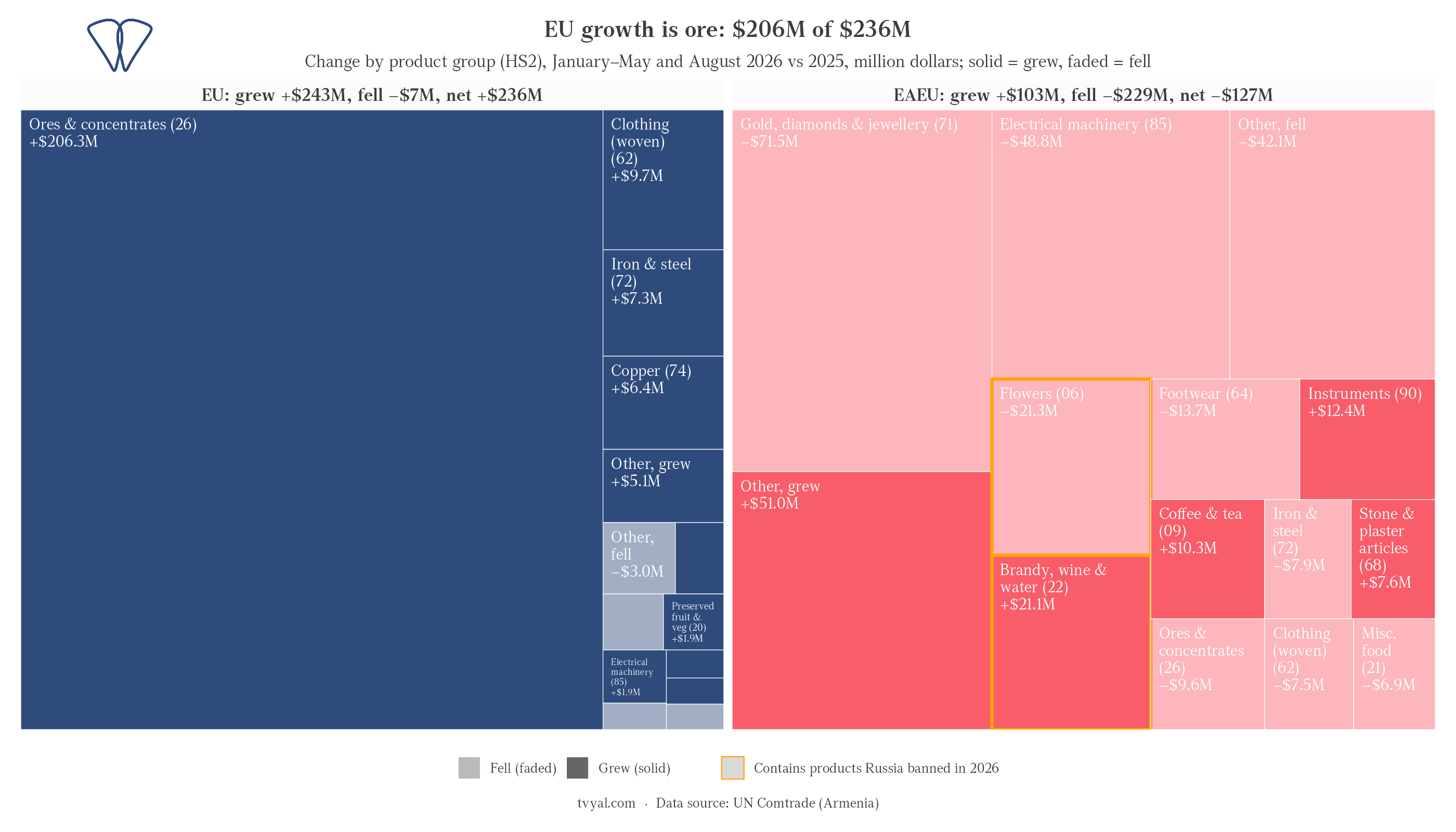
Macroeconomic indicators create an artificially positive picture due to the sharp growth of one highly profitable sector (mining). Meanwhile, the real sector, particularly agriculture, shows systemic losses from the absence of a main buyer. The growth of mining volumes in no way guarantees the further sale of agricultural products.
The structural features of exports to Europe were evident even before the restrictions were imposed, and the current year’s statistics make this trend even more pronounced. About 77% of the export structure to the European Union is accounted for by raw materials, in particular, copper-molybdenum concentrate and non-ferrous metals. These products are in stable high demand in international markets, regardless of the customs duty regimes and country of origin labeling. The only significant product group for final consumption and Armenian origin (“Made in Armenia”) sold in the EU market is light industry products - textiles and knitwear. In the same period of 2025, the share of raw materials was 62%, and the majority of the remaining volume was accounted for by clothing production. Clothing exports, as a unique final product with stable demand in the European market, increased by 15%. Since ore is already exported to the EU at zero customs duty, the newly granted privileges do not actually affect the main export volumes. By concluding comprehensive cooperation agreements, the European Union essentially creates favorable conditions for importing affordable and duty-free raw materials from partner countries, such as grain, metals or ore.
Losses in the EAEU market
In January-August, exports to the EAEU countries decreased by 8.5%, amounting to $1.79 billion. The main reason for the decline is the decrease in transit trade volumes. Re-exports, which imply the supply of goods to Russia through the territory of Armenia, have been consistently decreasing since 2024. During the period published by Comtrade, exports of gold and jewelry to the EAEU decreased by $72 million, and exports of electrical machinery and equipment (mainly telephones and consumer electronics) by $49 million. Due to the sanctions, the Russian Federation developed an artificially high demand for imported goods, turning Armenia into a transit hub. Moreover, this growth came mainly from quantitative, rather than qualitative or institutional, improvements. Meanwhile, Russian sanctions directly hit the other, more important component of the basket - local production. Before the restrictions were imposed, local production was in a phase of stable growth. In January-May, the export of prohibited goods increased by 11.7% compared to the same period last year. However, with the start of the active agricultural season, the borders were closed.
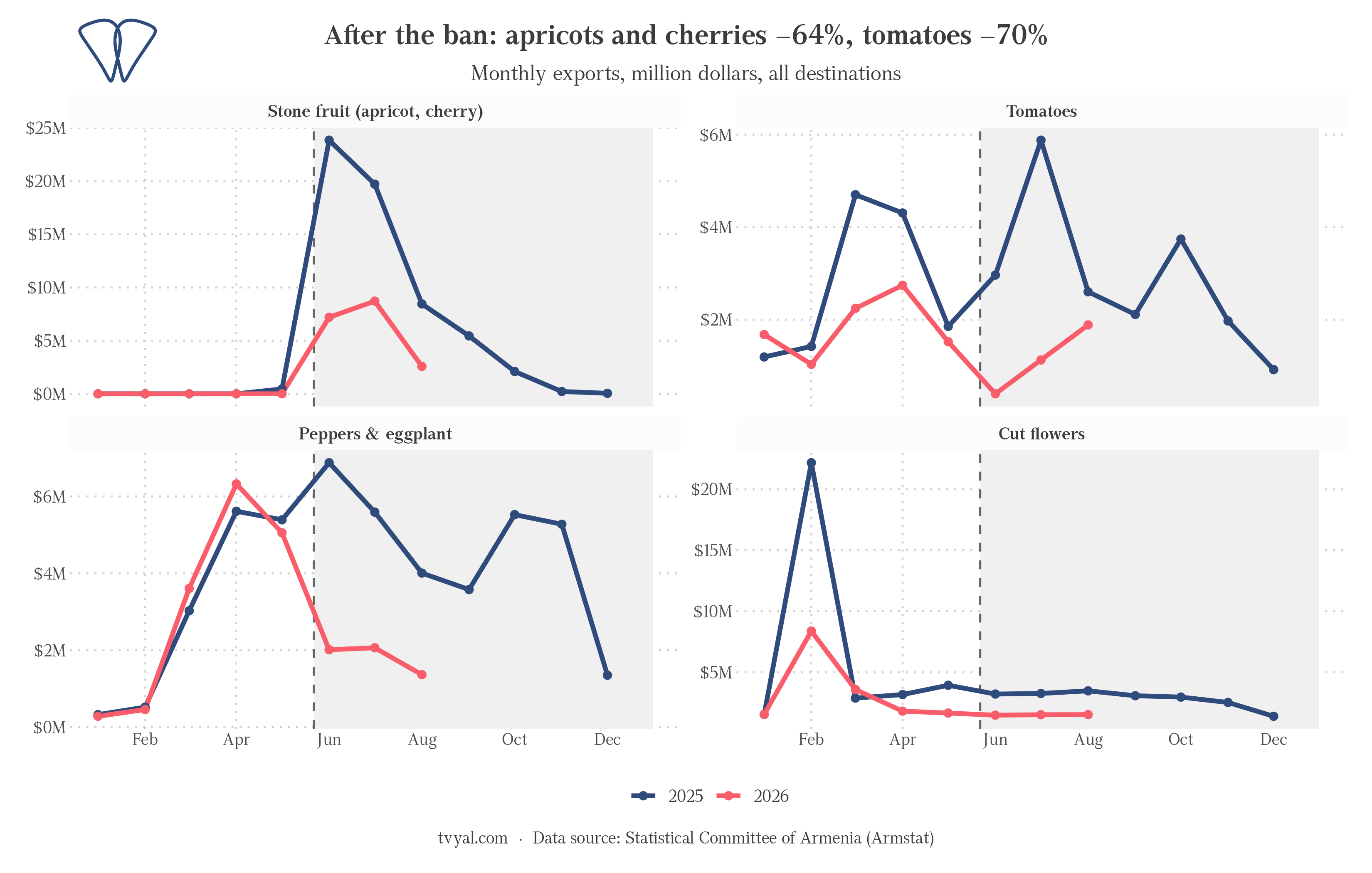
During the June-August period, apricot and cherry exports decreased by 64%, tomatoes by 70%, and fish exports almost stopped. All of these products belong to the category of perishable products. In the case of perishable products, there is very little time to find new consumption markets. In particular, apricot exports have high risk, since even during transportation to the Russian Federation, the quality of the product suffers significantly. From a logistical point of view, reaching the European market takes an additional two weeks.
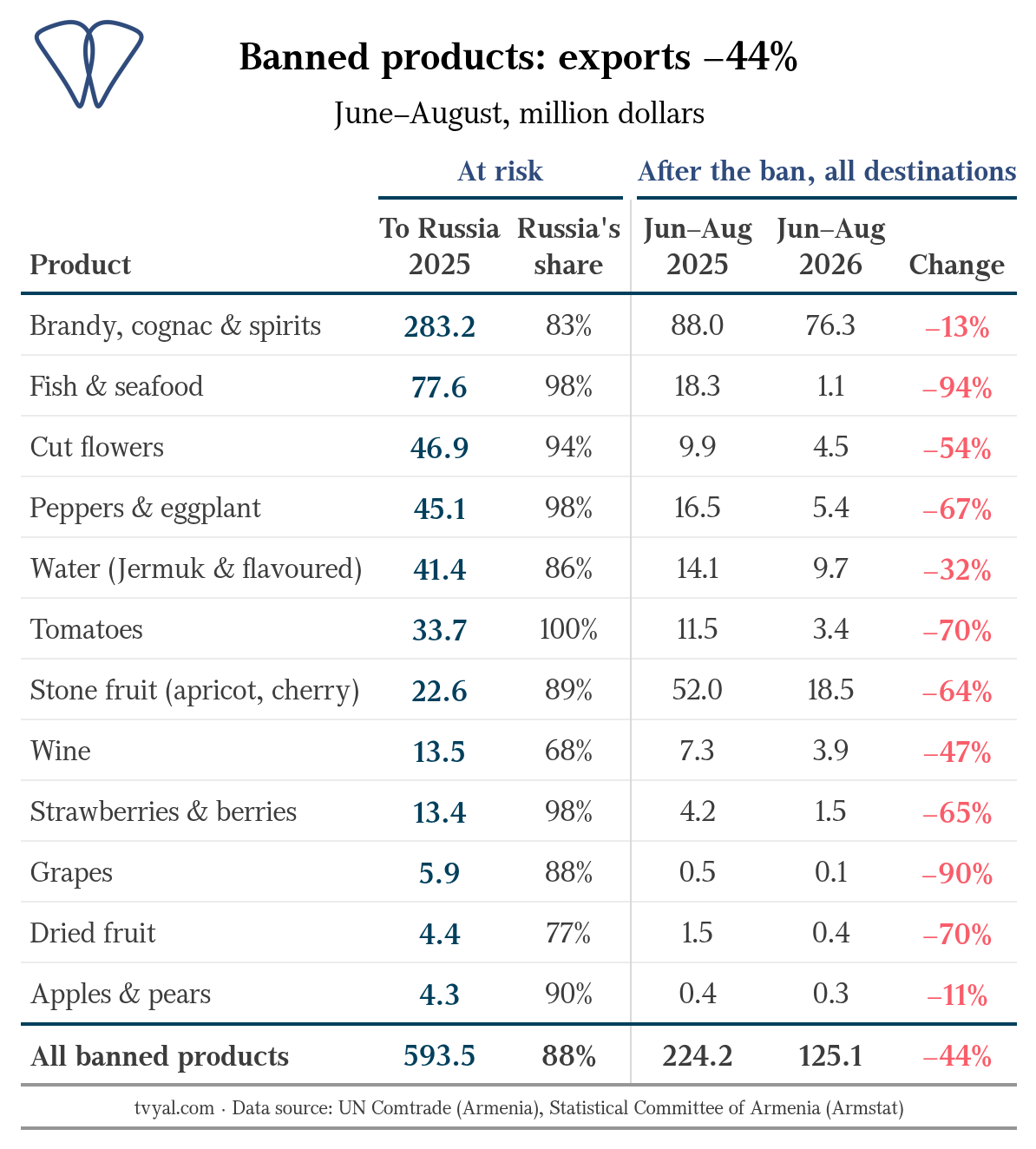
The shock effect of the restrictions comes from Russia having been an almost exclusive consumption market for these products. 80-90% of Armenian agricultural exports are traditionally sold in the EAEU, in particular, in the Russian market. In 2025, 86% of agricultural exports fell to the EAEU. The only exception was tobacco, the main buyers of which are the countries of the Middle East. In the overall structure of the products on the ban list, Russia’s share was 88%, and in the case of tomatoes, fish products and hot peppers it approached 100%. In June-August, the export of banned products decreased by 44%, dropping from $224 million to $125 million. Exports of cognac and mineral water decreased by only 13% and 32%, respectively, due to the non-perishable nature of these products. In the case of fresh agricultural products, losses were incomparably higher, ranging from 50 to 90%.
Were agricultural products sold in other markets?
Theoretically, it could be assumed that the commodity flows were redirected through the territory of Georgia or Iran, eventually reaching an alternative consumer. To test the hypothesis, we need to look at trade turnover by product type and partner country jointly. The Statistical Committee publishes these indicators separately. Combined data is provided exclusively by the UN Comtrade database. However, data for June and July for Armenia have not yet been published, which allows the analysis to be carried out only on the basis of August statistics.
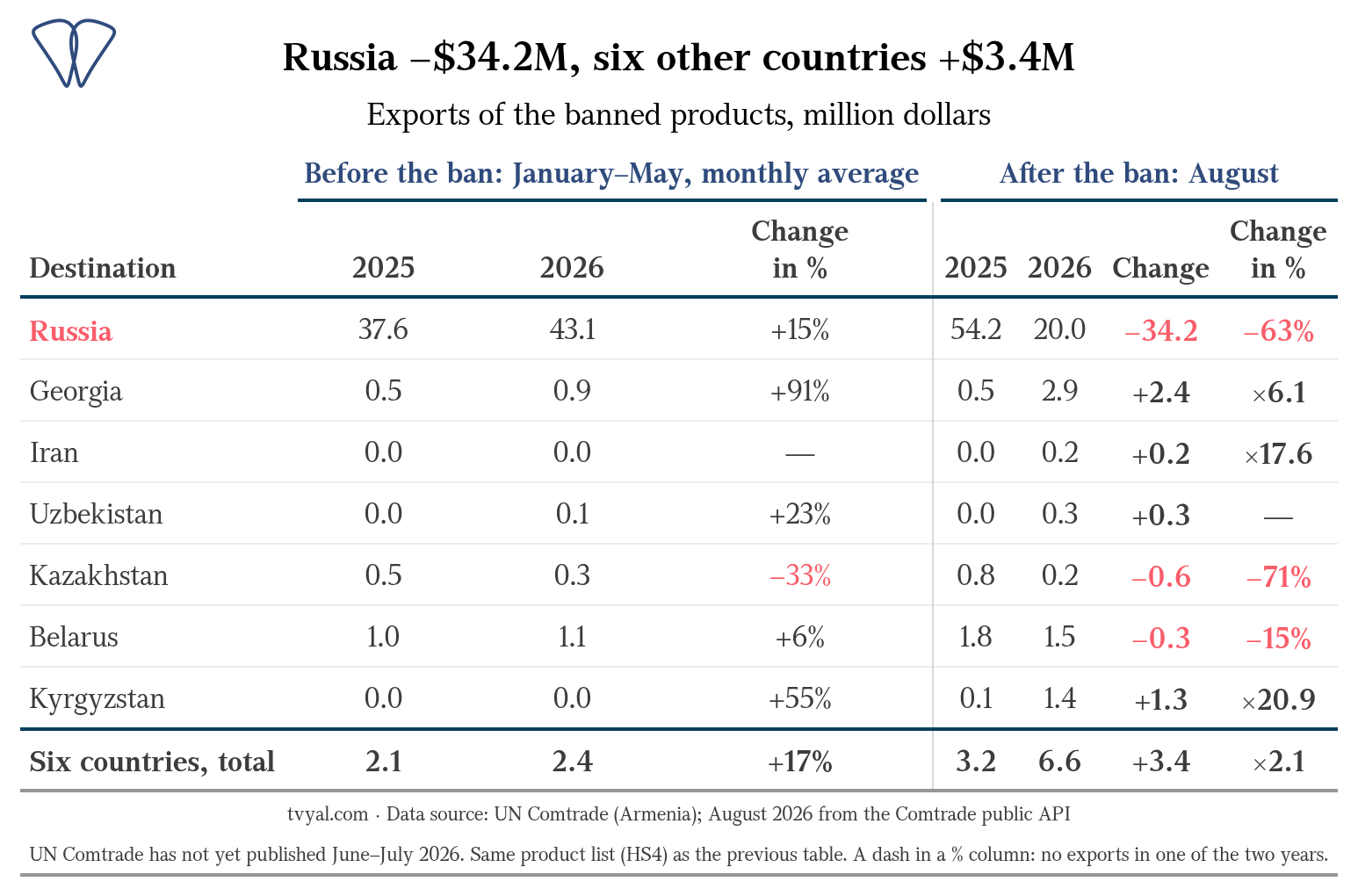
Before the ban, Russia’s purchases of banned products alone increased by 15% year-on-year between January and May. In August, Russia bought 63% less banned products, a drop of $34 million in monetary terms. At the same time, six other countries together bought $3.4 million more, with Georgia accounting for the lion’s share. Georgia’s purchases increased more than sixfold, reaching $2.9 million (mainly flowers, tomatoes, apricots, and cognac). While some of this volume may have been re-exported to Russia, it is still incomparably small compared to the losses suffered on the Russian market. Exports to Iran amounted to only $0.2 million. Looking at all directions and broader product groups, new buyers compensated for only a quarter of the losses recorded in August due to Russia’s withdrawal, with the EU market providing an additional consumption of $1.9 million. In fact, about three quarters of the goods not purchased by Russia were never reflected in any other declared export direction.
Although this time the restrictions were imposed by the partner, the economic logic of the process remains the same. Diversification of foreign markets is a complex and time-consuming institutional process: it is impossible to instantly find an alternative for a market that provided for the consumption of about 90% of agricultural products. The new EU privileges eliminate only legally established customs duties, which are only part of the barriers. Even in the conditions of comprehensive cooperation with the European Union, the elimination of customs duties does not guarantee unhindered access of goods to the European market. There are also non-tariff barriers, the key of which are strict requirements for product standardization and certification. For fruits with a shelf life of several days, logistics and transportation are also a kind of “customs duty”.
Europe has increased its purchases from Armenia, but the growth is mainly due to ore. Meanwhile, the agricultural products lost to the Russian market have not actually found alternative consumption channels.
Confirmation of projected losses
Back in June, at the initial stage of the restrictions, their economic consequences were assessed, according to the preliminary publication. In 2025, exports of the above-mentioned product groups to Russia amounted to about $594 million. It was assumed that part of the volume would be redirected to other markets, but the base scenario predicted a loss of half of that volume, about $300 million per year. Currently, it is possible to actually verify these forecasts. If the trend shown in January-May had been maintained in the summer months, then the revenue from the sale of prohibited goods in the June-August period would have amounted to about $251 million. According to the actual results, it amounted to $125 million. The loss was exactly 50.2%, which fully corresponds to the baseline scenario. In the event of maintaining such a rate of decline annually, the total loss would amount to about $300 million or 1.2% of the country’s GDP. The annual forecast, however, should be viewed with some reservation: it is based on the indicators of the most active three months, while in the autumn season, due to the increase in the export volumes of greenhouse tomatoes and hot peppers, the picture may change significantly. It should be noted that Armenia’s economic growth in the second quarter of 2026 was 6.7%, but agriculture has already experienced a decline, by a significant 15.3%. The decline in agriculture may deepen.
Comparative analysis of the two markets
There are profound structural differences between the two markets under consideration. The European export basket is small in size and consists predominantly of ore. Meanwhile, ore is almost absent from the Eurasian basket, which in turn exceeds the European one by 2.5 times in volume and is distinguished by high product diversification. The majority of not only agricultural products, but also finished products with high added value are directed to the EAEU market. The EAEU accounts for the main consumption of cognac and wine, machine-building products and machinery, vegetables, fish products, as well as electronics within the framework of transit trade.
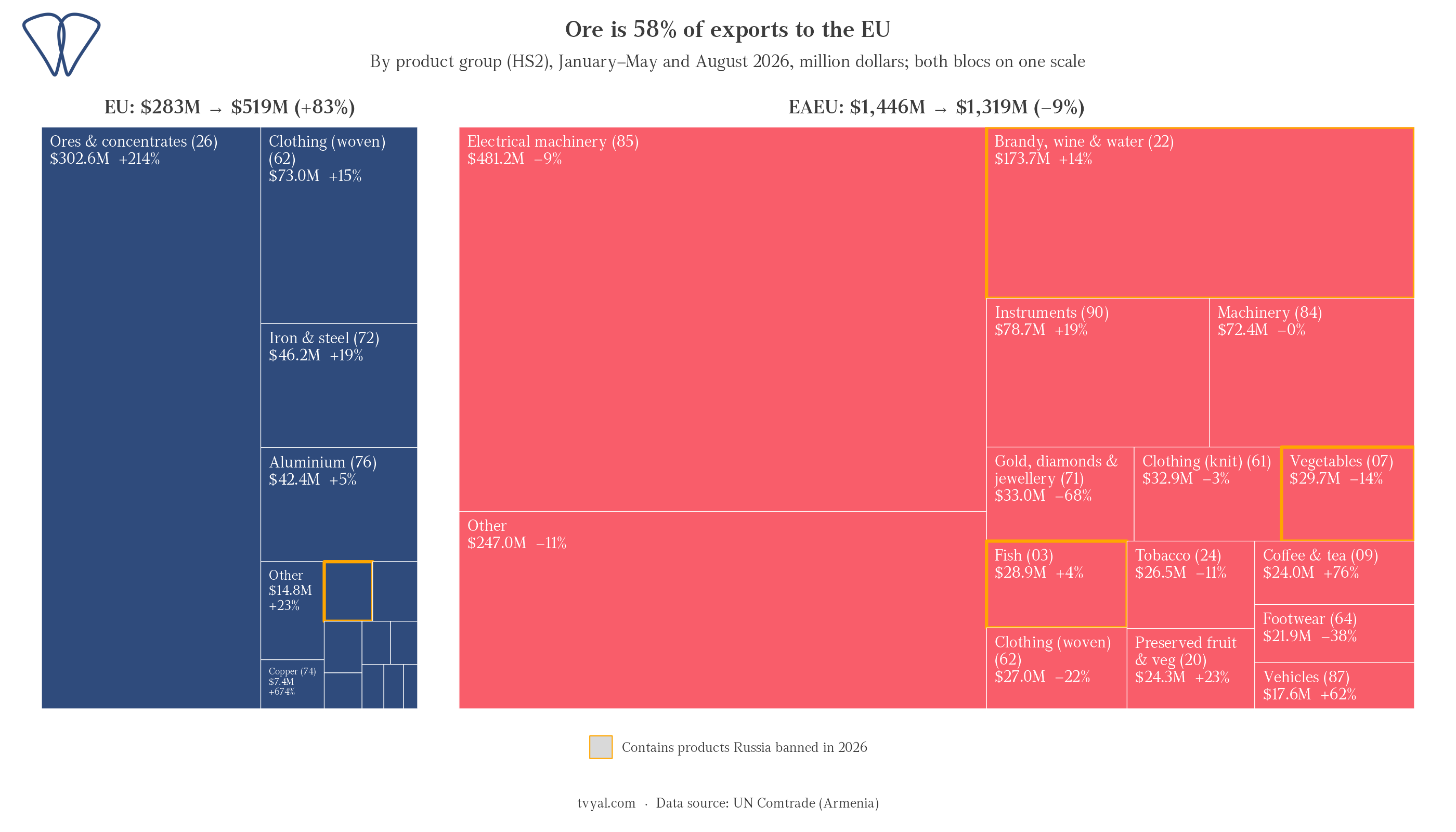
Changing this structural picture requires a comprehensive approach that goes beyond the scope of purely regulating customs tariffs, since tariff concessions do not solve the problem of logistical difficulties. In the case of the Republic of Armenia, as a small economy with closed borders, transport and logistics costs are extremely high. The strategy for entering alternative markets should target products with low weight and high added value, the so-called “boutique” products (for example, walnut jam). The effectiveness of this mechanism is best illustrated by the example of winemaking. In 2025, the average price of exported wine was about $2 per bottle. Therefore, the strategic task is not to ensure the sale of cheap (for example, $2) wine on the Russian market, but to standardize production and qualitatively shift to the premium segment (costing $20, 50 or even $80). In the case of such a high-value product, customs duties and transportation costs lose their critical importance, and it becomes economically profitable to transport the product, for example, by air to any EU country. The same logic is applicable to other sectors. Although Armenian fresh tomatoes are not competitive in the EU market, dried tomatoes (as a non-perishable and high-value product) have great consumption potential. Similarly, from the point of view of stone fruit exports, it is not apricots that should be exported to the EU, but almonds.
As a conclusion, we note that Armenia’s exports, of course, should be diversified. The export of most of our products should not depend on one country, in this case, the EAEU market. However, we should objectively assess our capabilities. The diversification of agricultural products should be directed not mainly towards the European Union market, but towards the countries of the Middle East.
Key monitoring indicator: Exports to the EU excluding mining commodities. During the period of available data, this indicator increased by 16%, from $187 million to $216 million. Apricots produced in the summer season of 2027 will be the first crop to be exported under the new customs preferences. The effectiveness of the preferential regime will be assessed solely by the dynamics of this indicator. If the indicator remains unchanged against the background of continued growth in ore volumes, it will be confirmed that Europe continues to be a market exclusively for mining, not agriculture.
On the directions of the EU and the EAEU since 2018: “The European Vector and the EAEU Reality”. On Russian restrictions and June assessments: “A Harvest With Nowhere to Go”. On the gold corridor and its end: how exports quadrupled and then decreased again.
* The source of trade data by partner countries (monthly, until August 2026) and by product types (4-digit classification of the HS, all directions) is the Statistical Committee of the Republic of Armenia (Armstat). Combined data by country and product types (2- and 4-digit classification of the HS) are taken from the UN Comtrade database (reporter: Armenia, January-May and August 2025 and 2026. June and July 2026 have not yet been published). The list of prohibited goods was compiled based on the restrictions applied by the Russian Federation in May-June 2026 (4-digit classification). The base (without restrictions) scenario for June-August was calculated by multiplying the June-August 2025 indicators by the January-May 2026 growth rate. The GDP volume was assumed to be $25 billion, according to the June estimate. The data were calculated by the author. The source code and database for the charts are available on the GitHub platform.
References
[1] Regulation (EU) 2026/2269 of the European Parliament and of the Council of 7 October 2026 // Official Journal of the European Union, 9 October 2026 – eur-lex.europa.eu
[2] The EU temporarily liberalises trade in certain products originating in Armenia // European Commission, Access2Markets, 9 October 2026 – trade.ec.europa.eu
[3] Russia Issues Sweeping Ban on Armenian Imports After Pashinyan’s Victory // The Moscow Times, 11 June 2026 – themoscowtimes.com
[4] Armenian exports to EU rise 70% // Armenpress, 24 September 2026 – armenpress.am
[5] Оверчук заявил о «драматическом падении» товарооборота между Россией и Арменией // RTVI, 6 August 2026 – rtvi.com
[6] Оверчук заявил о сокращении товарооборота России и Армении на две трети // BFM.ru, 6 August 2026 – bfm.ru