"Taking action for nature": what Armenia's own data shows as COP17 opens
This week, Yerevan is hosting the 17th Conference of the Parties to the UN Convention on Biological Diversity (COP17), with Armenia’s chosen theme as its chairmanship: “Action for Nature” [1]. Global environmental targets are the main issues on the agenda of this conference. The first comprehensive review of the agenda found that less than half of them are on target [2]. As economists, we will not focus on purely environmental issues in this analysis. Instead, we will examine Armenia’s statistical data as the host country of the conference. As chair, Armenia has set four priorities, two of which relate to biodiversity monitoring using the latest technologies, as well as the protection of mountain and freshwater ecosystems [1]. The Statistical Committee of Armenia (Armstat) has been monitoring these two indicators for years. According to official data, 13% of the country’s territory is under protection, while the framework agreement implemented by the conference requires that this figure be increased to 30% by 2030 (in 3-4 years) [3]. There has been no change in these figures over the past decade: the share of protected areas has remained unchanged since 2016, and forest lands since 2018. Therefore, the issue is not to assess the sufficient level of protection, but to identify the trends in statistical indicators and the reasons for the statistical distortions.
Indicator trends: garbage collection in rural areas
The positive shift is most evident in economic indicators. If in 2004, 87% of households in Armenian villages disposed of household waste by burning, burying, or piling it in open areas, then in 2024 this share decreased to 7%. A centralized garbage collection system has been introduced in rural communities. Moreover, garbage burning in yards is not administratively prohibited. The service has become available because households can now afford it, and local budgets have been able to provide its maintenance. This process is a classic manifestation of economic development: in parallel with the growth of the country’s incomes, villages are giving up burning their own waste. The change has stabilized and formed relatively recently, mainly between 2010 and 2020.
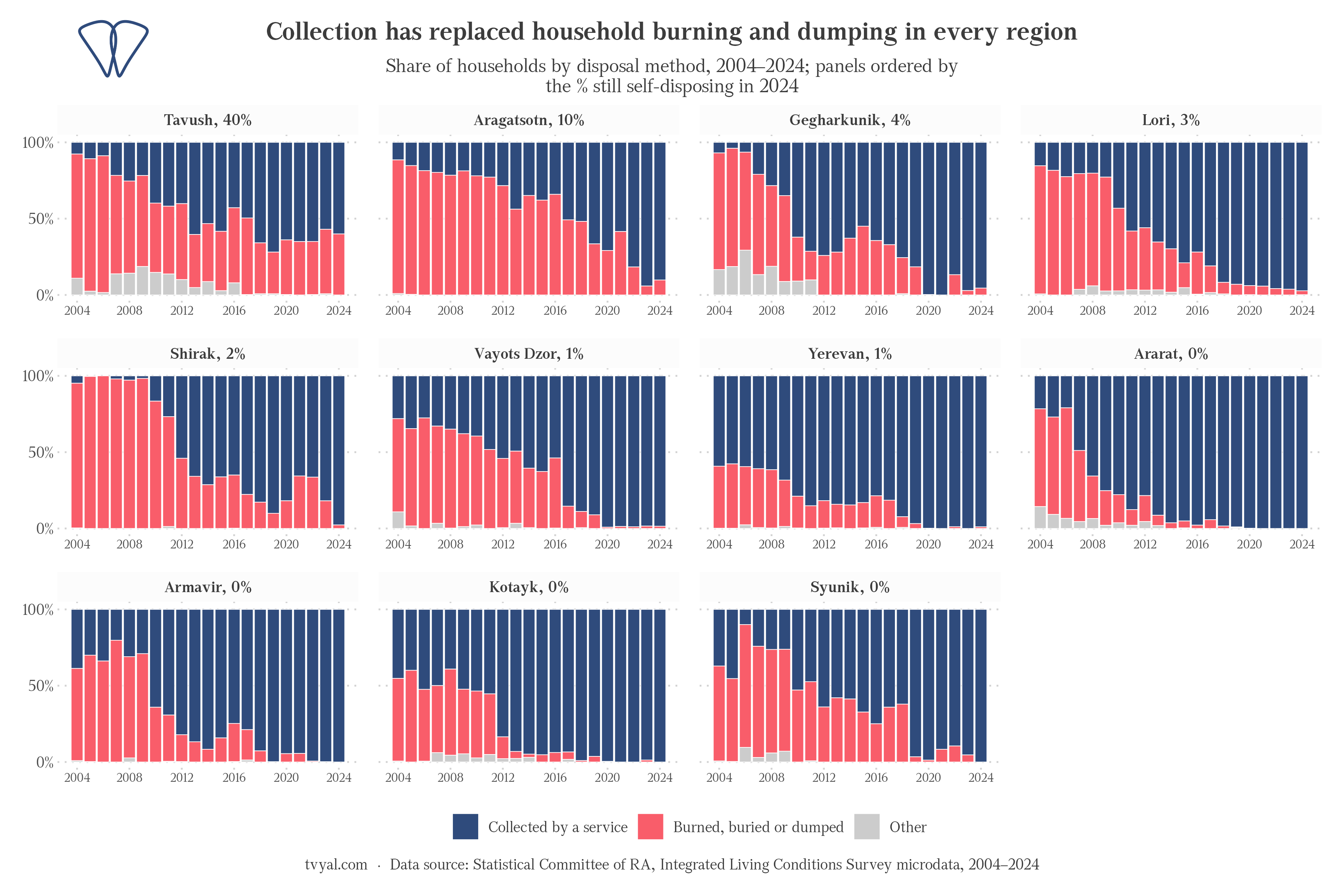
A study of regional distribution reveals unresolved areas of the problem. In particular, in Tavush, where villages are scattered in forested valleys, about 40% of households continue to independently dispose of their own waste. The latter leads to burning, burying or dumping waste in nature. At the same time, this indicator has dropped to zero in the Ararat, Armavir, Kotayk and Syunik regions. The organization of garbage collection is directly conditioned by road infrastructure and population density. In fact, the geography of self-incineration of garbage indicates those areas where collection trucks still can’t reach cost-effectively.
The source of the deterioration: the state of the Hrazdan River outside Yerevan
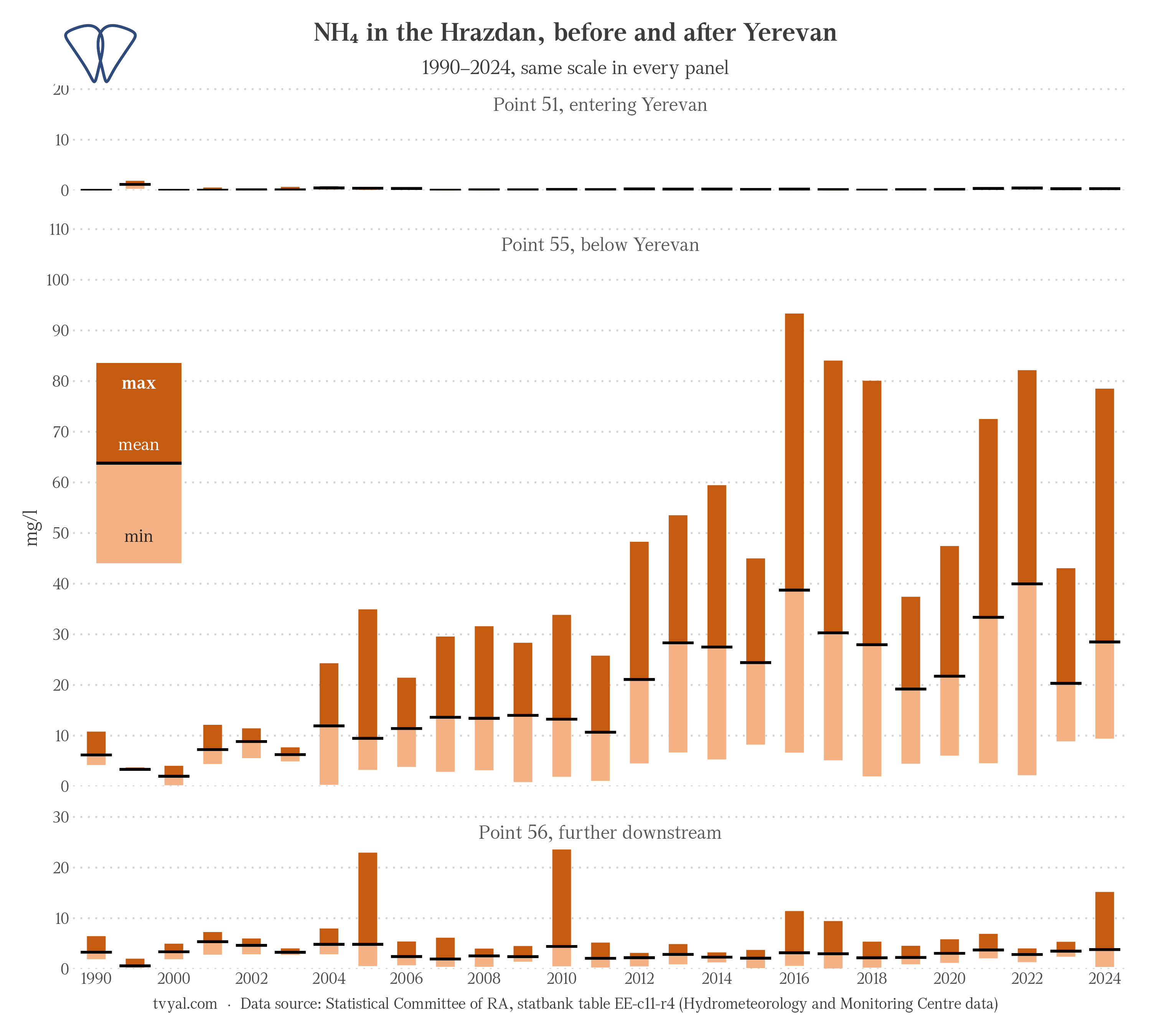
Considering the main priority of the Armenian presidency - the protection of freshwater, the Statistical Service is constantly monitoring the level of ammonium (NH₄), a nitrogen compound left over from wastewater, at 23 observation points in 8 rivers. The water is clean at almost all observation points, but there is one very notable exception.
In 2024, the average ammonium content in the Hrazdan River entering Yerevan was 0.35 mg/l, which is typical of a clean mountain river. A few kilometers downstream, in the section below the city, this indicator reached an average of 28.5. In 2017, at the same observation point, it was 30.3. Over the past seven years, the level of pollution has remained almost unchanged.
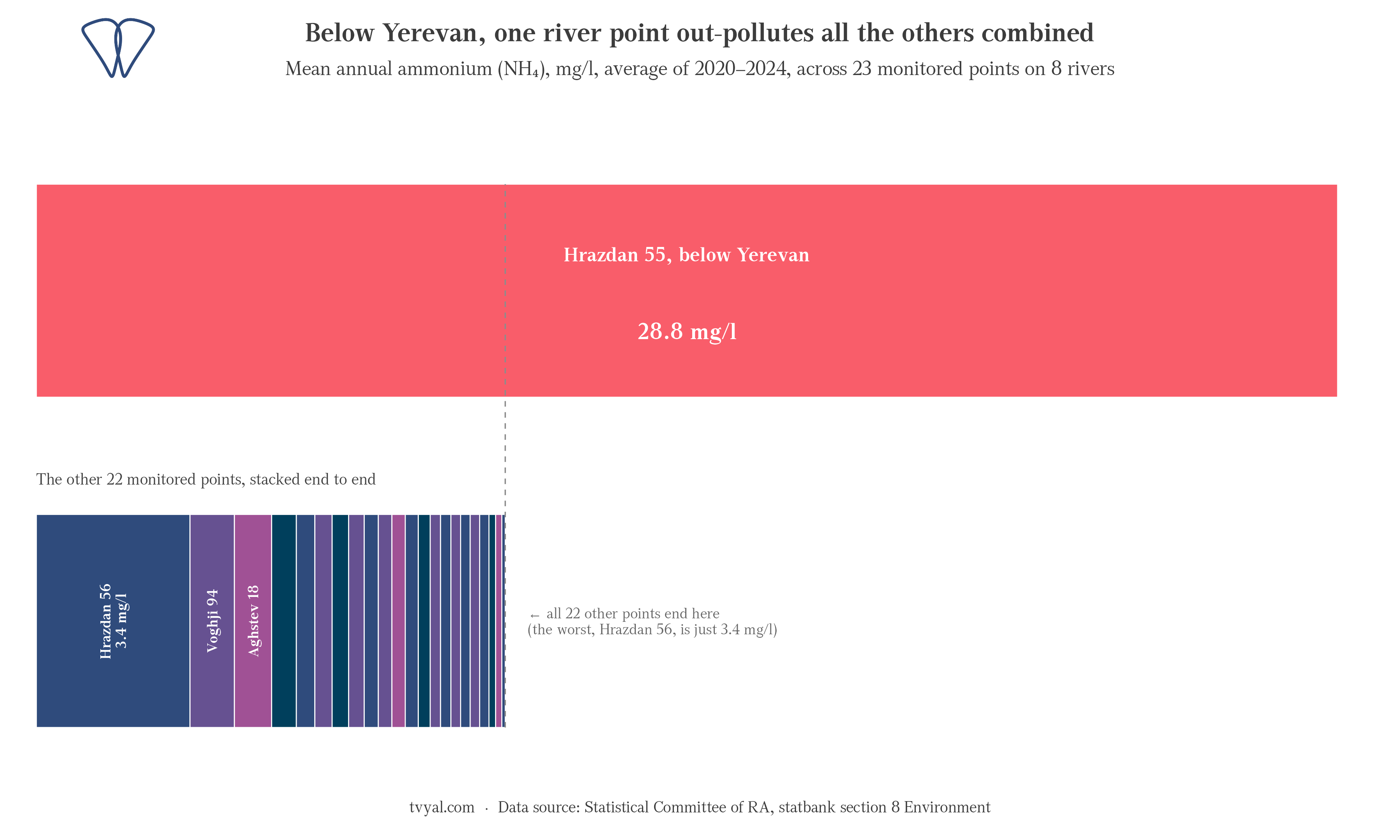
The picture becomes clearer if we compare this observation point with all other monitored points in the country. The ammonium content in the Hrazdan River downstream from Yerevan exceeds the combined index of the other 22 observation points. Moreover, it is about eight times higher than the index of the second observation point in terms of pollution level, which is also the result of pollution from the city.
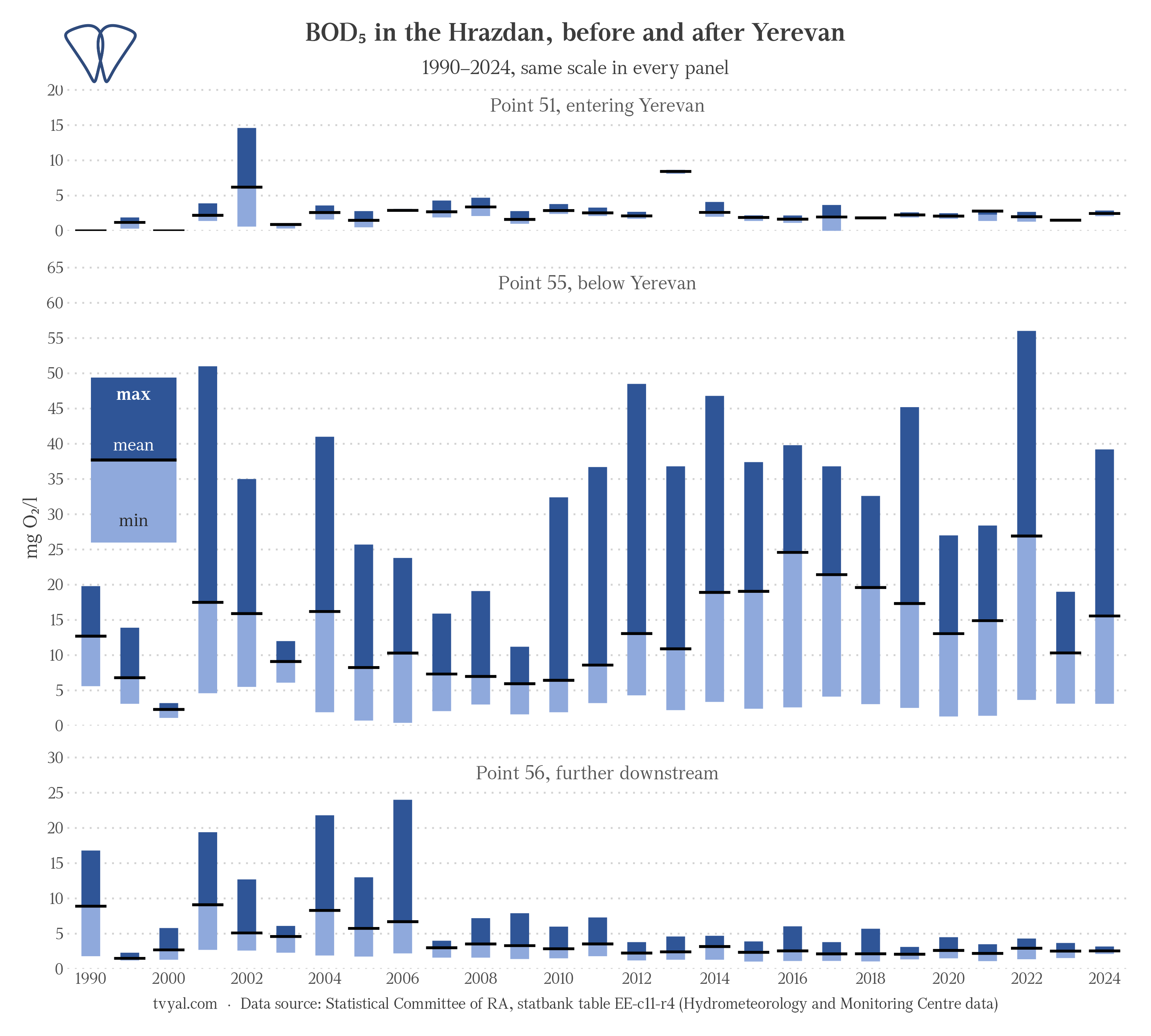
To be fair, there are improvements too. The biochemical oxygen demand (BOD₅) index (oxygen that bacteria use to decompose organic matter) at the same observation point decreased from 21.4 to 15.6 in the mentioned years. The organic load has weakened, but the ammonium content has remained. This indicates that Hrazdan is used relatively less as a sewage system, but other pollution is still high. The trend of increasing pollutants has stopped, but a decrease in the index has not been recorded.
We can officially consider that the Hrazdan River is connected to the treatment plant. However, year after year, the same level of pollution that existed before the plant was built has been maintained.
Formal connections
According to official data, 85% of the population was connected to wastewater treatment systems in 2024, up from 70% in 2017. This share doubled in rural areas. However, no significant change was observed in the level of pollution in the river downstream from the capital.
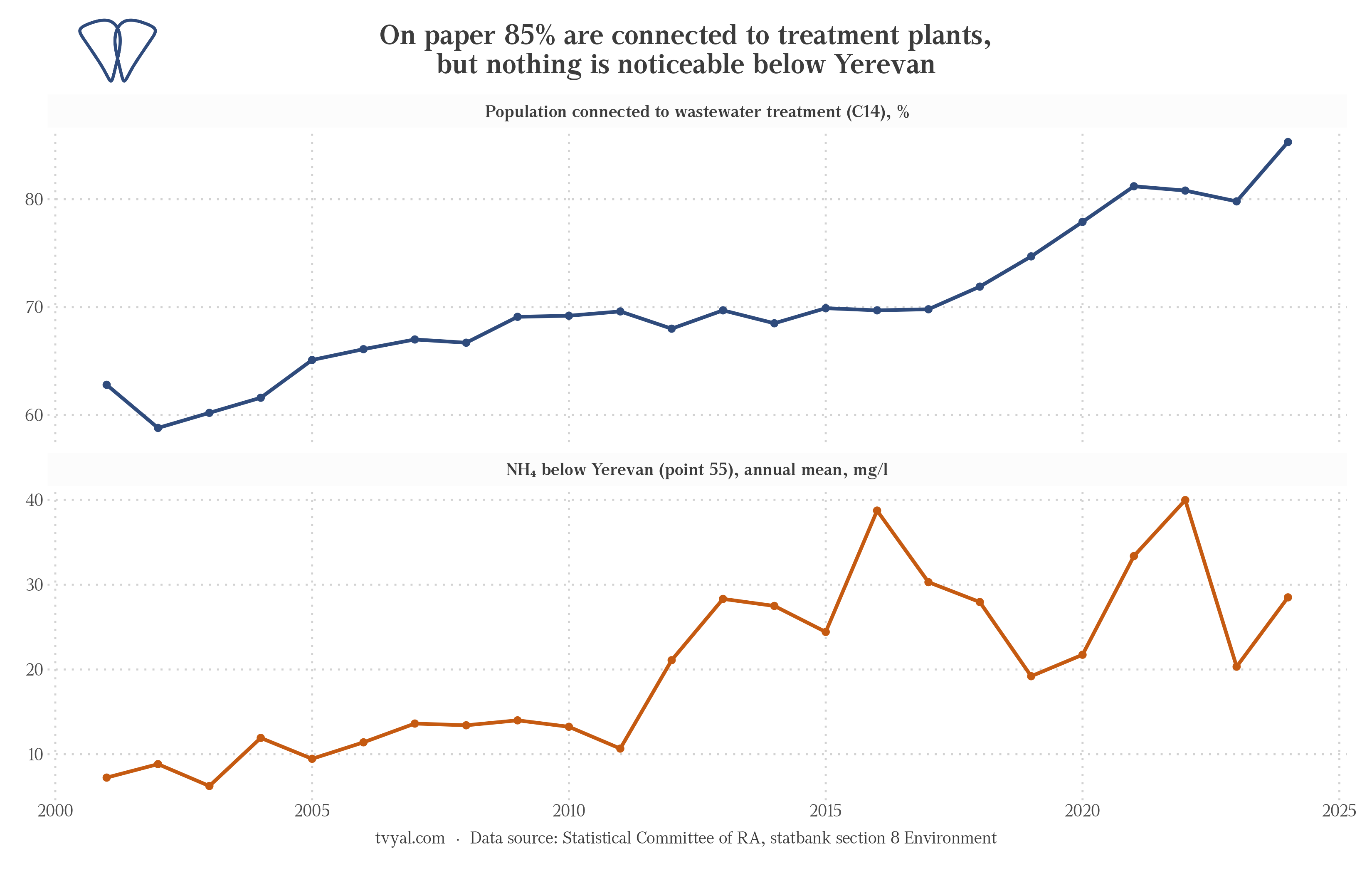
The reason is institutional: the “connected” status refers to households connected to the pipeline, not to the actual process of water treatment at the end of the system. The government-approved Hrazdan Watershed Management Plan for 2022–2027 clearly describes the mechanism: the sewer collectors of the cities upstream of the capital (Abovyan, Charentsavan, Yeghvard, Nor Hachn, etc.) are damaged, as a result of which part of the wastewater bypasses the treatment plants and flows directly into the river [4]. The connections have been provided, but the treatment process equivalent to the volume of connections is incomplete. From an economic point of view, this is the gap that requires the highest opportunity costs. Financial resources have already been spent on the construction of pipelines and plants, while the expected result - a clean river downstream of the capital - has not been ensured.
Financial resources and incentives
Armenia’s first declared priority within the framework of the conference concerns “positive incentives” for environmental protection [1]. Measured in fiscal terms, in 2024 organizations in Armenia spent 15.8 billion drams on environmental protection, which more than doubled the figure of 7.1 billion drams in 2012. In nominal terms, this indicates steady progress. However, as a share of the economy, the opposite trend was observed: the figure decreased from 0.17% of GDP to 0.15%. The collection of environmental taxes and fees for the use of natural resources in general amounted to about 0.07% of GDP. The issue of financing is the subject of the most complex discussions of COP17, which is singled out as a specific target by the Kunming-Montreal Agreement [3]. Moreover, the host country’s indicators show that, in parallel with the increase in spending in monetary terms, their weight in the economy has decreased. Fiscal incentives are available, but their volume is insufficient.
Unobserved indicators
Armenia’s third priority is biodiversity monitoring using cutting-edge technologies. However, the current monitoring system is showing the opposite trend. According to the Red Data Book of Endangered Species, the Statistical Committee’s table only shows one year of data, with 153 vertebrate species recorded in 2010. The data has not been updated since then. In the Hrazdan River downstream of Yerevan, the country’s most heavily polluted observation point, the number of annual samples taken has decreased from 12 in 2017 to between 5 and 8 since 2021. Although this week’s motto is Action for Nature, and the host country is seeing clear results from rural waste collection, state governance is impossible without statistical recording. In fact, Armenia now records far less data on the very issues this conference was called to address.
Additional on the decline in agriculture: “Crisis before the border closed: what’s behind Armenia’s 11.9% agricultural decline?” Additional on state expenditures and revenues: “4 trillion drams: What does the 2027 budget promise, and what will actually be spent?” Additional on the efficiency of using the invested infrastructure: “Energy problem: solar danger and summer records at the expense of Russian gas”
* The source of all data is the Statistical Committee of the Republic of Armenia (Armstat). The “Environment” section (river water quality by observation points, protected areas and forest lands, population connected to wastewater treatment plants, environmental expenditures, environmental taxes and nature use fees, Red Book table) and microdata of the Integrated Household Living Conditions Survey (2004–2024) on household waste collection. River pollution indicators are taken from the data of the observation points of the Hydrometeorology and Monitoring Center. GDP indicators for calculating fiscal shares are taken from national accounts. Calculations and chart codes are available on the GitHub platform.
References
[1] What to expect at COP17 in Yerevan: key events and priorities // Armenpress, October 2026 — armenpress.am
[2] COP17: the world has a plan to save nature. Is it working? // UN News, 15 October 2026 — news.un.org
[3] Kunming-Montreal Global Biodiversity Framework, decision 15/4 (Target 3, 30% by 2030; Target 19, finance) // Convention on Biological Diversity — cbd.int
[4] Government decision approving the Hrazdan basin management area plan for 2022–2027 // Legal Information System of the Republic of Armenia (arlis.am) — arlis.am