Not gas, but the banking system: what will be disrupted in Armenia if it leaves the EAEU?
On October 20, the other four EAEU member states (Russia, Belarus, Kazakhstan, and Kyrgyzstan) published a 72-page report [1] on the macroeconomic losses Armenia would suffer if its membership in the union were suspended. The report states that as a result of the suspension of membership, gross domestic product (GDP) would decrease by 15.6%, or $4.6 billion, gas prices would increase by 69%, and remittance inflows would be halved. The document, written by anonymous authors, quickly circulated widely in the news. A day later, the Armenian Minister of Economy contradicted the report’s claims, publishing his own estimate of a maximum −0.61% decline in GDP [2]. One estimate is 25 times higher than the other, and neither side has publicly presented the mathematical model underlying the calculations. Five days later, I was invited to the Public Television program “Public Discussion” to analyze this report. I began my speech with my main principle: it is hard to tell where the truth lies, but it is not in lies. I always try to present the truth, based on the right data. So let’s look at the foreign-trade component first, showing every step of the calculation.
Real sector loss: −4.6%
The methodology we used is simple and reproducible, and the trade indicators included in the report, the source of which is official data, were used as the starting data. For each indicator, one methodological question was posed: is it a product created in Armenia and providing income? Thus, the reduction in import volumes is not a loss of local production. The reduction in the volume of purchases of goods from abroad does not in itself lead to a reduction in Armenia’s GDP. Goods that are simply transited through the territory of Armenia to Russia are also not classified as local products, since only the service fee (about 5 percent of trade turnover) remains in the economy, and not the full value of the cargo. Counted in full as local output are the locally produced and sold agricultural products and brandy, exported services, as well as the additional costs expected for gas.
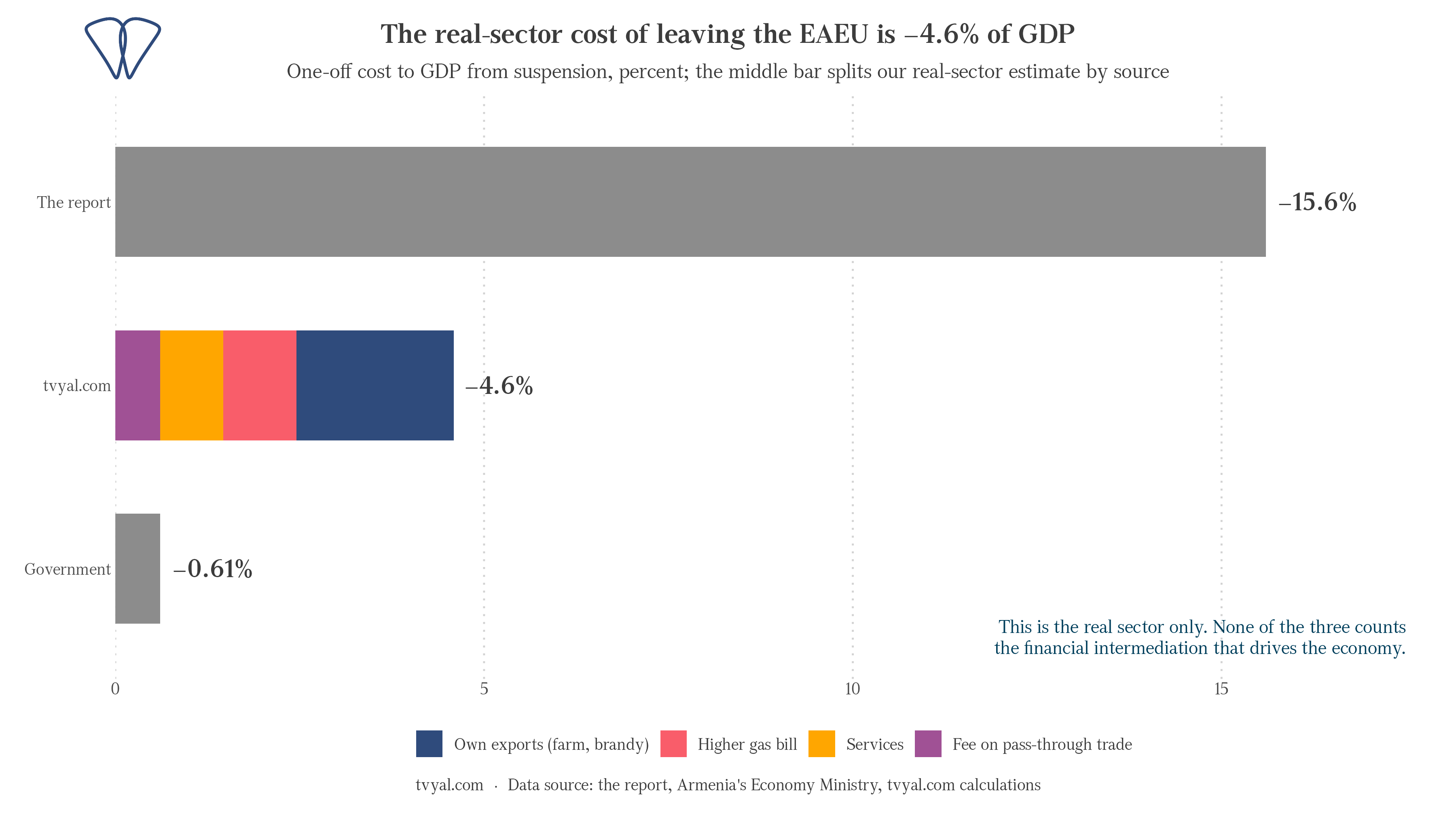
Summarizing the above indicators, we get a −4.6% decline in GDP, which in monetary terms amounts to about $1.3 billion. In the structure of the mentioned $1.3 billion, the largest share falls on the possible cessation of exports of local origin ($0.62 billion). This is followed by an increase in payments for natural gas ($0.29 billion), services ($0.25 billion), and transit trade service fees ($0.18 billion). The main part of the −15.6% decline mentioned in the report results from a methodological deviation, in particular, because gross re-exports and decreasing import volumes were counted as local production. This methodological problem was pointed out by Armenian analysts within a day of the report’s publication [3]. In addition, the document considers the macroeconomic environment as a static system, while the economy itself is a dynamic, complex system. If a door closes or fails in an economy, the economy always tries to find a new door. Moreover, the report does not specify any time horizon at all.
What worries the public most is gas tariffs. It should be noted that the increase in natural gas prices can also directly lead to an increase in electricity tariffs. Let’s consider the relevant calculations. The price indicated in the report is taken as the starting point: $300 per thousand cubic meters, instead of the current $177.5. We accept this as input data in the calculations. If $300 per thousand cubic meters is set, we accept it as input data and perform the remaining calculations. The current $165, taking into account the calorific value, is about $175 that we pay per thousand cubic meters. And this implies an additional cost of about $280-300 million for our economy, all other things being equal. Against the report’s 2025 GDP of $29.2 billion, that is about 1% of GDP. This is a real cost to the economy, but it does not lead to a systemic crisis. In fact, part of it can be compensated before reaching the final consumer (households): you are aware that there is a significant difference between the price sold at the border and the price supplied to consumers. It is also necessary to conduct a fairly in-depth study of the efficiency of the networks. Even the possible 69% increase in gas prices, which the report discusses, does not comply with the EAEU agreement, and this is more in the political sphere than in the economic one. The economy has already overcome a similar external shock in the petrol market. Petrol in the Armenian market is already diversified: if in 2023 90% of petrol came from the Russian Federation, now it is 20%. However, the price of diversification is the increase in the price of petrol, because Armenia purchases it from the world market at world prices (we referred to the shock recorded in the petrol market in September).
The loss of the real sector of the economy is, in fact, −4.6%, according to the objective calculations presented above. However, this applies exclusively to the real sector, while there is no mention of the financial system and, in particular, the banking intermediation Armenia provides, neither in the government’s positions nor in the anonymous report. Exiting the EAEU could lead to the termination of this very financial intermediation. Such a scenario would deal a much heavier blow to the economy than −4.6%, because this sector is the main driving force of economic growth.
Financial flows that stimulate economic growth
What is the reason for the recent economic growth? Let’s be honest with ourselves: the recent economic growth has been mainly due to significant financial flows from Russia, as well as the Islamic Republic of Iran. The reason for these flows is financial sanctions. As an intermediary, a large amount of financial flows have passed through Armenia compared to our economy.
During the first seven months of 2026, a total of $4.5 billion flowed into Armenia through the banking system as cross-border transfers from individuals. Of this volume, only $0.8 billion is classified as classic transfers (cash sent by labor migrants). The remaining $3.7 billion was of a commercial nature, including payments for goods and services, as well as capital movements through personal accounts. This commercial component has increased almost tenfold compared to the same period in 2019 ($0.4 billion).
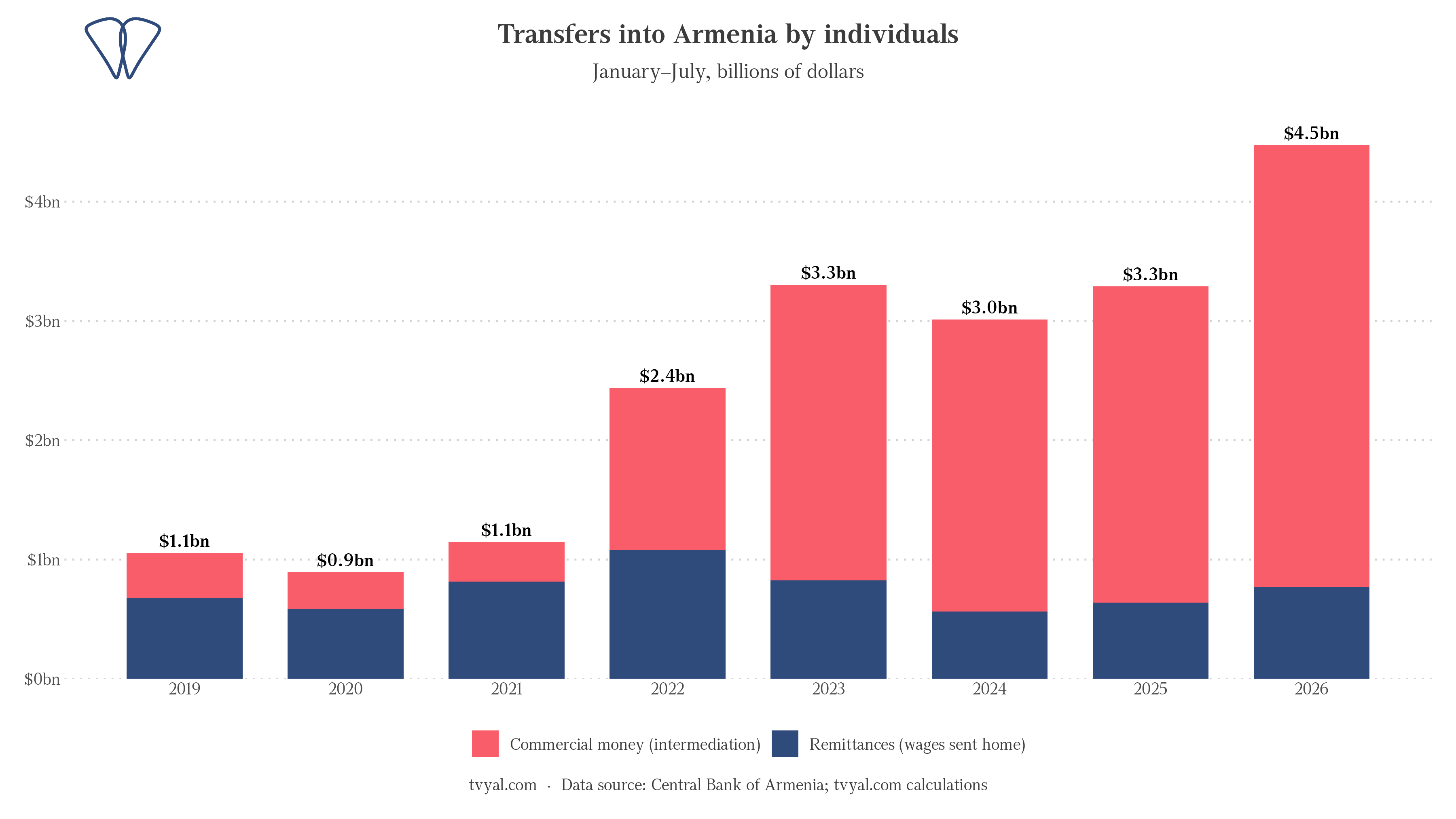
The report’s claim about a “double reduction” in remittances is methodologically the most vulnerable, as it considers all inflows exclusively as income from wages. It is assumed that the wages of Armenian migrants in Russia will decrease to the level of 2010–2014. In fact, however, wages currently constitute a small part of total flows, and the share of migrant workers in these transfers is no longer significant. Migrant workers will continue to send money. The main risks are that the servicing of trade flows through the Armenian banking system may disappear altogether.
Armenia: a transit hub
What is the reason for the inflow of capital, especially to Armenia? The Republic of Armenia has a unique strategic position: on the one hand, it is a member of the EAEU and has stable partnership relations with Iran, which is under sanctions, and on the other hand, it is integrated into the global financial (including offshore) systems. The banking system of Armenia is liberalized, provides fast service and freely carries out operations in almost all currencies, including the ruble and the Chinese yuan. In essence, we mediate the free movement of capital.
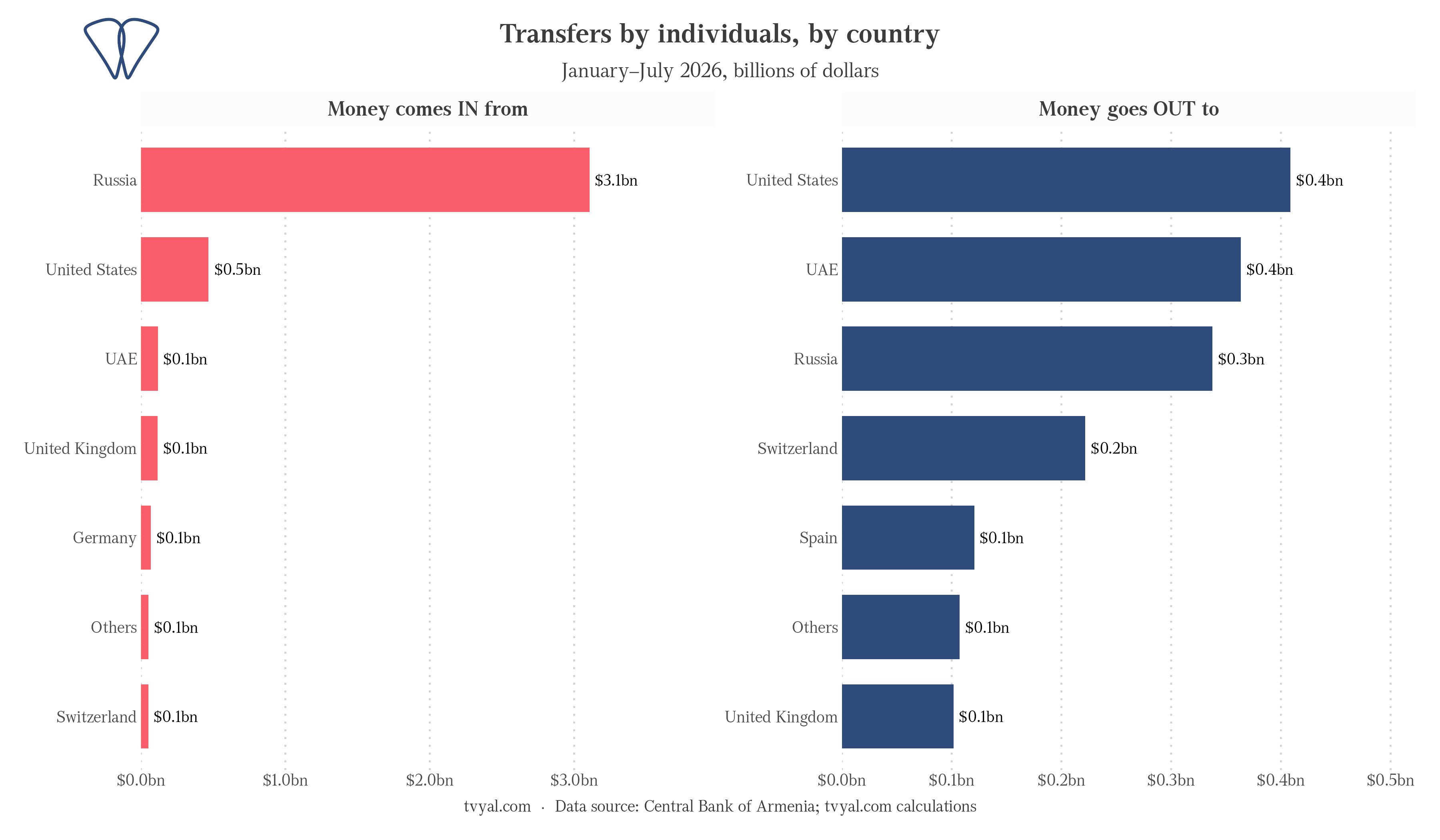
The statistics make the geography of the transfers clear. Of the $4.5 billion inflow recorded in January-July, $3.1 billion was provided directly from Russia. The main destinations for outflows are the United States of America, the United Arab Emirates, Russia and Switzerland. On the one hand, Armenia is a member state of the EAEU and has good neighborly relations with the Islamic Republic of Iran, and on the other hand, it is a full member of the international financial market. Due to geopolitical changes, money from these states comes to Armenia and moves to other countries: Switzerland, the Emirates and offshore zones. This dependence is bilateral in nature, which is also ignored in the report. From this point of view, we are a certain node for the Russian Federation, which is able to maintain financial and trade relations with the outside world to some extent. It is not that Russia has nothing to lose at all. We analyzed where Russian capital goes after Armenia in February 2025, and we addressed the impact of Iranian capital underlying the 7.2% growth in 2025 in April.
From the banking system to the construction sector
The chain from bank accounts to macroeconomic growth consists of four institutional stages. First, an inflow of financial resources is recorded, which expands the financial sector. Then the main part of the generated resources is directed as investment in the construction sector. This is followed by the activation of the real estate market, and then the growth of the domestic services sector. As substantiated in the analysis “Two economies and one average”, 2.2 percentage points (or one third) of the 6.7% economic growth recorded in the second quarter of 2026 was provided exclusively from one source: the financial sector. The joint contribution of the financial sector and construction to growth amounted to 3.3 percentage points, which is equal to half of the total growth. Agriculture, which is highly dependent on the Russian sales market, was the only sector where a deep decline was recorded. This problem has already reduced potential GDP growth by 1.1 percentage points. In fact, due to economic restrictions, we already have a certain economic decline, but in the conditions of a new massive wave of capital outflow from Russia, this issue has gone unnoticed. In mid-2026, the overall economy grew by 6.7%, but we had a 15.3% decline in the agricultural sector.
It would be logical to expect that such a volume of external financial inflow would be directed to the creation of production capacities and would form a stable base for long-term foreign direct investment (FDI). However, statistical data show the opposite. In 2015–2025, the two largest sources of FDI in Armenia were Luxembourg and Jersey. Luxembourg, Jersey and Cyprus, zones considered offshore centers, account for about a third of total investments.
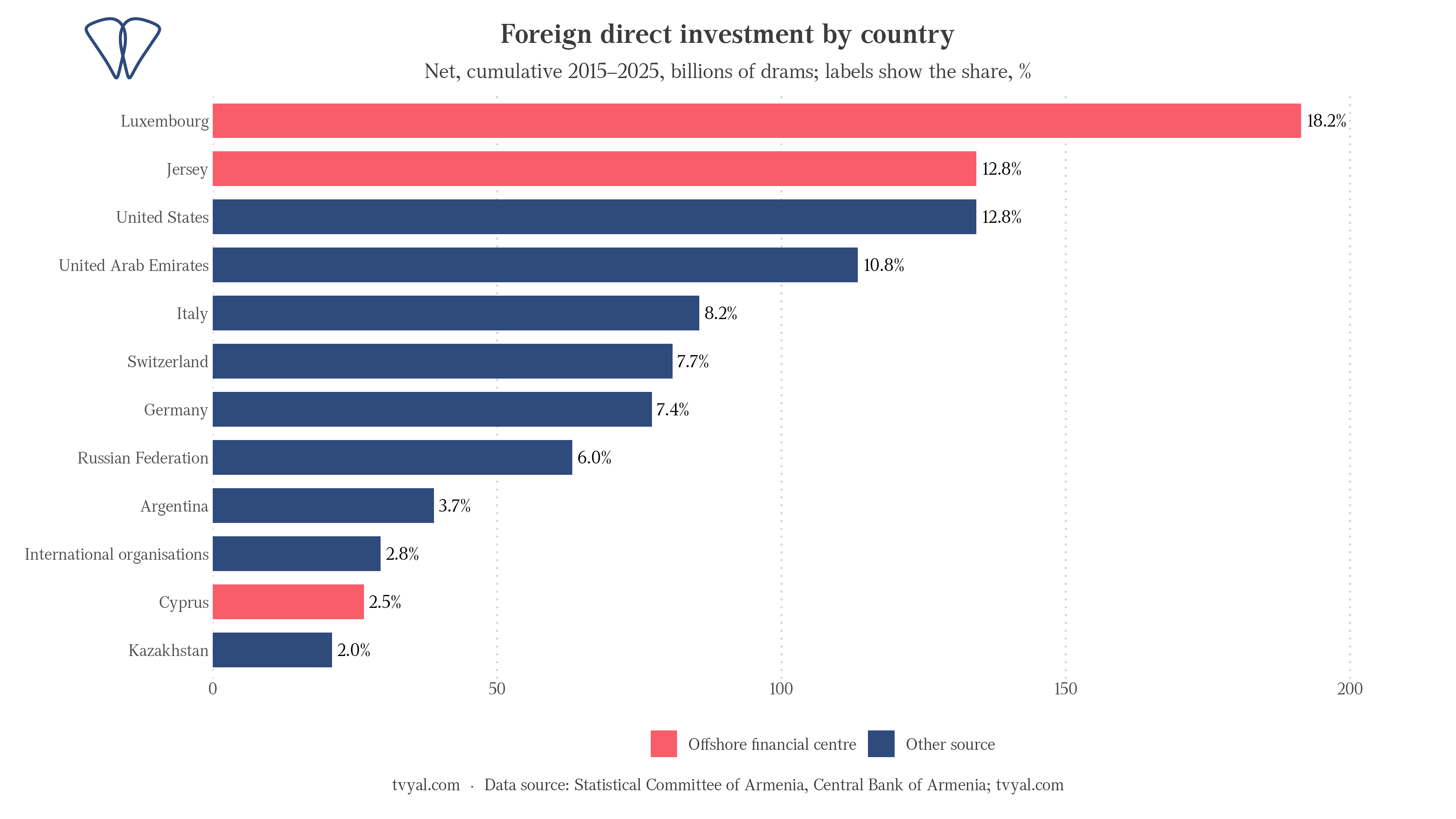
In dollar terms, direct investment volumes are small and volatile. In all years, they have remained below the $1 billion threshold. This indicator reached about $1 billion (998 million) only once, in 2022, after which it decreased to $132 million in 2024. It should be noted that this movement corresponds to the outflow of capital from our neighboring countries and is directly proportional to economic growth. According to the results of the entire 2025, it amounted to $605 million. For comparison, in the first seven months of 2026 alone, the inflow of trade transfers provided $3.7 billion.
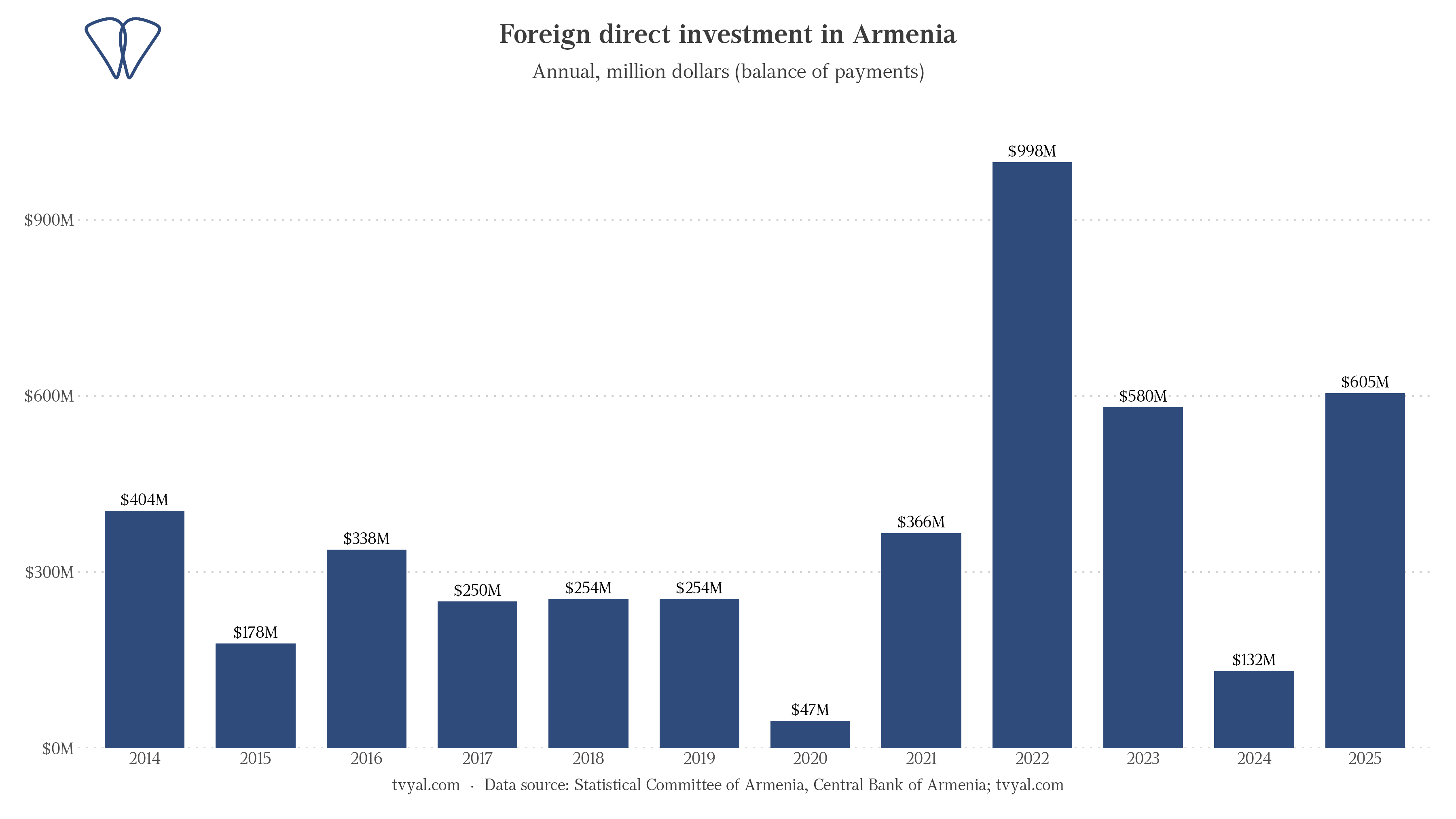
The above proves that the main driver of economic growth in Armenia is the capital circulating in the country, because Armenia is convenient for moving capital. Such capital has high mobility: it can quickly flow in and just as quickly turn into outflow. The current account gap of $2.5 billion objectively shows the structural vulnerability of the economy in the event of a cessation of external flows.
Strategic balance
As demonstrated by the example of the petrol market, it is possible to compensate for the loss of cognac or apricot sales markets, although this requires time and entails additional costs. The cost of compensating for losses in the banking sector, which is considered the main driving force of the economy, is incomparably higher. Neither the anonymous report’s −15.6% nor the government’s −0.61% estimates include this risk. The main problem is not the loss of the commodity market, but the loss of the status of a financial intermediary that has driven economic activity in recent years. Exiting the EAEU will not only disrupt the normal functioning of the real sector (for which there are alternatives), but will also lead to the cessation of the main vector of economic growth.
Regardless of political statements, regardless of what Moscow or Yerevan declares, it should be understood that the Republic of Armenia has always strived for the “both-and” formula: to be good with both the EAEU states and the European Union. At the same time, the EAEU Treaty provides for the free movement of capital and the formation of a common energy market [4]. Currently, however, none of the mentioned markets is operating in the format envisaged by the treaty (“A Harvest With Nowhere to Go”). At the moment, the EAEU Treaty is not fully implemented: the freedom of movement of capital does not work, Russia has imposed certain restrictions on both the outflow and inflow of capital, and the export of our agricultural products has decreased by 50% in recent months compared to 2025.
The Republic of Armenia should emphasize its own impartial position within the framework of the “both-and” concept. It is this approach that allows Armenia, in the conditions of a stable international financial system, to assume the role of an intermediary link between Russia, a member of the EAEU, and the outside world. Economic growth is largely driven by a balanced and depoliticized foreign economic policy. A unilateral deviation towards the EU or Moscow will lead to the disruption of the established strategic balance.
As noted at the beginning of the analysis, “It is hard to tell where the truth lies, but it is not in lies.” It is necessary to maintain transparency with both sides of the equation and avoid distorting the facts. Relying on real and factual data provides a stable negotiating position. Truth is a position of strength. For Moscow, Yerevan is of strategic importance not from the point of view of servicing re-export volumes, but from the point of view of being an important financial hub. And these financial transactions are carried out in accordance with the sanctions of the European Union and the United States. In other words, these flows do not violate either Armenia’s obligations or the sanctions regime in general. However, the established intermediary link must also maintain trust on the other side. Since August 12, the Central Bank of Armenia has obliged commercial banks to check the parties to the transaction, the geography of payment, and the origin of the goods in order to identify the risks of circumventing international sanctions. In the presence of such risks, payments are subject to suspension before their execution [6]. The mentioned regulations do not specify any specific country. Armenian commercial banks carry out settlements in dollars and euros through correspondent banks. Correspondent banks maintain the activity of these accounts only as long as they trust the internal control (compliance) processes. The viability of the node is guaranteed exclusively by the presence of mutual trust; this trust must be assessed.
The report will be officially discussed at the Supreme Eurasian Economic Council meeting in December [5], as a result of which the debate will once again shift to the numbers. Both the −15.6% and −0.61% macroeconomic estimates take into account only the movement of goods across the border. Meanwhile, the volume of financial resources exceeds the volume of goods several times, in effect financing the capital construction and real estate sectors of Yerevan. Available statistics on transfers are limited to July, before the introduction of new control mechanisms. Therefore, the indicators for August and September will show the actual degree of stability of trade inflows.
Full discussion on Public Television: “Risks of leaving the EAEU: gas, agriculture and energy”. On the financial sector as a growth driver: “Two economies and one average” and “The Growth Wave Stalled”. On Armenia’s exports to the EU and EAEU: “Ore instead of apricots”.
* The calculation of real sector losses is based on the trade, services and gas indicators presented in the report [1], as well as the 2025 GDP volume of $29.2 billion. The 5% service fee for re-exports is an expert assumption. The source of data on cross-border transfers of individuals by country is the Central Bank of Armenia. Trade transfers were calculated by subtracting non-trade flows (classical transfers) from the total volume for the January-July period of each year. Statistics on source countries of foreign direct investment are based on data from the Central Bank of Armenia and the Statistical Committee of Armenia (net flows, cumulative for 2015–2025). The dollar series reflects the net assumption of liabilities for direct investment in the balance of payments. Offshore centers are: Cyprus, Luxembourg, Jersey, British Virgin Islands, Cayman Islands, Belize, Seychelles and Panama.
References
[1] Доклад о возможных последствиях приостановления в отношении Республики Армения действия Договора о Евразийском экономическом союзе от 29 мая 2014 года // Government of the Russian Federation, October 2026 — government.ru
[2] Armenia’s exit from the EAEU may reduce the economy by 0.65%, says the Minister of Economy // ARKA — arka.am
[3] A 15.6% fall in Armenia’s GDP: the EAEU report’s unsubstantiated precision // 1in.am, 21 October 2026 — en.1in.am
[4] Treaty on the Eurasian Economic Union, 29 May 2014 // ILO NATLEX — natlex.ilo.org
[5] Report on suspending Armenia’s EAEU Treaty to go to the December 2026 Supreme Eurasian Economic Council // Armenpress, 29 May 2026 — armenpress.am
[6] New requirements for banks to manage risks of circumventing international sanctions come into effect // ArmBanks.am (ARKA), 17 August 2026 — armbanks.am